The parts every tuning peg shares
Whatever the housing looks like, a geared tuning peg uses the same basic parts. The button you turn drives a worm gear; the worm turns a gear attached to the string post, also called a capstan. Turning the button changes string tension and pitch. The designs differ in whether the gears are exposed, how the unit mounts, and how the string is held at the post. StewMac's tuning-machine listings show that open-gear tuners can also have locking posts.
The short version:
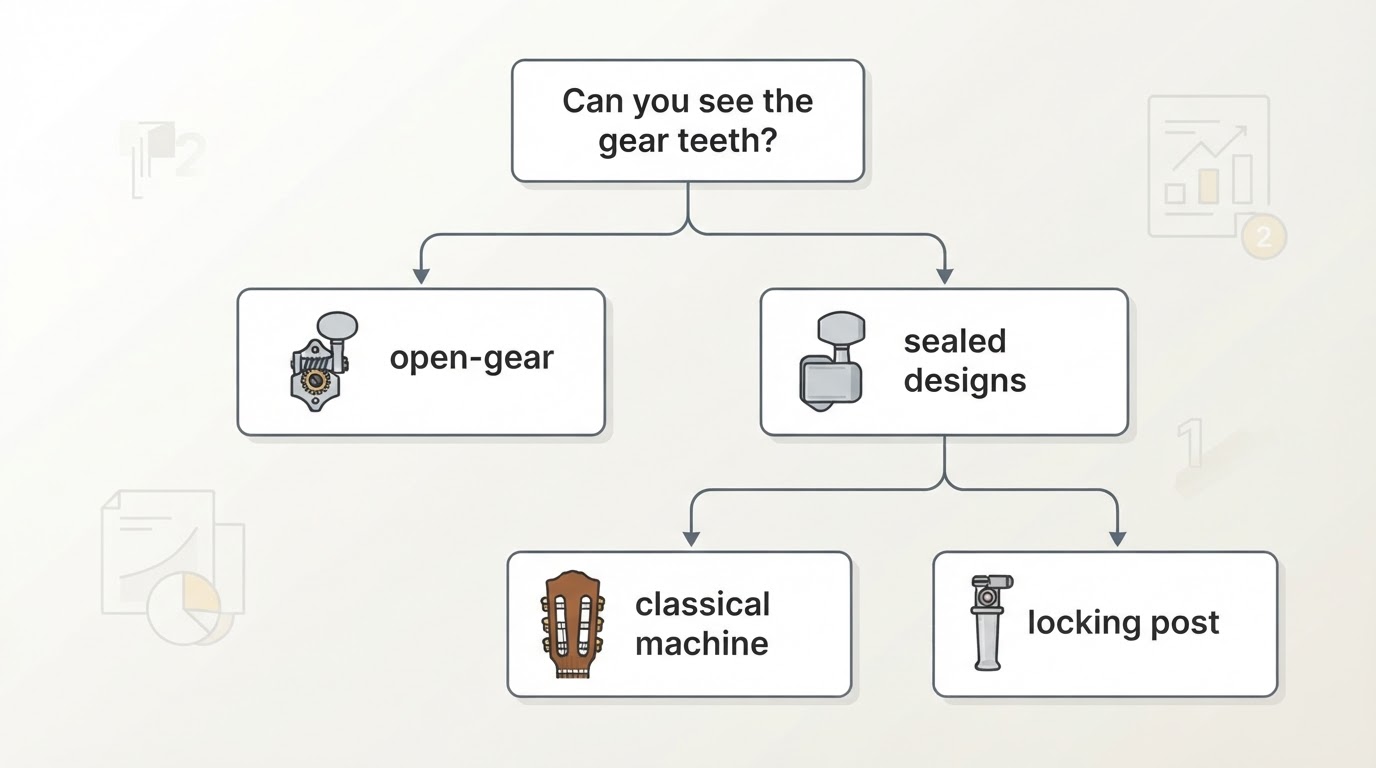
- Gear teeth visible: open-gear design.
- Gears hidden inside a closed shell: sealed design.
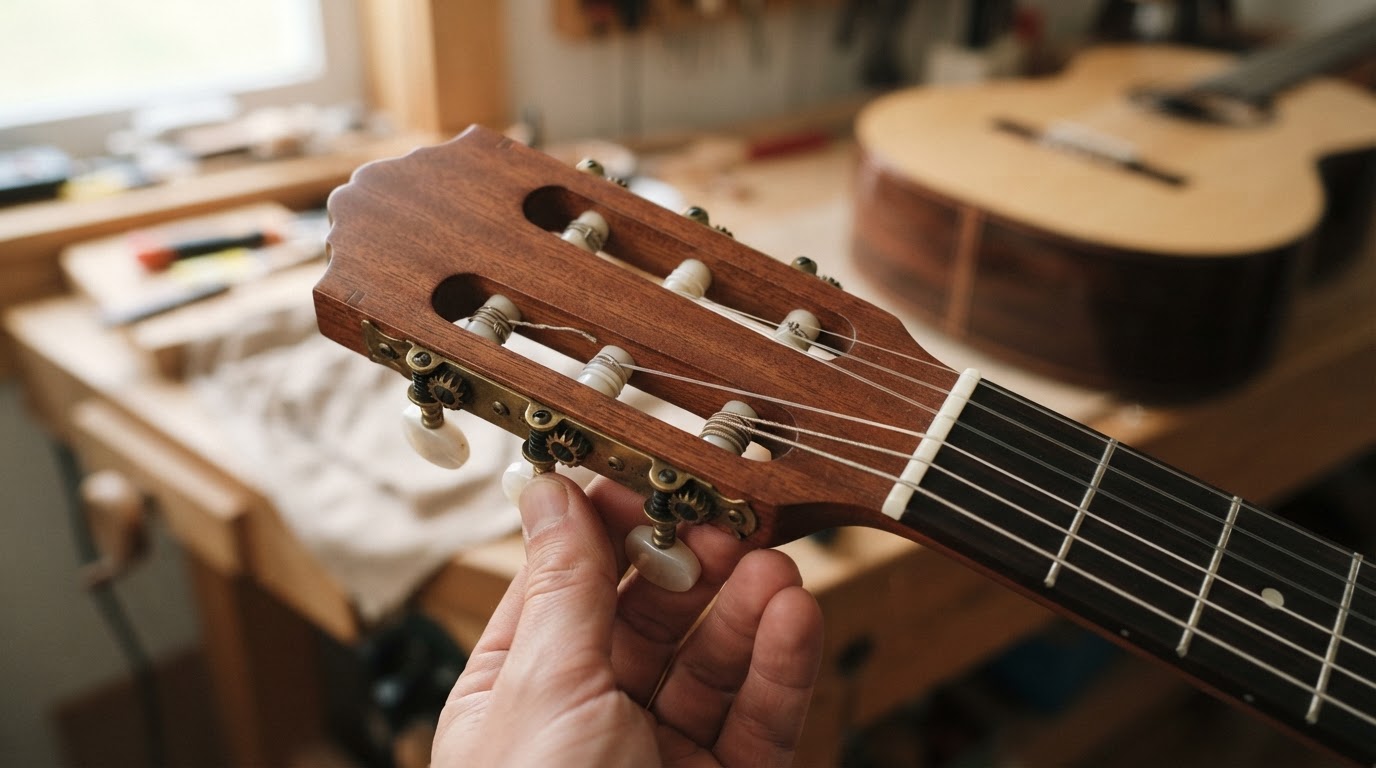
- Gears on a side-mounted plate, strings wrapped around rollers on a slotted headstock: classical machine.
- A clamp, wheel or screw at the post that grips the string: locking post.
The labels are independent: a sealed tuner is not automatically locking, and a locking tuner is not automatically sealed.
Sealed machine heads
A sealed tuner hides its gears inside a closed housing. From the back you see a smooth or shaped shell instead of gear teeth, held by a small screw, a locator pin, or both. There is usually one housing per post. The housing keeps dust out, but internal wear is harder to inspect than on an open-gear unit; consult the maker's service guidance before attempting repair.
Open-gear machine heads
Open-gear tuners leave the mechanism on show: a visible worm meshing with a visible cog. They appear as individual units or on a shared plate, across a wide range of instruments and prices. You can inspect the gear teeth for wear and debris. Follow the maker's cleaning and lubrication guidance rather than assuming exposed gears need oil.
Locking and non-locking posts
"Locking" describes how the string meets the post, not how the gears are built. A locking post has a clamp: a thumbwheel at the back, a screw at the top, or an automatic cam, so the string needs few or no wraps. A non-locking post relies on neat windings. StewMac's locking-tuner guide notes that locking tuners do not literally lock the instrument in tune. They can speed string changes and reduce slack windings, but they do not fix nut friction or setup problems.
Classical slotted-headstock machines
A classical guitar uses a different system: a slotted headstock, a side-mounted plate, one roller per string, and exposed gears on a backplate. The string is tied and wound around the roller instead of passing through a ball-end post, and the parts are built around nylon strings. That is why classical machines do not interchange with steel-string tuners: the plate mounts on the headstock side, the string attachment differs, and the roller sizes suit nylon.
Identification table
What you can see | Most likely design | Confirm with | Do not confuse it with |
|---|---|---|---|
Closed housing per post, no gear teeth | Sealed machine head | Small screw or locator pin | An open tuner under a cover |
Exposed worm and cog, single unit | Open-gear tuner | Visible teeth and individual mounting | Plate-mounted budget gears |
Exposed gears on one shared plate | Plate-mounted open set | One plate carrying several posts | A classical side plate |
Clamp or wheel at the post | Locking post | String is gripped, not wound | Anti-backlash "locking" gears |
Side plate with rollers | Classical machine | Slotted headstock and nylon strings | Any steel-string tuner |
What is not interchangeable before you replace a peg
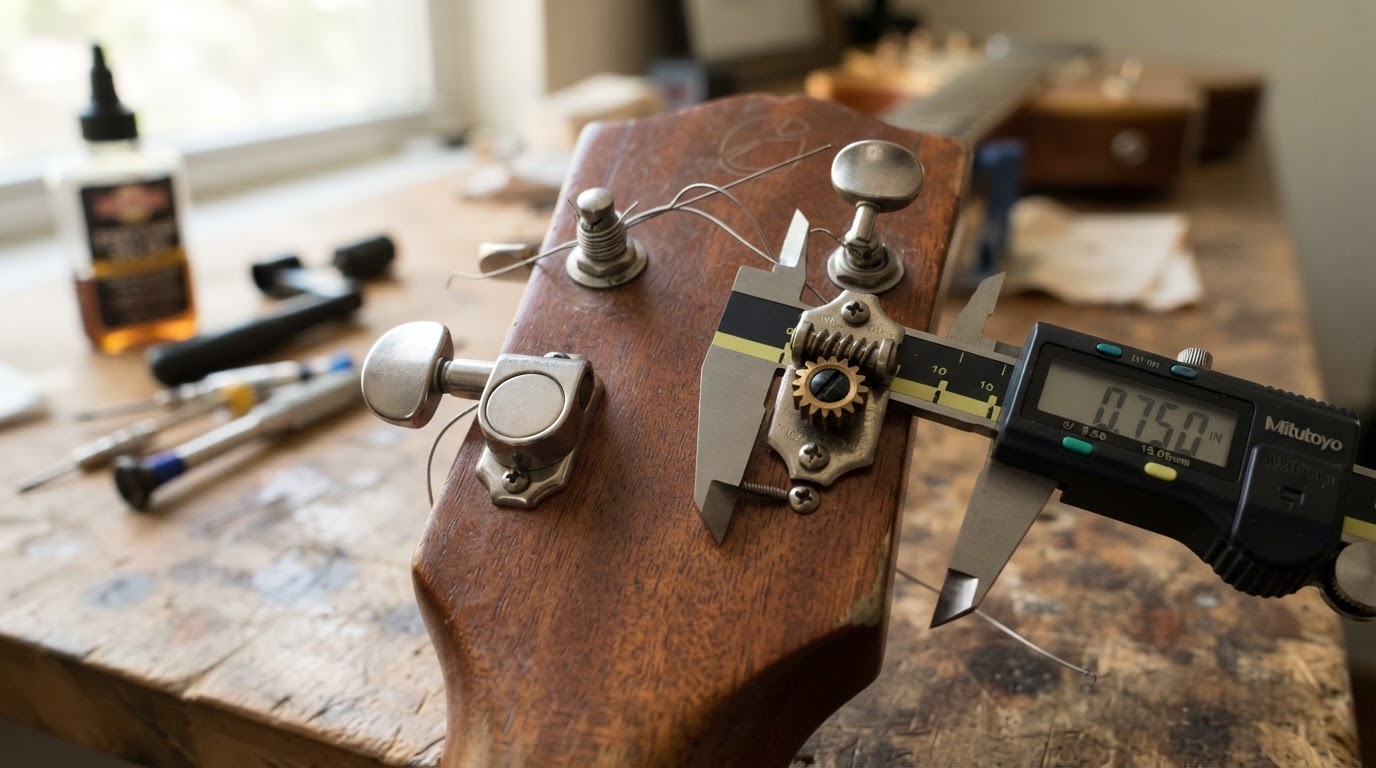
Looks are not fit. Before ordering a set, measure with calipers rather than a ruler:
- Mounting hole diameter: the hole that takes the post's bushing or collar.
- Center-to-center spacing: the distance between neighbouring posts; a small difference shifts every string.
- Post diameter and exposed height: a thin post can wobble, and the wrong height changes the string path.
- Headstock thickness: the shaft, washer and nut must clamp the wood without bottoming out.
- Mounting pattern and orientation: screw and locator positions, button side, and left- or right-handed winding.
A post that does not match its hole cannot sit still, and enlarging a hole is irreversible and weakens the headstock. If the numbers differ from a set's specification, keep looking, use an adapter where one exists, or ask a repairer to check the fit.
Limits of identifying a peg by eye
Visual identification narrows the field but does not prove what a part is. Housings get swapped, budget guitars mix exposed gears with plate mounts, older instruments have been modified, and photos hide scale and material. Confirm the shortlist by touch and measurement.
FAQ
Are sealed tuners better than open-gear tuners?
Not by themselves. Sealed housings keep contamination out; open gears can be inspected, cleaned and lubricated more easily. Fit, gear quality and condition matter more than the label.
Do locking tuners fix tuning problems?
Only those caused by slack windings around the post. Nut friction, old strings and setup issues will still pull the pitch out. If your real concern is the tuning device, a specialist overview such as Andertons' guide to tuner types covers clip-on, pedal and strobe options.
Can I fit classical machines to a steel-string guitar?
Usually not. Classical machines are built for slotted headstocks and nylon strings wound on rollers. Most steel-string electrics and acoustics use different mounting dimensions and posts, so check the actual headstock and tuner specifications before considering a replacement.
Practical next steps
Identify the design from the back of the headstock, confirm it at the post, then measure before you buy. If a peg feels loose or a string is stuck, treat that as a repair job, separate from identifying the type. See the separate guides for a loose tuning peg and a string stuck in a tuning peg.