The six notes in B standard
Fender's comparison of the Bass VI and the baritone guitar describes the common baritone tuning as a fourth below standard guitar, BEADF#B, with the fifth-string E matching the sixth-string low E of a standard-tuned guitar. Written low to high, the six open notes are B1 E2 A2 D3 F#3 B3.
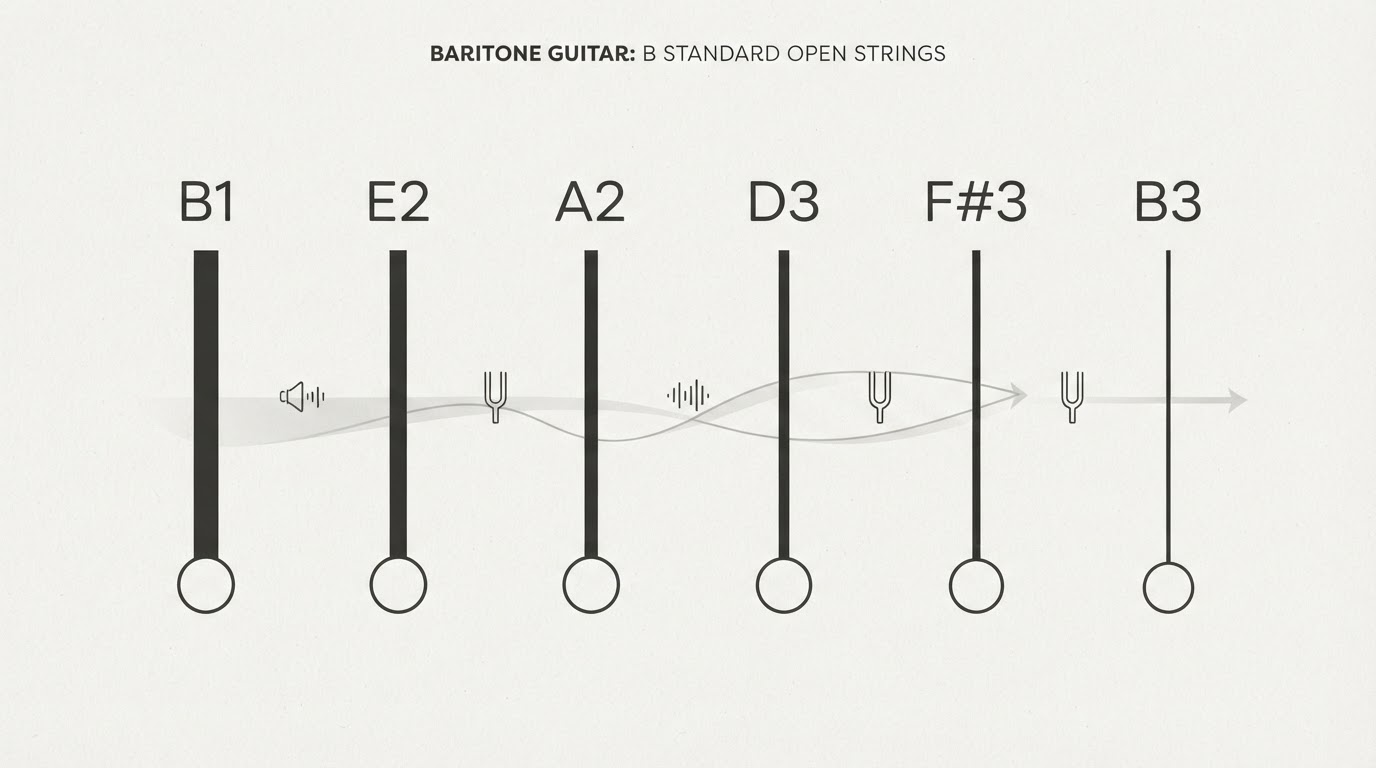
String | Note | Frequency (A4 = 440 Hz) | Same pitch on a standard guitar? |
|---|---|---|---|
6th (lowest) | B1 | 61.74 Hz | No, a fourth below low E2 |
5th | E2 | 82.41 Hz | Yes, the low E |
4th | A2 | 110.00 Hz | Yes, the A string |
3rd | D3 | 146.83 Hz | Yes, the D string |
2nd | F#3 | 185.00 Hz | No, a semitone below G3 |
1st (highest) | B3 | 246.94 Hz | No, a fourth below high E4 |
The intervals match standard tuning: three fourths from the sixth string up to the third, a major third from D3 to F#3, then a fourth to B3. B is also the only pitch class that appears twice, at B1 and B3, two octaves apart.
Frequencies in the table are calculated in twelve-tone equal temperament from f = 440 × 2^((MIDI − 69)/12) with A4 = 440 Hz, rounded to two decimals. A tuner set to a different A4 reference moves every target proportionally; the note names and octave numbers stay the same.
Tuning order for B standard
Tune one string at a time from the sixth string to the first, and keep the octave number in view: a chromatic tuner that shows only the letter treats B1, B2, B3 and B4 as the same answer.
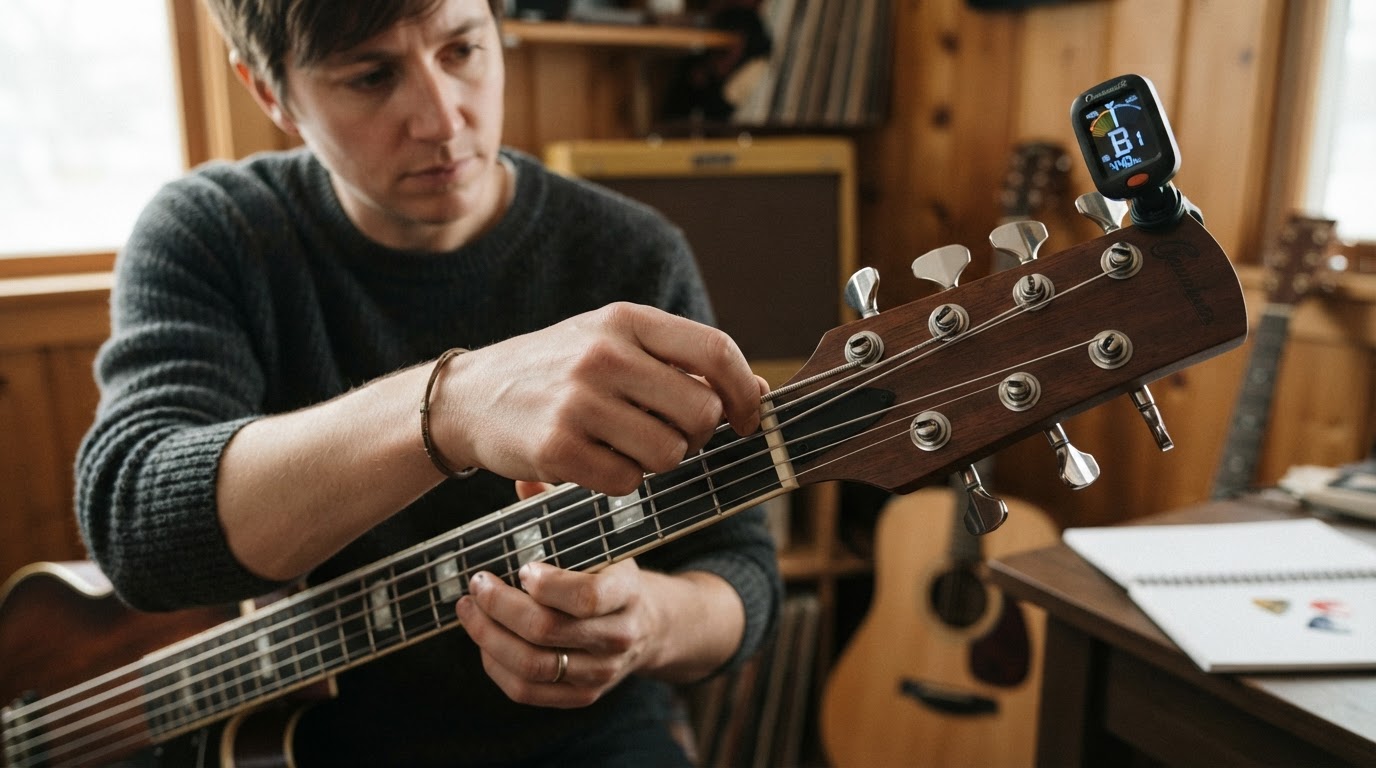
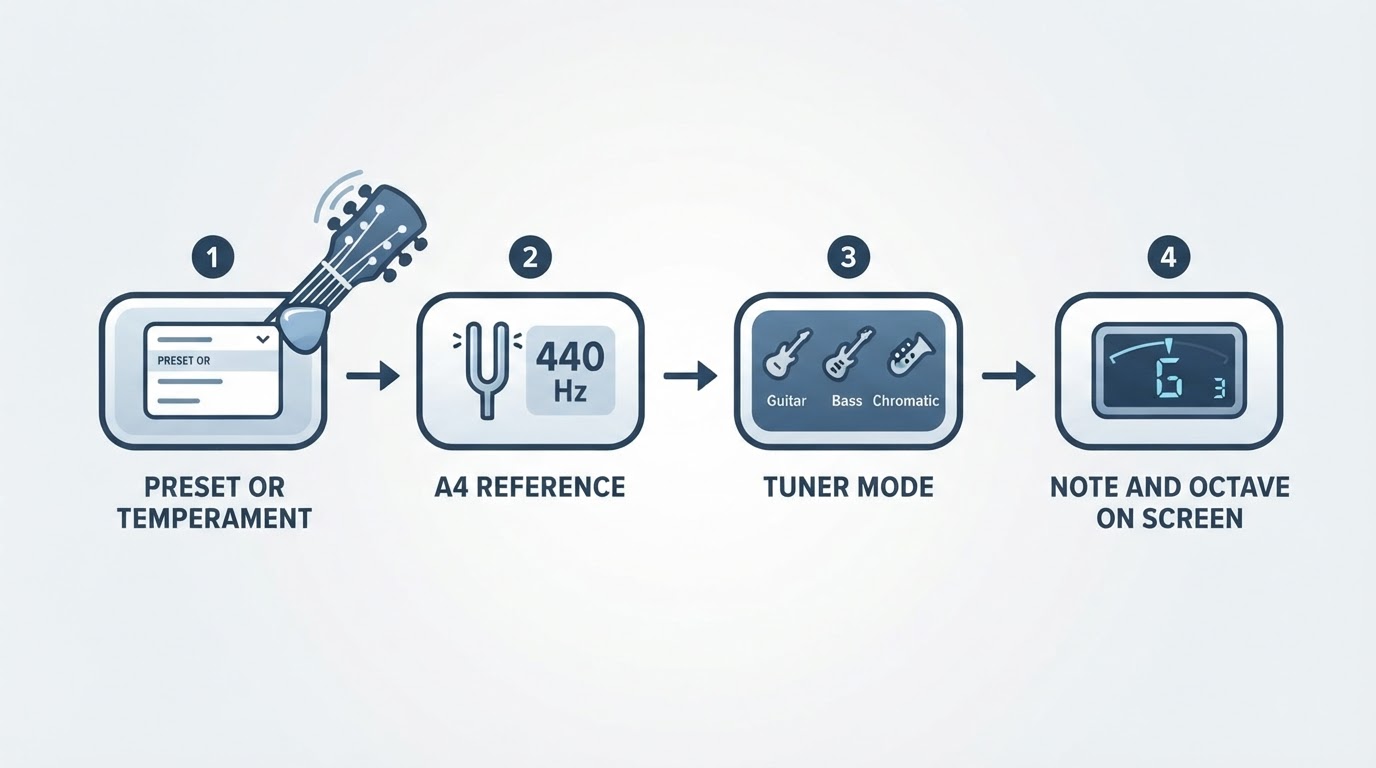
- Set the tuner to chromatic mode and confirm its A4 reference; 440 Hz is the common default. Play the sixth string open and bring it to B1. If the display shows B2 or B3, stop and check the octave before turning the peg further.
- Tune the fifth string to E2. This is the same pitch as the low E of a standard guitar, so a second instrument or another reference at E2 gives an independent check on where the low end sits.
- Continue upward: A2 on the fourth string, D3 on the third, F#3 on the second, B3 on the first.
- Recheck every string a few minutes after the first pass. New or recently changed strings move as they settle, so a short drift is expected rather than a sign that the tuning is wrong.
Tuning by intervals works the same way as on a standard guitar: the fifth fret of each string gives the pitch of the next string open, except that the second string is taken at the fourth fret of the third. Small errors accumulate along the chain, so check the result against an outside E2 reference rather than trusting it alone.
B standard vs seven-string standard
Seven-string standard tuning, from the lowest string to the highest, is B1 E2 A2 D3 G3 B3 E4, as described in Wikipedia's article on the seven-string guitar and walked through string by string in our 7 string guitar tuner guide. The two tunings share their lowest four pitches — B1, E2, A2 and D3 — and then diverge: the baritone's third string is D3, its second F#3 and its first B3, while the seven-string's third string is G3, its second B3 and its first E4.
A six-string baritone moves the whole instrument down a fourth, so its highest open note is B3. A seven-string keeps standard guitar's upper strings where they are and adds a low B below them, so its highest open note stays E4, a fourth above the baritone's top string.
B standard vs a Bass VI
Fender describes the Bass VI as a six-string bass guitar with a 30-inch scale, a special bass string set made for the model, and standard EADGBE tuning one octave below a standard guitar — E1 A1 D2 G2 B2 E3 on the open strings.
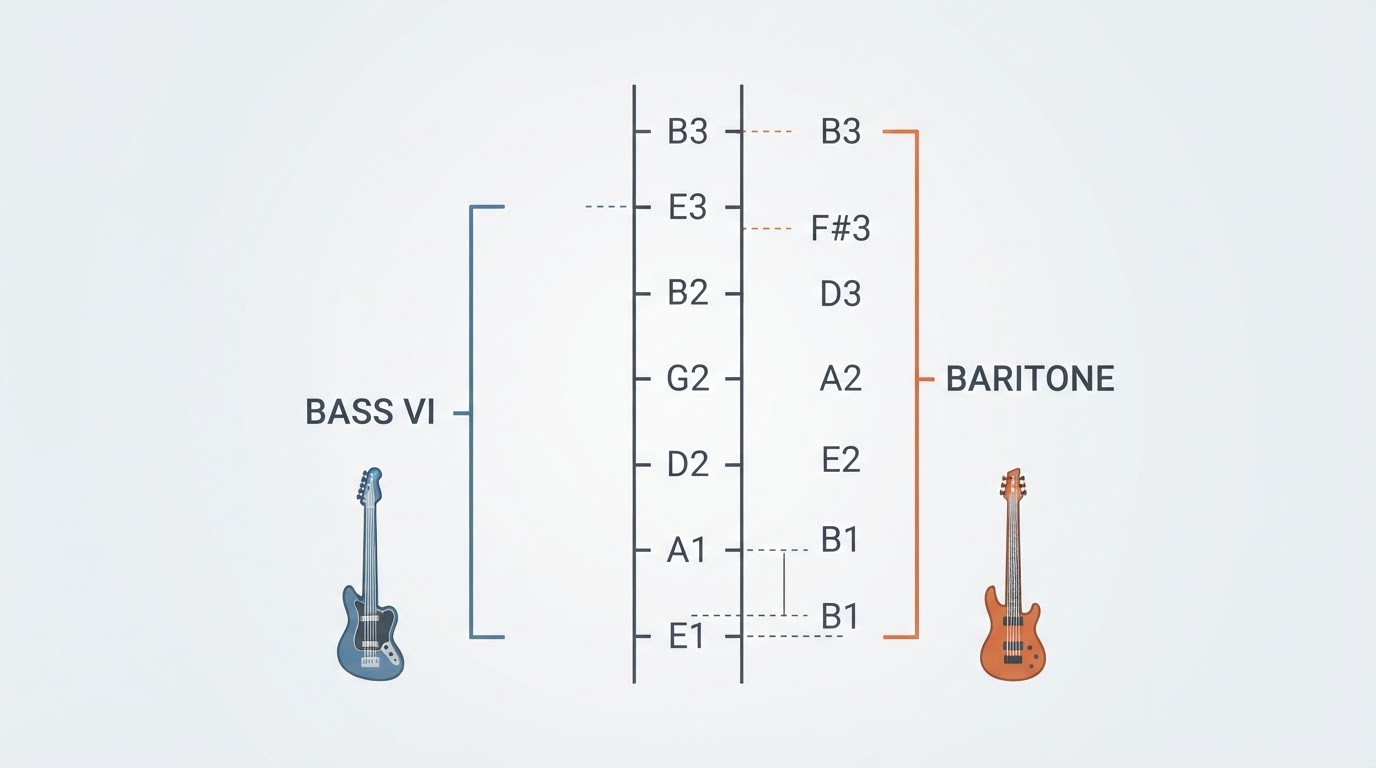
The patterns differ in shape, not just register. The Bass VI keeps standard guitar's EADGBE arrangement an octave down; a B-standard baritone uses BEADF#B, standard tuning shifted down a fourth. Comparing those two open-string sets, B1 E2 A2 D3 F#3 B3 and E1 A1 D2 G2 B2 E3, no exact pitch appears in both.
Tuning alone does not identify an instrument. Fender notes that a Bass VI can be given another tuning without becoming a baritone, so treat BEADF#B and EADGBE-down as the setups each model is designed and sold for, not as a test to apply to whatever six strings are in your hands.
Strings and setup
Fender describes baritone guitars as guitars strung with guitar strings and usually tuned a fourth below standard, and the Bass VI as a bass with a special bass string set made for the model. Follow the instrument and string maker's stated setup for the tuning rather than a general string-size rule.
Detuning a normal-scale guitar to B standard is a separate setup question. The six note names above describe target pitches only; they do not establish that a particular guitar's strings, nut and intonation suit that tension.