The OUTPUT jack mutes; the BYPASS jack keeps playing
BOSS documents the two audio outputs separately in the TU-3 owner's manual. Section 8 assigns the OUTPUT jack to an effects processor, guitar amp or similar device and states that the output is muted when the tuner is on. Section 9 gives the BYPASS jack a different job: it carries the signal from the instrument connected to INPUT at all times, and the manual recommends it when you want to be heard while you tune.
So OUTPUT is the switched jack. Press the pedal switch to tune, and the guitar leaves that path while the meter reads the notes you play. BYPASS is the unswitched jack: it keeps feeding whatever is plugged into it, tuner on or off. The pedal switch starts and stops the tuner either way; what changes is whether the mute sits between you and the amp.
If your amp is fed from OUTPUT, tuning is silent. If it is fed from BYPASS, you tune with the sound on and everyone hears it.
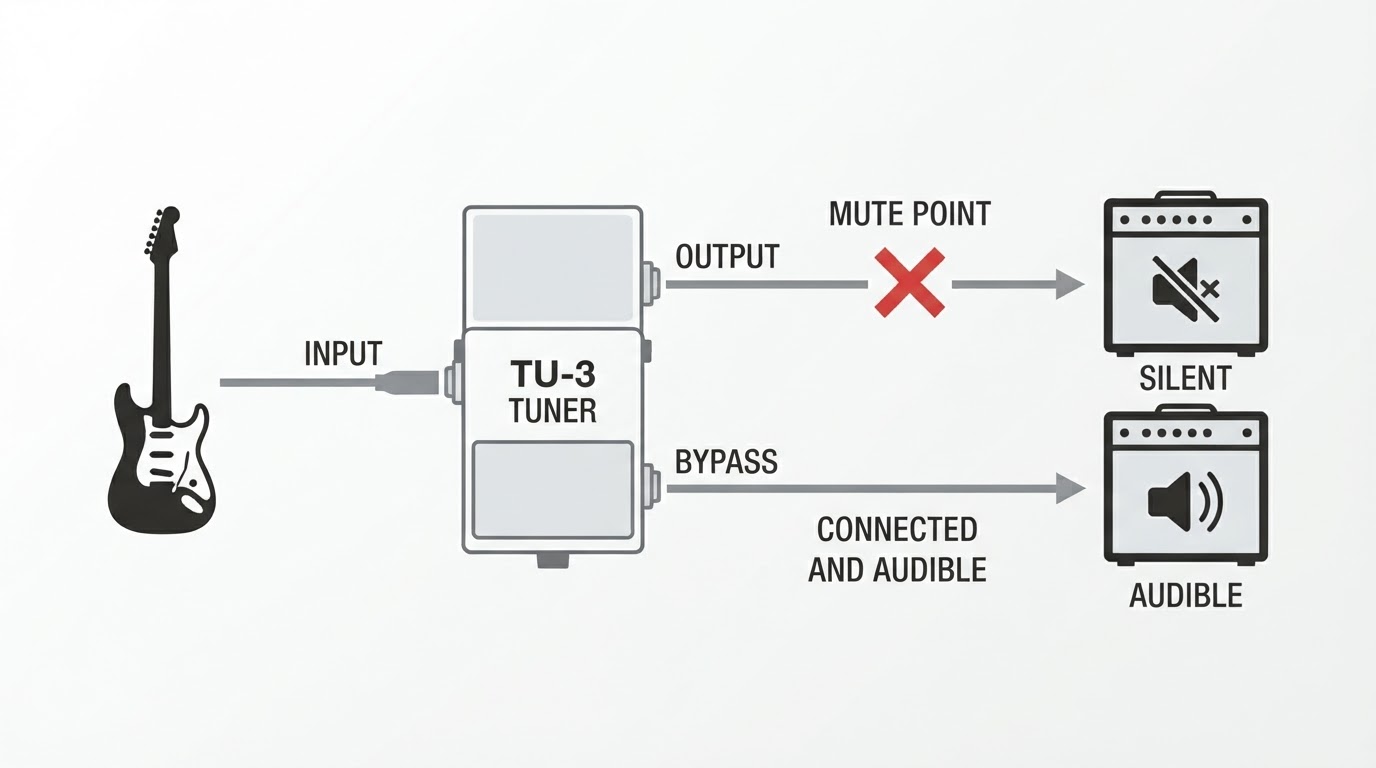
What each jack does while you tune
Jack | What it connects to | While the tuner is on |
|---|---|---|
INPUT | Guitar or bass; plugging in also switches the power on | Feeds the meter and both audio outputs |
OUTPUT | Effects processor, amp, or the next pedal in the chain | Muted |
BYPASS | The same kinds of destinations, kept live on purpose | Still passing the instrument signal |
DC OUT | Power for other PSA-adaptor-compatible pedals | Power only, no audio |
The label that causes most of the confusion is BYPASS: it names a jack, not the pedal's bypass circuit.
The BYPASS label says nothing about the bypass circuit
The standard TU-3 uses buffered bypass, as its official product page states. That is the pedal's bypass design, and it applies whichever audio output you use. For the wider comparison of circuit types, our guide to true bypass and buffered tuners covers what each one does to a chain.
So the word BYPASS printed beside the jack is not a claim about true bypass, about an extra route through the pedal, or about a second mute. It describes the jack, not the circuit: the instrument signal keeps coming out of it while the tuner is on. The bypass type governs what stays in the signal path when the tuner is off, and it does not decide which output goes quiet.
This article covers the standard TU-3. The TU-3W is a separate model, and its documentation should not be carried over to the pedal described here.
Wiring for silent tuning
Before connecting anything, turn down the volume and switch off the power on the amp and other devices, as the manual's standard precaution advises.
- Plug the guitar into INPUT. This jack also switches the power, so the TU-3 turns on when the cable goes in.
- Run a cable from OUTPUT to the next pedal in the chain, or straight to the amp you want quiet while you tune.
- Power up the rig, switching the guitar amp on last as the manual specifies, then press the pedal switch. The CHECK indicator lights to show the tuner is engaged.
- Tune one string at a time until the meter settles at the correct pitch. OUTPUT stays muted for as long as the tuner is on.
- Press the pedal switch again to play, and switch the amp off first when you shut the rig down.
Nothing in that sequence uses the BYPASS jack, which is why silent rigs often leave it empty.
Checking which jack is feeding the amp
- With the tuner off, strum a chord. An amp fed from OUTPUT should sound normally.
- Engage the tuner. The meter should respond as you play each string, and that amp should go silent.
- Disengage the tuner. The sound should return.
If the amp keeps sounding while the meter moves, read that as a clue about the path you are listening to rather than a diagnosis of the pedal. One possibility is that the cable feeding that amp sits in BYPASS rather than OUTPUT. Others: a second connection from BYPASS is still live, a delay or reverb after the tuner is still producing a tail, or the tuner is not engaged at all. The CHECK indicator settles the last point quickly. For the rest, trace the cable from the jack to the device you can hear and confirm where the mute actually sits.
Why a tail can outlast the switch: the mute only stops what leaves OUTPUT, so a delay or reverb placed after the tuner, or the amp's own reverb, can ring on briefly, and a separate path connected to BYPASS stays audible by design. That reading follows the manual's description of which jack is switched; it is a wiring inference, not a measured result.
When you want to be heard while you tune
Move the cable from the amp or next pedal to BYPASS and the pedal switch now only turns the tuner on and off. The meter still reads the instrument at INPUT, so the reference pitch and the accuracy of your tuning are unchanged. What goes away is the mute, because it no longer sits between you and the amp.
This is the audible route the manual points to. It suits situations where hearing yourself matters more than silence, or where another device further along the chain handles muting. The trade is straightforward: while you tune, the audience hears the strings.
What the mute cannot cover
Nothing plugged into OUTPUT can silence a path that is not connected to it. If the amp you can hear is fed from BYPASS, engaging the tuner will not quiet it.