The short answer: match the mode to the chain
Pick buffered bypass when the guitar signal has a long way to travel: a long cable to the amp, a large board of passive pedals, or both. Pick true bypass when you want the tuner's active electronics out of the off-state path, most often when a sensitive vintage-style fuzz seems to prefer the guitar's high-impedance signal directly.
That is a starting point, not a ranking. The right choice depends on where the tuner sits, your pickups, and how much cable runs between the guitar and the first buffered device. The rest of this guide shows how those variables interact and how to test the result.
What true bypass and buffered bypass actually do
True bypass means the guitar signal passes from the pedal's input to its output without going through active electronics when the pedal is off. The signal still passes through jacks, switches, and wiring inside the pedal, so "true bypass" describes a route, not a magical wire.
Buffered bypass means a buffer amplifier stays in the signal path whether the pedal is on or off. The buffer takes the guitar's high-impedance signal and presents a low-impedance output to the next cable or pedal. That is the trade: you keep a low-impedance output for the cable and pedals that follow, and you give up the idea that nothing is connected between guitar and amp when the tuner is not tuning.
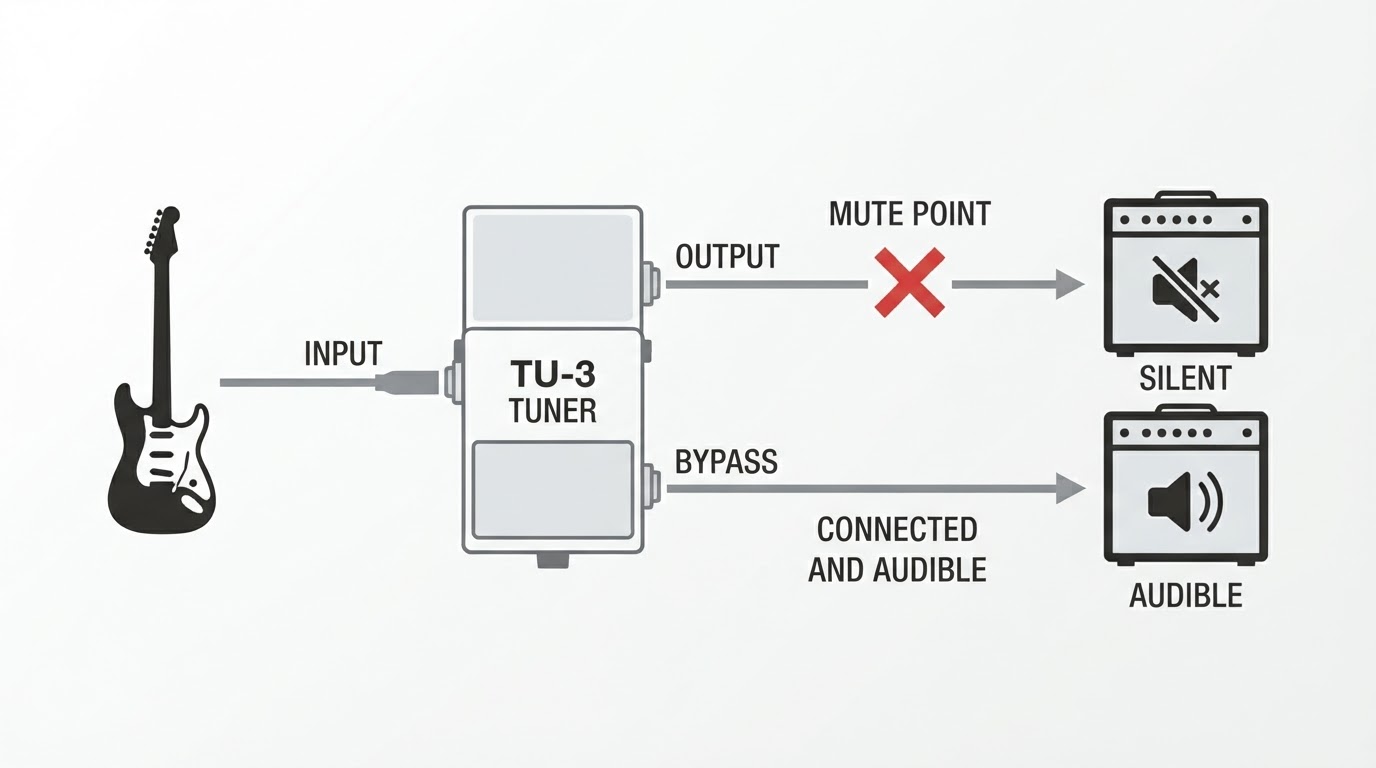
A jack labeled BYPASS does not prove the circuit is true bypass. The label tells you what the jack is for, not how the pedal is wired. The BOSS TU-3 is a useful example: it has a BYPASS jack and is still specified as buffered bypass. Read the specification line for the exact model instead of judging by the label or the enclosure.
Why cable length changes the answer
Passive pickups produce a high-impedance signal, and every foot of cable adds capacitance. BOSS explains that the cable and the input form a low-pass filter, so as cable length and capacitance increase, high frequencies roll off. BOSS illustrates the effect with an 18-foot cable example, where it says a treble reduction can begin to be heard and measured.
Treat that 18-foot figure as the manufacturer's illustration, not an engineering threshold for every rig. Cable design, pickup output, and the input impedance of the next device all affect what you hear, so the audible point may arrive earlier or later in your setup.
A signal buffer lowers output impedance, so the signal can travel farther after the buffer with less high-frequency loss. What a buffer cannot do is restore treble that was already lost before it. If the cable from the guitar to the first buffer is long and capacitive, the high end that never arrived at the buffer is not recovered downstream.
That is why the position of a buffered tuner matters. At the front of the board it can present a low-impedance output to the cables after it, but it also becomes the first thing a fuzz pedal sees. At the end it can help the run to the amp, but it does nothing for the cable before it.
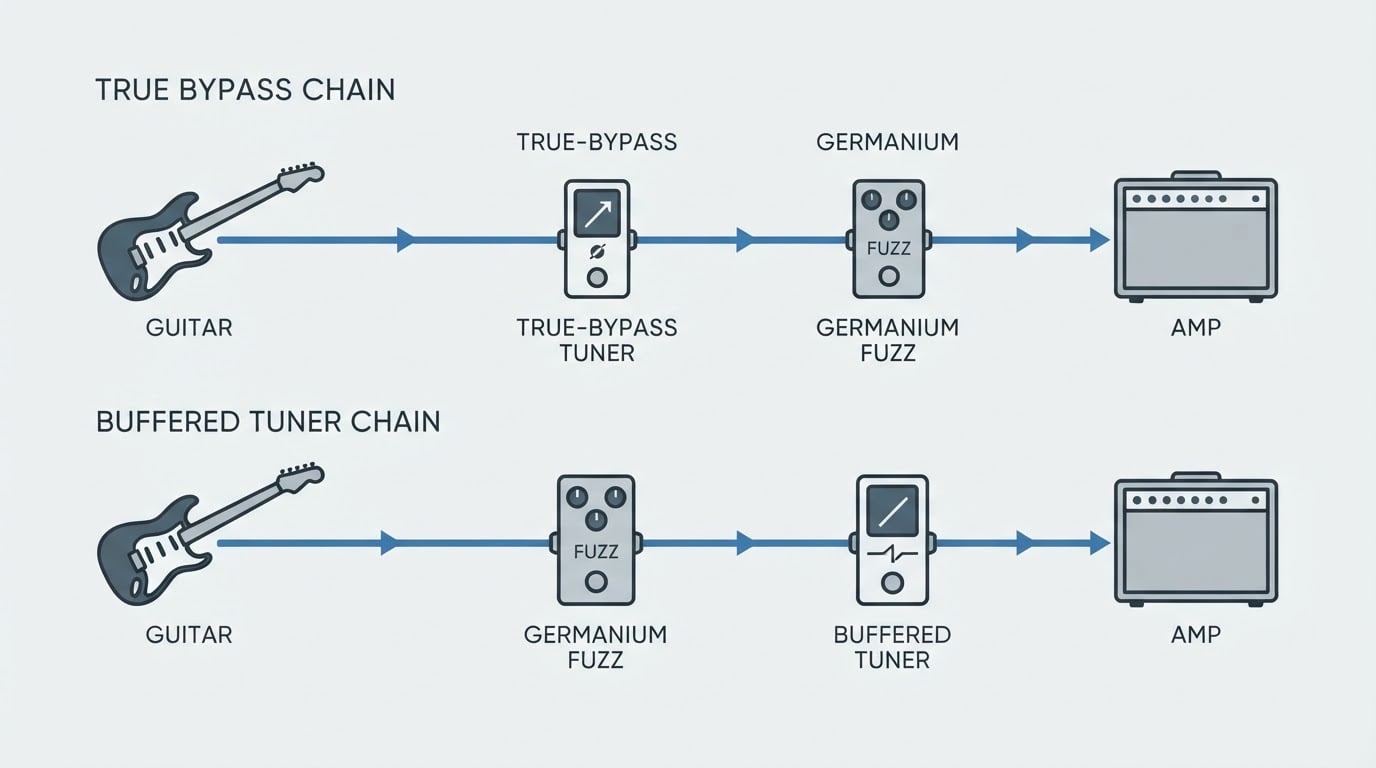
The fuzz exception: when the buffer should wait
Vintage-style fuzz pedals are the most common reason players choose true bypass for a tuner. BOSS notes that some germanium-transistor fuzz pedals usually sound their best when the guitar is plugged into them first. Those circuits were designed around the guitar's high-impedance signal, and a buffer ahead of them changes what they see. The result can be a different sound, sometimes thinner or harsher, and the pedal's clean-up behavior may change. That is a possibility for some designs, not a universal outcome.
If that describes your fuzz, true bypass is appropriate before it while the tuner is bypassed: with the tuner off, the fuzz sees the guitar more directly. A buffered tuner after the fuzz is another approach. Once the tuner sits after the fuzz, its bypass mode is a separate decision: choose buffered or true bypass according to what the rest of the chain needs, not because the fuzz somehow requires true bypass in that position. A selectable tuner such as the TU-3W can be set to true bypass ahead of the fuzz, then run in its buffered mode if the remaining cable run is long.
None of these is a universal rule. Some fuzz designs are less sensitive, and some players prefer a buffer in front. Test the placement instead of assuming that "fuzz first" or "tuner first" always wins. BOSS's explanation of buffers and cable capacitance is the source for the cable and fuzz-placement observations: Why Buffers Are Important for Great Tone.
TU-3 and TU-3W: two bypass configurations
The BOSS TU-3 is specified as buffered bypass: its buffer stays in the signal path even when you are not tuning.
The BOSS TU-3W is listed as offering selectable buffered or true-bypass operation. That listing is the basis for the claim here; the procedure for selecting the mode on a specific unit belongs to that model's manual, so consult the manual for your exact revision rather than following a guessed switch sequence.
BOSS lists "Buffered bypass" in the TU-3 specifications: TU-3 product page. The TU-3W product page lists "Buffered bypass or True bypass" for the W model: TU-3W product page.
The difference matters when one pedal has to serve one board. The TU-3 gives you a fixed buffered path. The TU-3W adds the option to take the buffer out of the path when a sensitive fuzz wants the guitar directly, then return to a buffered path for a long cable run. Neither model is a sound-quality ranking here; they are two bypass configurations.
Two cautions. First, do not assume the standard TU-3 has a bypass switch; the selectable mode belongs to the TU-3W listing, not the TU-3. Second, do not assume that a pedal will pass sound when its power is off. Power-off behavior is not guaranteed by the bypass label, so check the exact model's manual if that matters to you.
What bypass mode does not change
Bypass mode does not change the tuner's tuning accuracy. Accuracy comes from pitch detection and calibration, not from whether the off-state path is buffered or unbuffered. How a tuner reads pitch is a separate design question from how it routes signal when it is off: a chromatic tuner names one note at a time, while a polyphonic mode reads several strings from one strum, as this guide to polyphonic vs chromatic guitar tuners explains. Neither detection method tells you whether the off-state path is buffered or true bypass.
Bypass mode also does not fix a long cable before the tuner. If that cable is the main source of treble loss, a buffered tuner after it cannot recover the high end that never arrived. Keep the cable before the first buffer short, and put the buffer where it can serve the longest remaining run.
Finally, bypass mode does not guarantee sound when the pedal loses power. Some designs pass signal unpowered and some do not. If that matters for a gig, verify it for the exact model rather than assuming "true bypass" covers it.
A repeatable listening check
Before you decide, run a check that changes one variable at a time. It will not prove that one mode is better for every player, but it can tell you whether the difference is audible in your rig.
- Set a clean amp tone at a comfortable volume and leave the controls alone for the whole check. Use the same guitar and cables.
- Power the tuner as its manual specifies and confirm it is actually in the signal path. An unpowered pedal may pass nothing at all.
- Match levels before you judge tone. If switching modes changes loudness, use a loop switcher or a clean level control to compensate. A small volume difference can sound like a treble difference.
- Play the same short phrase each time: an open chord, a single note on the high strings, and a short passage with the fuzz engaged if you use one.
- Change one thing: change the tuner's bypass mode following its manual, or move the tuner from before the fuzz to after it. Keep the amp and guitar controls fixed.
- Repeat the phrase and listen for two things: whether clean highs disappear, and whether the fuzz keeps the character and volume-knob cleanup you expect. If you cannot hear a reliable difference, that is a valid result; choose the simpler path.
These are reader checks, not our test results, and they are not a guaranteed diagnosis. The outcome depends on your pickups, cable capacitance, pedal order, and the input impedance of the next device.
Decision table
Your setup | Start with | Why |
|---|---|---|
Short cables, a few pedals, no fuzz | Either mode | Both paths are workable; choose by listening rather than by slogan. |
Long cable to the amp or a large passive board | Buffered bypass early in the chain | A buffer lowers output impedance and presents a low-impedance output to the cable and pedals after it. |
Vintage-style germanium fuzz first in line | True bypass ahead of the fuzz, or place the tuner after it | Ahead of a sensitive fuzz, true bypass keeps the guitar's high-impedance signal at the fuzz input when the tuner is off. |
Fuzz already after a buffered tuner | Move the fuzz ahead of the buffer, or put a true-bypass tuner ahead of the fuzz | The goal is to stop a buffer sitting between guitar and fuzz. After the fuzz, either bypass mode can work. |
Tuner placed after the fuzz | Buffered or true bypass, depending on the rest of the chain | Once the fuzz sees the guitar first, the tuner's bypass mode is about cable runs and downstream loading, not about satisfying the fuzz. |
Tuner last before the amp | Either mode; buffered can help the final run | The buffer's position decides which cable it can serve. |
One board that needs both options | A selectable-bypass tuner such as the TU-3W | The TU-3W listing describes selectable buffered or true bypass; consult its manual for the selection procedure. |
You need sound with the pedal unpowered | Check the exact manual | Power-off pass-through is not guaranteed by the bypass label. |
Bottom line
True bypass and buffered bypass are tools for different cable problems. A buffered tuner is the practical starting point for long passive-pickup runs and large boards, because it lowers output impedance and presents a low-impedance output to what follows. A true-bypass tuner, or a selectable tuner set to true bypass, is the practical starting point when a sensitive vintage-style fuzz needs to see the guitar's high-impedance signal directly while the tuner is off.
Check the specification for the exact model, keep the cable before the first buffer as short as your layout allows, and run the listening check before you rebuild the board. The goal is not to join a bypass camp; it is to keep your clean tone and your fuzz behaving as expected, and to know which part of the result comes from routing rather than from tuning.