Tune Open, Seat The Capo, Then Check The Notes
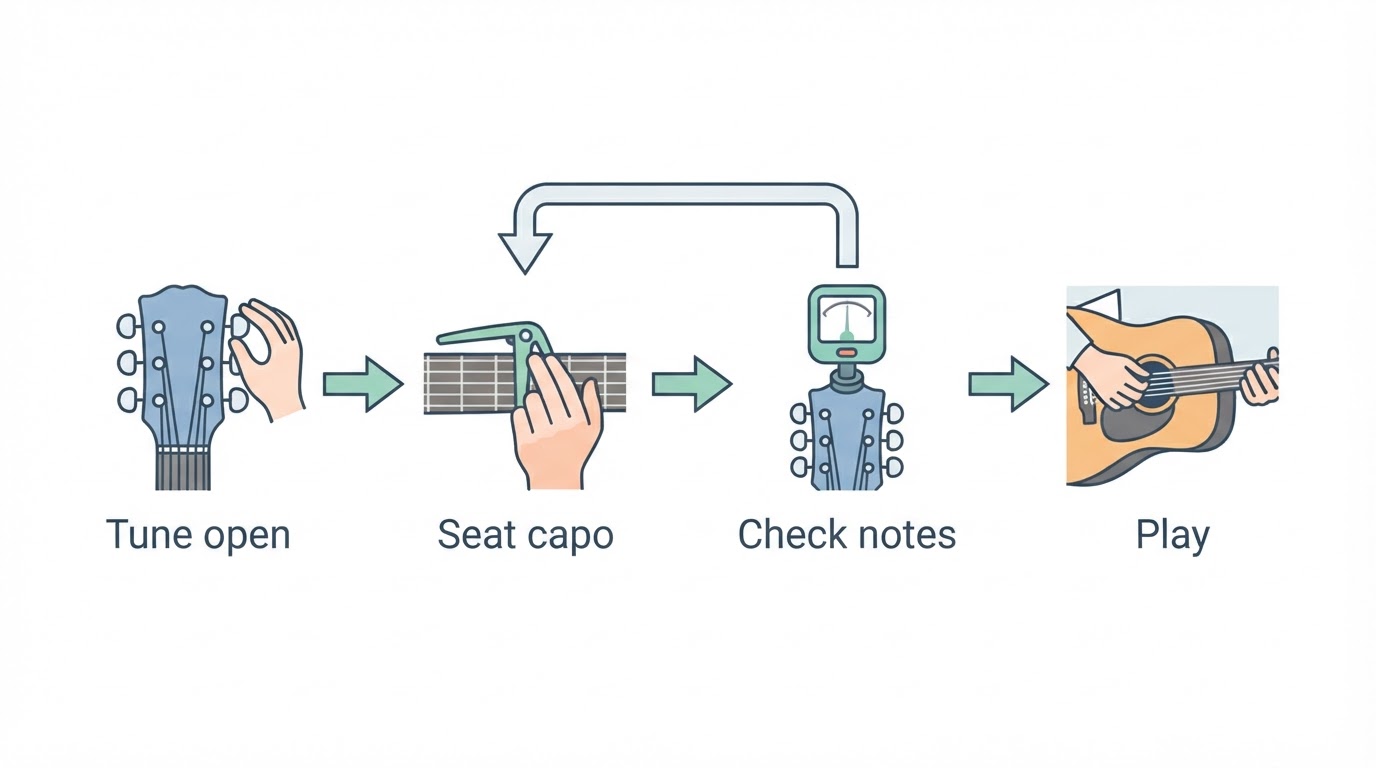
The order that works is tune the open strings, fit the capo, then check the notes the capo now produces. Tuning open establishes a reference the clamp cannot influence. The capo then changes what each string is supposed to sound like, so the second reading is not a repeat of the first one.
Work through it in this sequence:
- Tune the six open strings with a tuner you trust.
- Fit the capo behind the fret you intend to use, with no more pressure than the notes need.
- Play each string with the capo on and read the pitch on a tuner.
- Reseat or loosen the capo if the notes read sharp, and use the tuning pegs only for what remains after the clamp sits properly.
- When the capo comes off or moves to another fret, check the open strings again.
Fender gives the same order for a related reason: clamping the capo on pulls the strings toward the fretboard and fitting or sliding it moves them as well, so it recommends tuning once before the capo goes on, again with it in place, and once more after taking it off (Fender, "5 Times to Tune Your Guitar You Might Miss").
A capo behaves like a movable nut: it shortens the speaking length of every string by the same stretch of fretboard, so the strings keep their relationships to one another, but it cannot repair the reference they started from.
What The Capo Changes About Pitch
Every fret on a guitar is one semitone. Clamp at fret 2 and each string should sound two semitones above its open pitch; fret 1 is one semitone, fret 3 is three. The fret spacing fixes that part, which is why the target notes for any capo position can be written down in advance.
The small errors come from the stretch. Shubb's description of its own design says most capos have a pad too hard for the string, so the string bends over the fret instead of settling into it, and a clamp-style capo drags the strings sideways as it engages (Shubb on intonation). Either action stretches a string past the intended fretted pitch, which at fret 2 is two semitones above open rather than one, and a stretched string reads sharp.
Shubb also states the limit plainly: "Fretted instruments are not perfect machines. And no capo, not even a Shubb, can make these imperfect machines perfect" (Shubb on intonation). That sentence is the reason a check matters even after careful placement. How far the pitch moves on your guitar depends on the pressure the capo applies, the fret height, the string gauge, the action and the instrument's own intonation. It is not a fixed number of cents that you can subtract in advance, and no single figure applies to every guitar and every fret.
On that same page Shubb makes the case for its own hardware: a softer pad and a hand-like closing action that cut the sideways pull, and a set screw that repeats the same pressure next time. Treat it as a manufacturer's claim about a product rather than a measurement of your instrument. The part that transfers to any capo is the goal it names: affect the string the way a fingertip does, and the tuning error gets smaller.
Seat The Capo So It Needs No Extra Pressure
Placement is the part you control, and it decides how much correction the tuner will ask for. Shubb's application guide lays out the sequence it recommends (Applying the Capo):
- Press the rubber-sleeved bar against the strings parallel to the fret, just behind the fret wire, where a finger would sit.
- Push straight down onto the strings instead of dragging the bar into position, so nothing shifts to one side.
- Confirm that the first and sixth strings are fully covered before the lever closes.
- Close with even pressure across the width of the fretboard.
- On an adjustable capo, set the screw so the strings ring clearly at the least tension that does it, and make screw adjustments with the capo disengaged.
Shubb ranks the amount of pressure, the proximity to the fret and direct application above the question of whether you apply the capo from above or below the neck (Applying the Capo). Those three details are also what separate a capo that needs a small correction from one that pulls several strings audibly sharp.
If the notes still read sharp, reset the capo before you touch a tuning peg. Move it closer to the fret, ease the tension, straighten the bar and check that the strings still run in a clean line down the neck. Moving or loosening the clamp takes seconds and you hear the result immediately. Peg corrections made to compensate for a badly seated capo are better postponed until the clamp sits properly, because you will check the open tuning again once the capo comes off, and anything you turned for the clamp may have to be undone then.
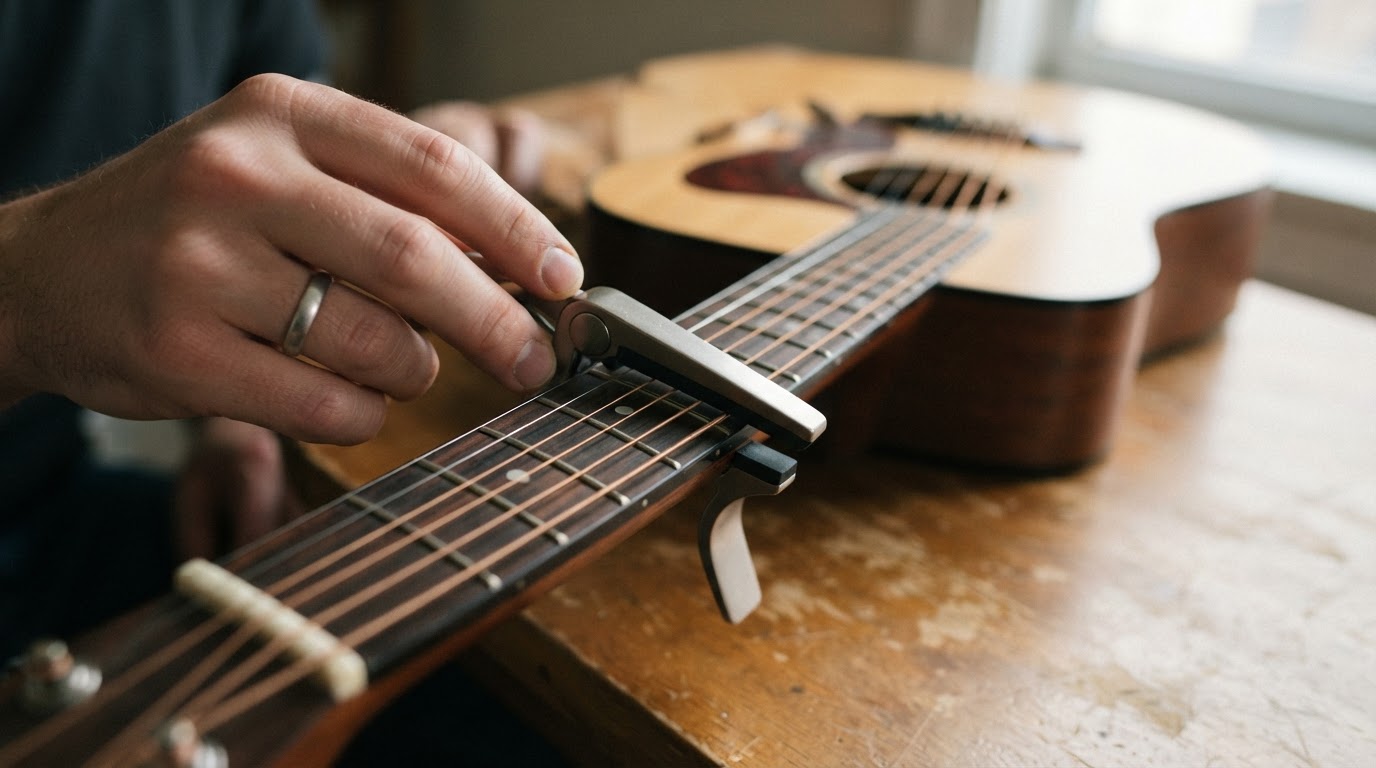
Tuning With The Capo On The 2nd Fret
With the capo fitted, the tuner should name the note the string now sounds: the open note raised by one semitone for each fret the capo covers. In standard E A D G B E tuning, a capo at fret 2 targets, low string to high, F# B E A C# F#.
String | Open note | Target with capo at fret 2 |
|---|---|---|
6th (low E) | E2 | F#2 |
5th (A) | A2 | B2 |
4th (D) | D3 | E3 |
3rd (G) | G3 | A3 |
2nd (B) | B3 | C#4 |
1st (high E) | E4 | F#4 |
The octave matters if your tuner names octaves: the sixth string under a fret-2 capo is F#2, two octaves below the F#4 of the first string.
A Capo Tuning Chart By Fret
The same arithmetic produces a capo tuning chart for every position you are likely to use. Each fret adds one semitone to the open note, so the low E of the sixth string becomes F2 at fret 1 and F#2 at fret 2, and every other string moves by the same interval. Read across each row for the six strings, low to high:
Capo fret | 6th | 5th | 4th | 3rd | 2nd | 1st |
|---|---|---|---|---|---|---|
1 | F2 | A#2 | D#3 | G#3 | C4 | F4 |
2 | F#2 | B2 | E3 | A3 | C#4 | F#4 |
3 | G2 | C3 | F3 | A#3 | D4 | G4 |
4 | G#2 | C#3 | F#3 | B3 | D#4 | G#4 |
5 | A2 | D3 | G3 | C4 | E4 | A4 |
Enharmonic spellings are interchangeable here; A#2 and Bb2 name the same pitch, so a tuner that prefers flats is not wrong. What matters is that the display matches the row for the fret you clamped, not the open-tuning row.
Check The Raised Notes On Your Tuner
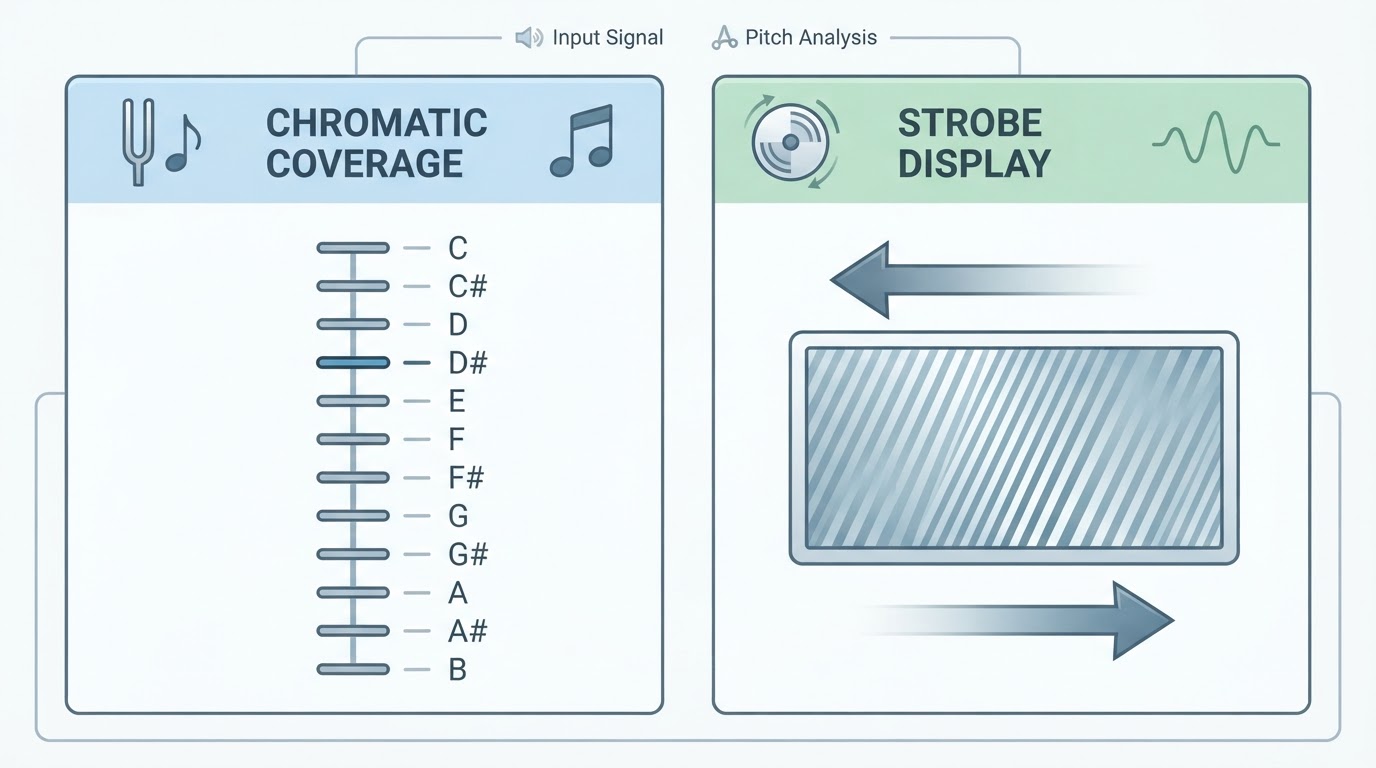
Chromatic mode is the straightforward option for this check, because it reports the pitch it hears instead of expecting a fixed set of notes. Some tuners set to a standard-guitar mode expect E A D G B E and try to fit each incoming pitch into that set, which can mislabel or limit the raised notes a capo creates. That depends on the tuner rather than on capos in general, so read what yours displays instead of assuming it will follow the shift. A guitar-mode tuner that names the note it hears, or an ear check against a reference pitch, can confirm the same targets.
Check one string at a time instead of strumming a chord. A single string can sit sharp while the chord still sounds acceptable, and one pitch at a time resolves more reliably than six together. If the display shows a cents offset beside the note, what cents mean on a guitar tuner explains how to read that number before you decide the capo is at fault.
When The Capo Comes Off Or Moves
Removing the capo may or may not leave the open strings where you tuned them, so take a reading rather than assuming movement in either direction. Play the strings with the clamp off, correct only the ones that moved, and if all six are off, consider the room, the age of the strings and recent bending before blaming the capo.
Moving the capo deserves the same check. Fret 3 raises every string three semitones, and a capo that sat cleanly at fret 2 may not sit the same way at fret 4. Neck profile, action and how a particular capo fits a particular neck all vary, so take the new reading instead of adjusting the pegs to match the old row.
If The Notes Stay Sharp After A Clean Seat
A capo that is seated with the least pressure that rings clean and still produces sharp notes after a reseat leaves more than one possibility open: the capo's fit on this neck, the way the strings are being pressed, and the guitar's existing setup. The comparison below narrows where to look; it does not name a cause on its own.
Play the same notes with your fingers, pressing just behind the fret with ordinary pressure, and read them on the tuner. If the finger-fretted notes also read sharp, the clamp is not the only thing involved, and a technician can assess the setup. If they sit close to pitch while the capoed notes run sharp, the capo's placement and fit are the first things to revisit. When neither comparison settles it, have the setup inspected rather than adding more capo tension or trying another brand of clamp.