What a tuner compares before it shows cents
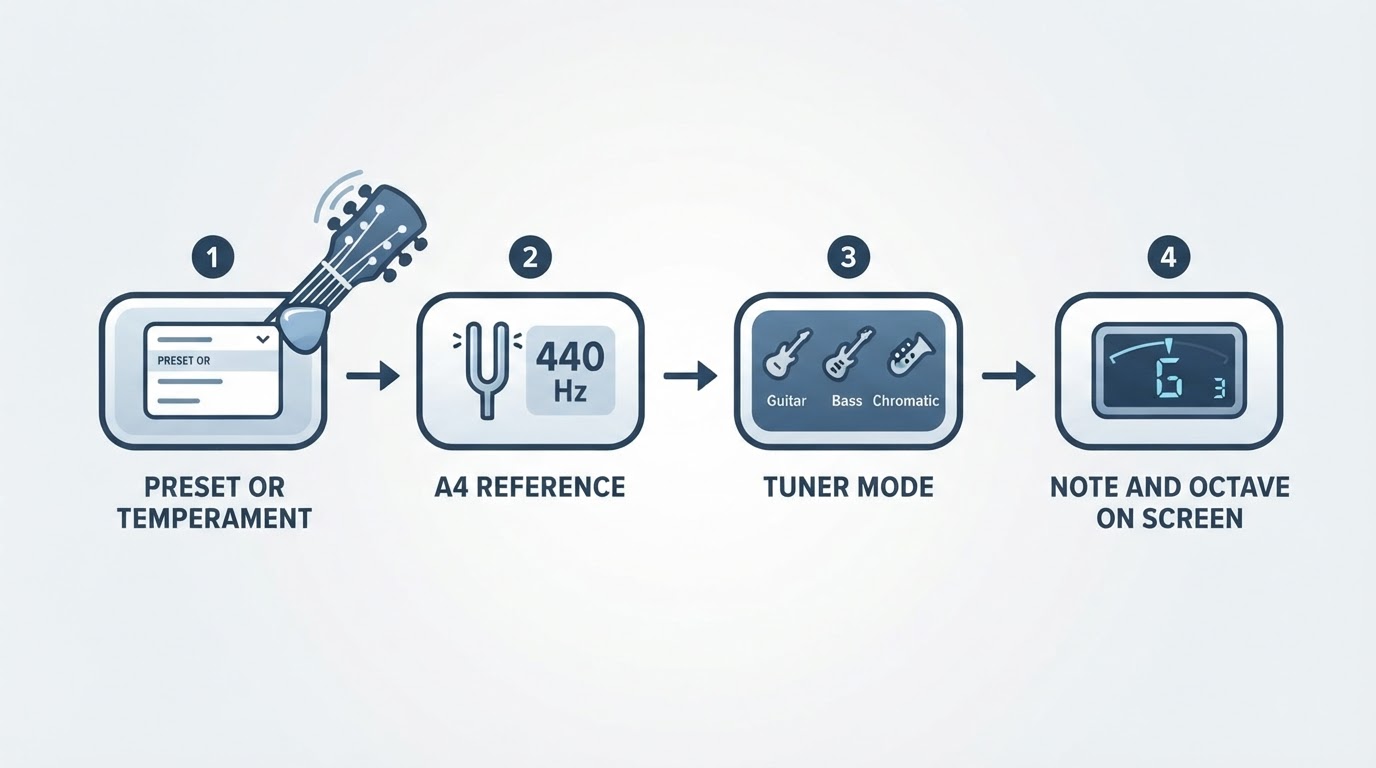
A tuner does not report a frequency in a vacuum. It decides which note it is hearing, compares that pitch with the target it holds for the note, and expresses the leftover difference in cents. In standard tuning at A4 = 440 Hz, the open strings target E2 82.41 Hz, A2 110.00 Hz, D3 146.83 Hz, G3 196.00 Hz, B3 246.94 Hz and E4 329.63 Hz, as listed in this guitar tuning frequency chart. The cents value is the gap between one of those targets and the pitch the microphone or pickup detects.
The reference pitch is part of that comparison. A4 = 440 Hz is the usual convention, specified in ISO 16:1975, but tuners also offer 435, 432 or 415 Hz. Changing the reference moves every target by the same proportion, so the same string can read a few cents sharp at one setting and a few cents flat at another while the guitar itself has not changed.
A cent is one hundredth of a semitone
One cent is one hundredth of a semitone, the definition Octave Tuner's FAQ gives for the unit. A semitone — one fret, or one adjacent key on a piano — is 100 cents, and an octave is 1,200 cents in every key, because 12-tone equal temperament divides the octave into twelve equal steps.
Those steps are equal ratios rather than equal frequency differences, so the arithmetic is logarithmic. The distance between a measured frequency and a target is
cents = 1200 × log₂(measured ÷ target)
and the reverse gives the frequency for a known offset:
measured = target × 2^(cents ÷ 1200)
One cent is a multiplier of about 1.000578, which is why a cent is a ratio and not a fixed number of hertz. Ten cents is not ten hertz, and a reading of −40 means four tenths of a semitone, not forty of anything.
What plus and minus cents tell you to do
A positive number means the string is sharp: it is above the target. A negative number means it is flat: below the target. A zero reading means the tuner is showing no offset at its display resolution. That is not proof of a mathematically exact pitch, and the point at which a display turns green is a design choice that differs between models.
So +8 asks you to lower the pitch and −8 asks you to raise it. The sign gives the direction; the size tells you how far you have to go.
On a conventional peghead, tightening a tuning peg raises the pitch and loosening lowers it, but the direction of the turn depends on which side of the headstock the peg sits and on the machine head itself. Check the first small movement rather than trusting a rule about clockwise. On a guitar with a locking nut or a headless bridge, tuning happens at a different point entirely.
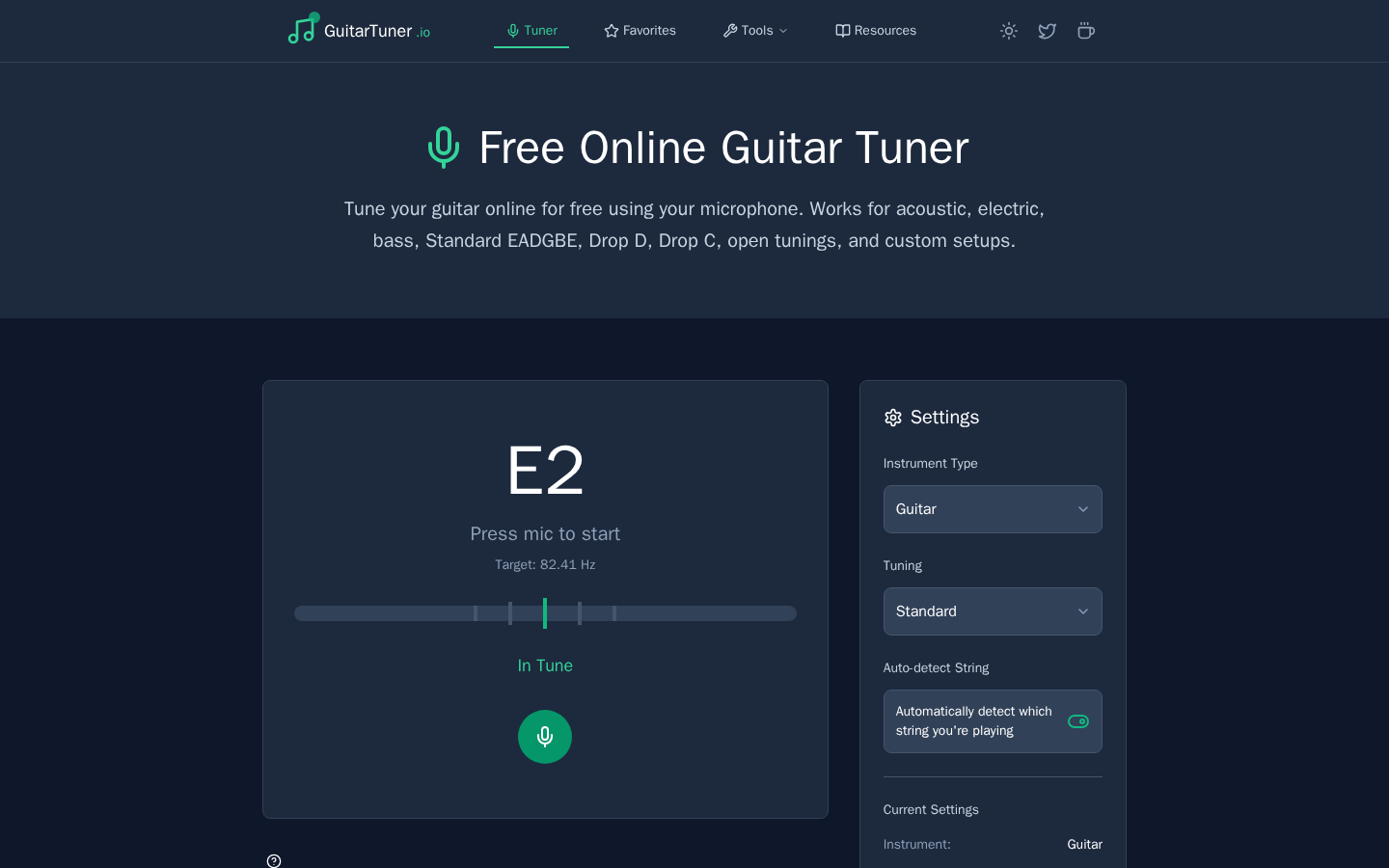
The target for the selected string is what the cents offset is measured against.
Why the same cents error is a different number of hertz
A cent is a ratio, so its size in hertz grows with the pitch. At A4 = 440 Hz, +10 cents works out to about 442.55 Hz and −10 cents to about 437.47 Hz. The low E string is less than a fifth of that frequency, so the same ±10 cents is a much smaller hertz change.
Offset | E2 (82.41 Hz) | A2 (110.00 Hz) | A4 (440.00 Hz) |
|---|---|---|---|
+10 cents | 82.89 Hz | 110.64 Hz | 442.55 Hz |
−10 cents | 81.94 Hz | 109.37 Hz | 437.47 Hz |
1 cent | about 0.05 Hz | about 0.06 Hz | about 0.25 Hz |
The same 10-cent move is less than half a hertz on the low E and about 2.5 hertz at A4.
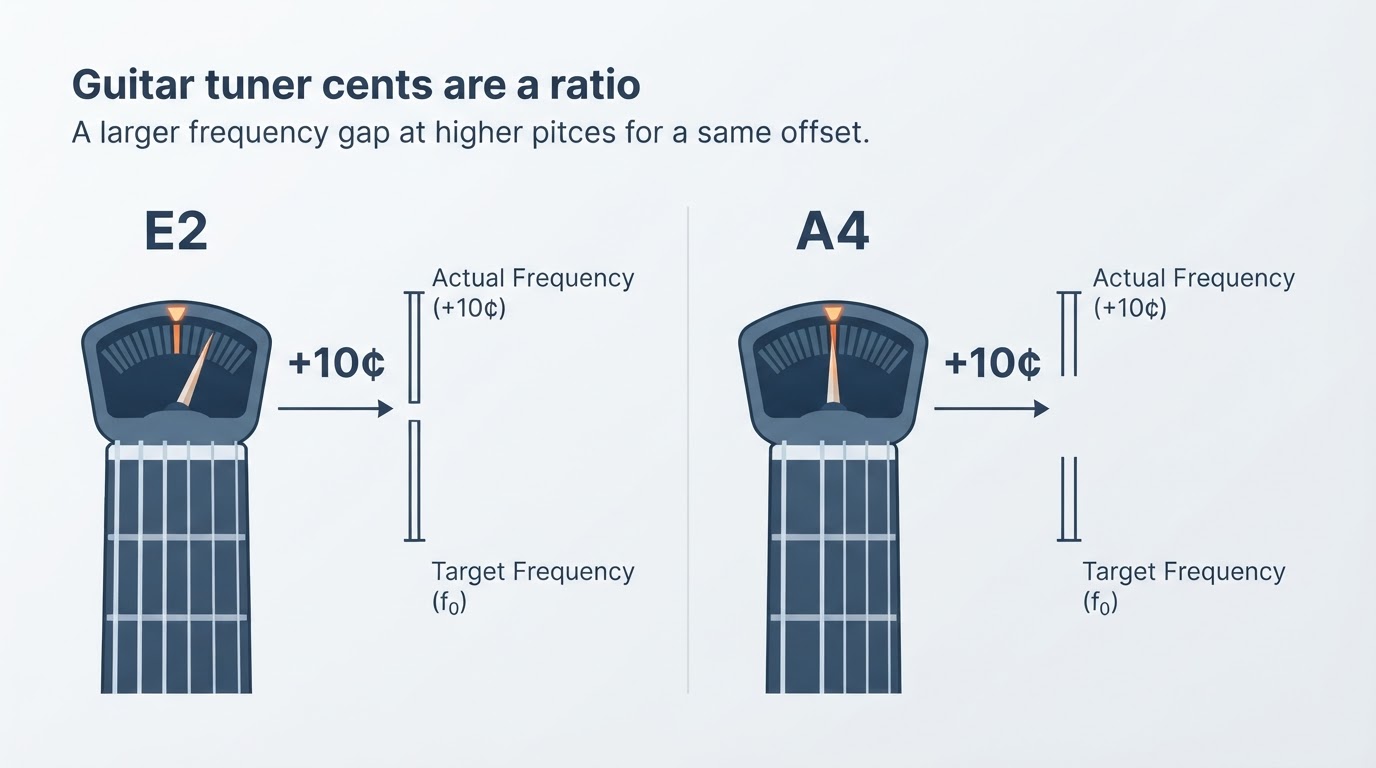
That is also why "just a few hertz" is not a useful goal on its own. Two hertz is about 42 cents at the low E, about 8 cents at A4, and three hertz at the high E is still close to 16 cents. Every one of those is a multiple-cent error, which is why hertz alone says little until you know which string you are on. The cents display makes the cases comparable, and it is the number to read when you want to know how far out of tune a string is rather than merely which way.
Correcting a small offset without chasing it
Work on one string at a time and mute the others. Pluck the string once at normal playing volume, let the note settle for a moment, and read the number after the display stops jumping. Then move the peg in a small increment — a nudge rather than a turn — and check again. Overshooting is normal; the goal is a smaller correction each time, not a single perfect twist.
Many players approach a target from below: flatten the string slightly, then raise it to pitch, so the final movement tightens the string instead of slackening it. A string that finishes its travel under tension often holds better than one that was tightened and then backed off. The frequency chart lists the target each string should reach.
If a string keeps falling flat minutes after you set it, the cents figure is no longer the main question. Check how the string sits at the saddle and nut, whether the windings at the post are slipping, and how old the string is. A slipping peg, an unsettled tremolo or a change in temperature or humidity can all move pitch, so treat persistent drift as a setup question rather than assuming one cause.
When a centered reading still sounds wrong
If chords sound sour while every open string centers, the tuner is agreeing with the open strings and the fretted notes are the ones to investigate. Check intonation — the relationship between open and fretted pitch, set by saddle position, string height and neck relief — rather than turning the pegs harder.
The reading also depends on the note the tuner chose and the reference you gave it. A right letter in the wrong octave, or a target left at 432 Hz while the rest of the band tunes to 440 Hz, will produce a confident zero for a pitch nobody wants. When the display and your ear disagree, confirm the note name, the octave and the calibration before adjusting anything else.