Which string pairs the fifth- and seventh-fret harmonics compare
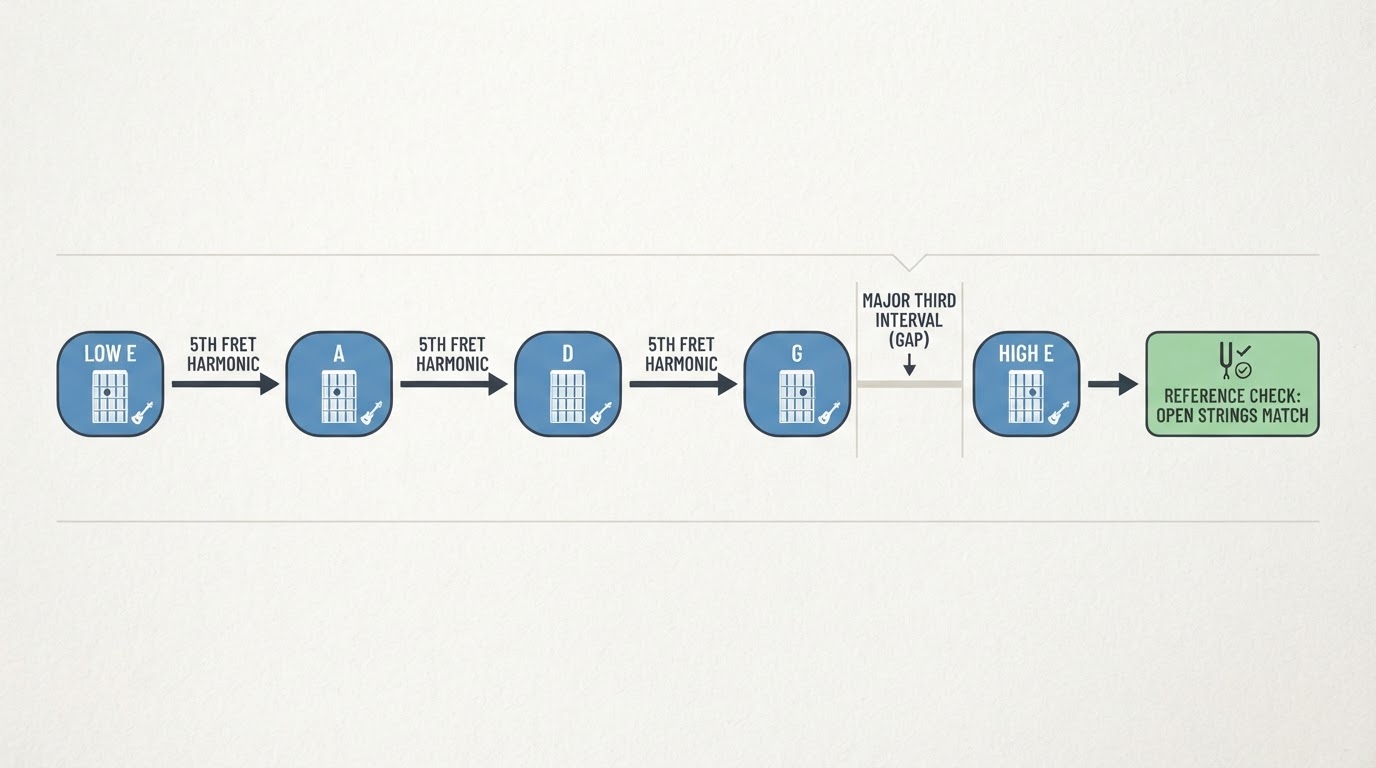
The method compares a low string's fifth-fret harmonic with the next string's seventh-fret harmonic, moving from the low E toward the high E. On a standard E-A-D-G-B-E guitar, the pairs are:
Lower string, fifth fret | Higher string, seventh fret | Interval the match creates |
|---|---|---|
Low E | A | Fourth (4:3) |
A | D | Fourth (4:3) |
D | G | Fourth (4:3) |
B | High E | Fourth (4:3) |
Those are the four comparisons in Fender's harmonic-tuning guide, which runs from the low E up and leaves the G/B pair out of the pattern. The omission is deliberate. G to B is four semitones, a major third, while the other adjacent pairs are five semitones, a fourth. A 4:3 match describes a fourth, so it cannot set G against B. The B string needs a different check.
Touch the string directly above the fret wire, not behind it: the fingertip only creates a node, and the string sounds the partial when you pluck and release. You do not press the string down to the fretboard.

Why a zero-beat fourth is about two cents narrow
At the fifth fret the string divides into four equal parts, so the harmonic is the fourth partial, two octaves above the open string. At the seventh fret it divides into three, giving the third partial, an octave and a fifth above the open string. The University of New South Wales physics pages lay out this partial numbering and the fret positions behind it.
When the fourth partial of the lower string and the third partial of the higher string meet, the open strings sit at the ratio their partial numbers imply: 4f(low) = 3f(high), so the higher string is 4/3 of the lower one. That ratio is 1200 × log₂(4/3) = 498.045 cents, against 500 cents for an equal-tempered fourth, so the zero-beaten match is 1.955 cents narrow. The arithmetic assumes the lower string already sits at its reference pitch; the match only fixes the higher string at a 4:3 relationship with whatever the lower string is doing.
That is why a dead-clean zero beat does not produce an equal-tempered guitar. Zero-beating the low E/A pair leaves A about two cents flat of the tuner's A, and each further zero-beaten fourth pushes the next string a little flatter again, so the offsets accumulate toward G. The error is small, but it is systematic, and it sits underneath every open-position chord.
Real strings do not sound textbook partials. Bending stiffness at the nut and bridge stretches the higher partials, so the interval you hear is not exactly the ideal 4:3, and how far off it is depends on the string and its condition. The 1.955 cents is a statement about ideal strings, not a calibration for any particular guitar.
Harmonic tuning is therefore a relative check with a known bias, not a way to set absolute pitch. Match each pair to a zero or near-zero beat to get the strings consistent with each other, then correct the set against a reference.
The B string: why G/B is not a fifth/seventh pair
G to B is four semitones, a major third, while the other adjacent pairs are five. The 4:3 relationship belongs to the fourth, so the fifth/seventh match cannot set the G/B pair.
Fender's guide offers a workaround for that pair: compare the G string's ninth-fret harmonic with the B string's fifth-fret harmonic. Those partials relate as 5:4, a just major third, which is not the equal-tempered major third the tuner's B3 expects, so a zero beat there cannot agree with the reference.
The safer route avoids a just-third match altogether. Target B3 on the tuner, or fret the third string at the fourth fret and compare that B with the open B string, then recheck the whole set against your reference. Either route inherits the state of the string you compare against: if G was set with a zero-beaten harmonic and sits a little flat, a fretted comparison carries part of that error onto B.
The B fifth-fret / high E seventh-fret pair is the one valid 5/7 comparison that involves B. Use it as a cross-check after B is already set, not as the setting itself.

A sequence with a checkable finish
- Set the reference. Tune the low E with a tuner set to A4 = 440 Hz, or with another trusted pitch source. Harmonics can make the six strings agree with each other; they cannot establish concert pitch by themselves.
- Set the high E from the low E. Touch the low E directly above the fifth fret, let the harmonic ring, and compare it with the open high E. These are the same pitch, so a zero beat is the correct target.
- Set A, D and G from the chain. Match low E fifth fret to A seventh fret, A fifth to D seventh, and D fifth to G seventh. Each match puts the higher string a 4:3 fourth above the lower one.
- Set B. Use a tuner targeting B3, or fret the third string at the fourth fret and compare that B with the open B string. Do not use the G ninth-fret / B fifth-fret zero beat as your final setting.
- Check against the reference. Compare every open string with the tuner or pitch source you started from. Six strings that agree with each other can still sit sharp or flat of A4 = 440 Hz, so relative consistency is not the same as the correct register. A strummed chord is not a finish line either: equal-tempered thirds beat audibly even when the tuning is right.
Where the method stops
The harmonic check tests the open strings against each other. It says nothing about fret placement, nut and saddle condition, neck relief or the intonation of fretted notes. A guitar can pass every harmonic pair and still play sharp at the third fret; that is an intonation check, separate from whether the open strings were tuned correctly.
The fretted fifth-fret method is a different technique, not a variant of this one. There you press the lower string at the fifth fret and compare the fretted note with the next open string, using the fourth fret for the B string. That method compares fundamentals, so finger pressure and fret wear affect it; the harmonic method compares upper partials, so temperament and inharmonicity affect it. Both still need a final reference check.