What the fifth fret method compares
The fifth-fret method tunes the guitar to itself. Each step compares two strings: a note you fret on the lower-pitched string and the open string beside it. When those two match, the open string is in tune with its neighbor, and you move one pair up the neck.
Standard tuning runs E2, A2, D3, G3, B3, E4 from the thickest string to the thinnest. Four of the five adjacent pairs sit a perfect fourth apart, which is five frets wide. The G and B strings sit a major third apart, four frets wide, which is why that one pair uses the fourth fret.
Pair | Fretted note | Open string to match | Interval |
|---|---|---|---|
6th to 5th | 5th fret on low E gives A | open A | perfect fourth |
5th to 4th | 5th fret on A gives D | open D | perfect fourth |
4th to 3rd | 5th fret on D gives G | open G | perfect fourth |
3rd to 2nd | 4th fret on G gives B | open B | major third |
2nd to 1st | 5th fret on B gives E | open high E | perfect fourth |
The five comparisons, in order
Start with the low E string already close to its target pitch, since every later comparison uses the string below it as its reference.
- Low E to A. Fret the 5th fret of the low E string. The note under your finger is A. Pluck it, let it ring, then pluck the open A string and turn the A string's tuning peg until the two pitches match.
- A to D. Keep the same pattern one string over: fret the 5th fret of the A string, which gives D, then tune the open D string to it.
- D to G. Fret the 5th fret of the D string, which gives G, and match the open G string to that note.
- G to B. Move to the 4th fret of the G string, which gives B, and tune the open B string to it.
- B to high E. Return to the fifth fret: fret the 5th fret of the B string, which gives E, and match the open high E string.
You can hold the fretted note and reach across with your strumming hand to pluck the open string, so both notes ring together long enough to compare. That overlap is what makes the next step possible: you are not trying to remember a pitch, you are hearing two pitches at once and closing the gap between them. Jon MacLennan's walkthrough of the fifth fret method uses the same five pairs and describes that reach-across motion.

Play one pair at a time. A strummed chord or two open strings ringing together blurs the comparison, and on an acoustic guitar the body amplifies every stray vibration.
Why the B string takes the fourth fret
G to B is the one major third among the five adjacent pairs, so the note that matches the open B string sits four frets up the G string rather than five. The fifth fret of the G string is C, and tuning the open B string to that C leaves the B a semitone sharp of where it belongs. The pair itself can sound convincing while every open B in a chord sits a half step high.
Listening for the beats
When two strings are close in pitch but not identical, you hear a pulse: a wa-wa-wa warble riding on top of the note. The pulse rate tracks the difference between the two frequencies. Far apart, the warble is fast or turns into roughness. As the strings converge, it slows to a lazy throb and then stops when the two pitches become one.
MacLennan describes the same target: listen for the warble and make it go away as the notes approach unison. In practice, that means turning the peg in small increments, plucking the pair again, and listening for the pulse to slow. If the pulse speeds up, you turned the wrong way; reverse direction instead of forcing the peg further.
A few conditions make the pulse easier to hear:
- Pluck the pair cleanly and let the notes settle before judging. A hard attack has its own initial wobble.
- Compare in a quiet room. Background noise masks the slow pulse, which is the part you need.
- Keep your fretting hand still while both notes ring. Moving the finger changes the fretted pitch and restarts the comparison.
Where tuning error comes from
Press just hard enough to sound the note cleanly, with your finger just behind the fret. Extra pressure stretches the string and raises the fretted note. If the fretted note is sharp because you are gripping too hard, you will tune the open string up to that sharp reference, and it will stay sharp when you let go.
The low E is the one note you take from outside the chain. If it is a few cents flat and every comparison afterward is matched exactly, the other five strings end up roughly the same few cents flat: the starting offset is carried along at its original size, not multiplied by the method. What can add up is new error introduced at each comparison — a unison you judge a hair early, or a fretted note pushed sharp by a heavy finger. Because each string is tuned from the one before it, those separate mistakes can stack up across five pairs.
Turn the pegs in small increments and repluck after each one. If a string is already sharp, lower it slightly past the target and bring it back up; that avoids the overshoot that comes from approaching from the wrong side with a stiff peg. Two habits keep accumulated error small:
- Set the low E from a reference before you start, so the chain begins at the right pitch.
- Recheck the 6th and 5th strings at the end. Adjusting the later strings changes the overall tension on the neck, and the strings you tuned first can drift slightly.
What the fifth fret method cannot set
The method is relative. It makes the strings agree with each other, but it never establishes what A should be in absolute terms. A guitar tuned this way can be perfectly in tune with itself and still sit a semitone or more below concert pitch, which becomes a problem the moment you play with another instrument or along to a recording.
To fix that, set one string from an external reference first: a tuner, a piano, a tuning fork, or the recording you plan to play along with. Then use the fifth fret comparisons to carry that reference across the other five strings. Tuning the low E from the reference and working upward is the simplest order, because the low E is the string you will recheck at the end.
Two other limits are worth knowing:
- Setup and intonation. If fretted notes run sharp as you move up the neck, the fifth fret comparison can be matched while chords still sound out higher up. That pattern gives you a reason to have the action, nut or saddle checked, but it does not identify the cause on its own: fretting pressure, string condition and the guitar's setup can produce similar symptoms.
- Slipping and settling. A string that slips at the peg or is still stretching will move after you have moved on. If a pair keeps drifting back out, look at the string, the winding at the peg and the conditions the guitar is kept in. Another careful pass will not fix a mechanical or environmental cause, and the drift alone does not tell you which of those it is.
When a tuner is the better reference
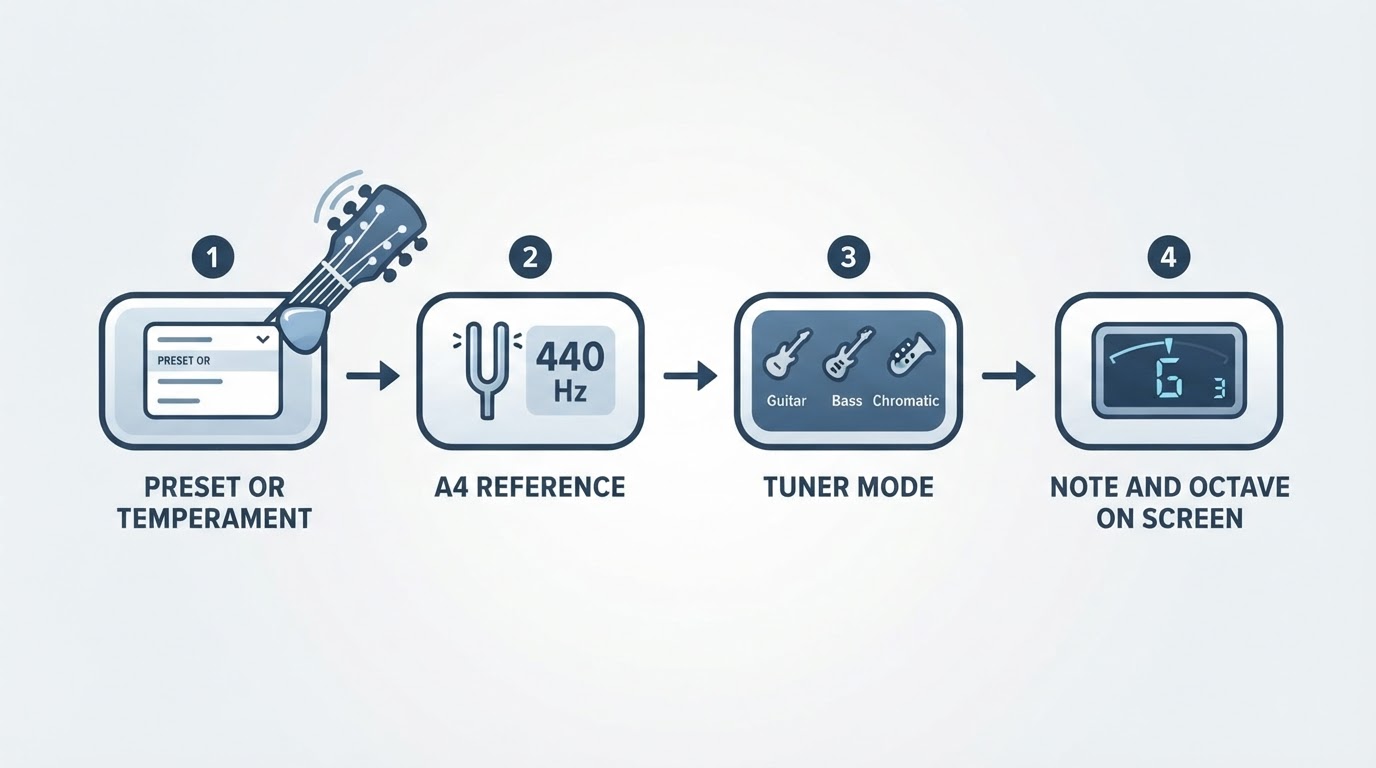
If you want a reliable starting note, or you would rather skip the by-ear comparisons, a microphone tuner is the faster route. GuitarTuner.io runs in a browser, uses the device microphone, and needs no account or download. You allow microphone access, choose Standard tuning, and play one string at a time while the display shows the target note and whether the pitch is sharp or flat. The site's six-step tuner walkthrough covers the full sequence, including the recheck of strings 6 and 5 at the end.

The tuner screen names the note it expects and shows whether the string is above or below it, which is enough to set the low E before you start the by-ear comparisons.
A practical division of labor: use the tuner to set the low E, or all six strings, then use the fifth fret pairs as a quick by-ear check before you play. If a pair disagrees with the tuner, trust the tuner for absolute pitch and check your fretting pressure before you turn anything.
Final check
Run the five pairs once more, then play an open G major or E minor chord as a listening test. Do not expect the chord to be perfectly free of beating: in equal temperament, the major third is wider and the fifth narrower than their pure ratios, so some slow wavering is normal even when every string is where it should be. Judge the job by the unison pairs and by the reference you started from, not by whether the chord is beatless.
If one string stands out, isolate it and repeat its own comparison rather than turning pegs at random. When the pairs agree and the 6th and 5th strings still hold after the final adjustment, the tuning is as close as this method can bring it.