What a tuned 7-string sounds like
Standard tuning for a seven-string guitar, low to high, is B1 - E2 - A2 - D3 - G3 - B3 - E4 (BEADGBE). The seventh string sits a fourth below the low E, so the chord shapes you already know keep working while the guitar covers the bottom octave of a bass.
String | Note | Target frequency (A4 = 440 Hz) |
|---|---|---|
7th (lowest) | B1 | about 61.7 Hz |
6th | E2 | about 82.4 Hz |
5th | A2 | about 110.0 Hz |
4th | D3 | about 146.8 Hz |
3rd | G3 | about 196.0 Hz |
2nd | B3 | about 246.9 Hz |
1st (highest) | E4 | about 329.6 Hz |
The finished result has three parts. Every open string centers on its note without wandering. The low B rings with a steady pitch instead of a wobble. And the octave between the sixth string (E2) and the first string (E4) sounds clean rather than beating against itself. The steps below get you to that state and keep you there.
How to tune a 7-string guitar to standard, step by step
- Turn on the microphone tuner in your browser. Open the tuner, allow microphone access when the browser asks, and keep that tab in the foreground. Pluck one string before you touch a peg, just to confirm the display reacts. Done when: the tuner shows a note name and its meter moves only while you are playing.
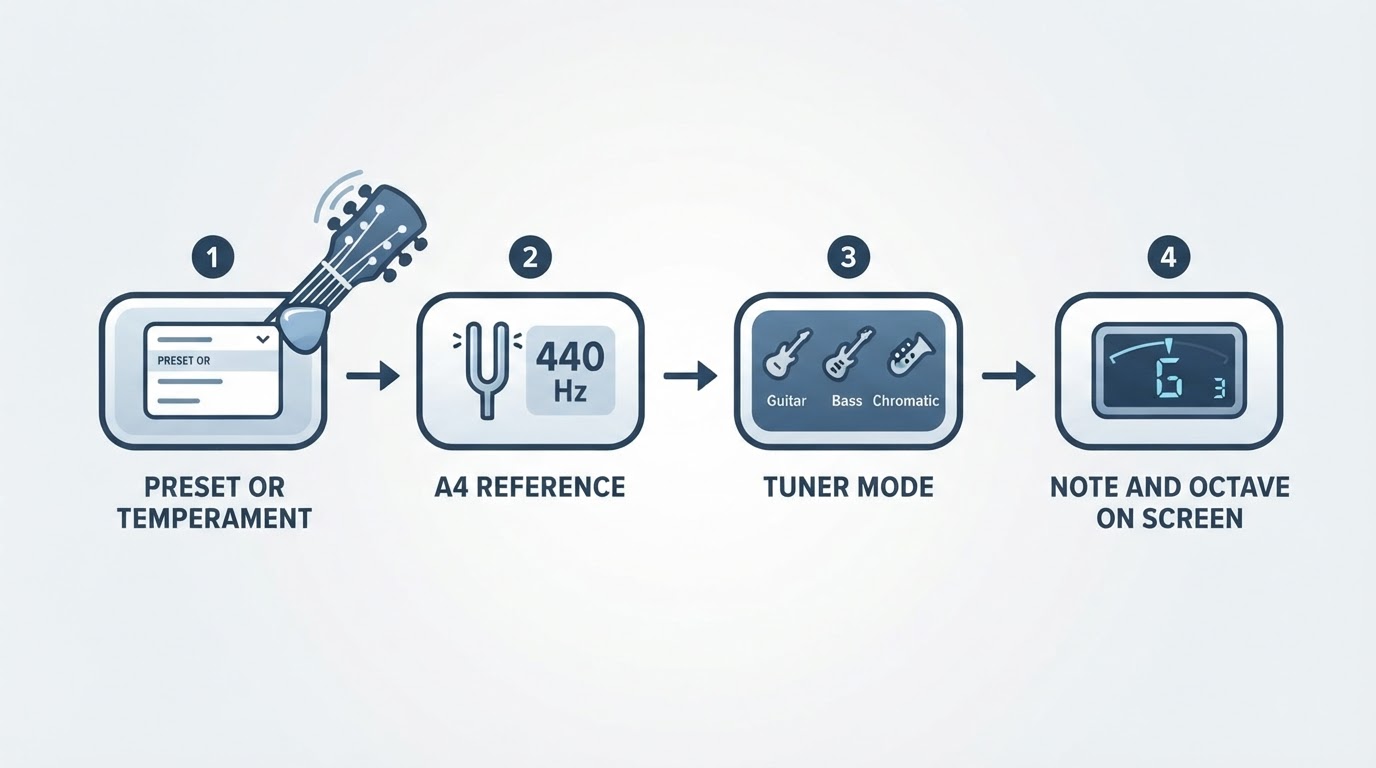
- Set the target to 7-string standard. Choose the BEADGBE or 7-string preset if your tuner offers one. If it does not, keep the notes in view and work from the list: B1, E2, A2, D3, G3, B3, E4. Done when: the target readout for the lowest string shows B1 - not B2, which is an octave too high and far too tight for that string.
- Tune the low B first, with a firm and even pluck. Play the seventh string and let the note ring. Read the display, then move the peg in small increments: tighten when the note is flat, loosen when it is sharp. If you overshoot, drop slightly below B1 and come back up. Done when: the meter centers on B1 and stays centered while the note fades.
- Work up the strings one at a time: E2, then A2, D3, G3, B3. Mute the other strings lightly with your fretting hand and pluck only the string you are tuning. Use the same small peg moves and the same steady attack you used on the low B. Recheck the seventh string after this run, because added tension can pull it a little flat. Done when: each of these strings centers on its note and the low B still reads B1.
- Finish with the top E4 string. Tune the first string the same way, then play the sixth and first strings together and listen for a clean octave instead of a slow beat. Done when: E4 centers on the display and the octave against E2 sounds solid.
- Run one final verification pass, low to high. Play each open string once, in order, and listen without adjusting anything until you have heard all seven. Note which strings drifted, then repeat steps 3 to 5 for those strings only. Done when: all seven strings hold their notes through a slow count, the low B is still on B1, and the E2 to E4 octave is clean.
FAQ: practical pitfalls and honest fixes
Why does my low B sound flabby or keep drifting?
The seventh string is the one most often let down by the set that is on the guitar. A low B that flops, wobbles, or reads sharp on the attack and flat a moment later is usually too light for the scale length it has to cover. Move up to a proper 7-string set or a heavier B string, pick closer to the bridge with a firm, even stroke, and give the note a moment to settle before you trust the reading. A string that creeps flat again and again may not be seated cleanly at the peg or the bridge, so check both before you tune it once more.
Why do I keep overshooting the note?
Turn the peg a fraction of what feels necessary, and always finish from below. Small moves keep you from jumping past the target, and if you do land above it, loosen past the note and bring it back up to pitch. Tuning upward keeps the tension seated on the peg and makes the reading hold longer. The same habit carries over to alternate tunings: take the string down first, then tune up to the new note.
Why does the tuner jump between notes or hear nothing?
Most of the time the room is the problem, not the tuner. Work somewhere quiet, keep fans and air conditioning away from the microphone, and set the guitar on a stable surface so handling noise does not reach the mic. Pluck one string at a time at a moderate volume; hitting the string hard right next to the microphone can overload the input and make the reading jump. If the meter still flickers, confirm the browser is using the input you expect and that no other application is holding the microphone.
My new strings will not stay in tune yet. What now?
Fresh strings stretch, and the low B stretches more than the rest because it is the thickest string carrying the most tension change. Tune all seven strings, play for a few minutes, then run the final pass again. Two or three rounds of playing and retuning are normal before the instrument settles. If a string keeps dropping after that, check that it is wound cleanly around the peg and seated at the bridge.
Common alternate 7-string tunings
Tuning | Notes, low to high |
|---|---|
Standard (BEADGBE) | B1, E2, A2, D3, G3, B3, E4 |
Drop A | A1, E2, A2, D3, G3, B3, E4 |
Half step down | A#1, D#2, G#2, C#3, F#3, A#3, D#4 |
Full step down | A1, D2, G2, C3, F3, A3, D4 |
Drop G | G1, D2, G2, C3, F3, A3, D4 |
Drop A is the one you will meet most often in heavy music: the seventh string drops a whole step to A1 while the top six stay in standard, so familiar shapes still work and a one-finger power chord sits on the bottom strings. Half step down and full step down lower every string by the same interval, which keeps your shapes intact but changes the tension and feel of the whole neck. Drop G takes the seventh string down two whole steps. When you change tunings, move one string at a time, retune from the low string upward the way step 3 describes, and check the low B again at the end.
Optional: tune in the browser with nothing to install
If you would rather not install an app, GuitarTuner․io publishes free online microphone tuner pages for 7-string tuning presets, and each page lists the target notes for that tuning. There is nothing to download before you start, and the low-B-first routine above works exactly the same there. Treat it as one option among many: any tuner that clearly shows the target note will get you to BEADGBE.
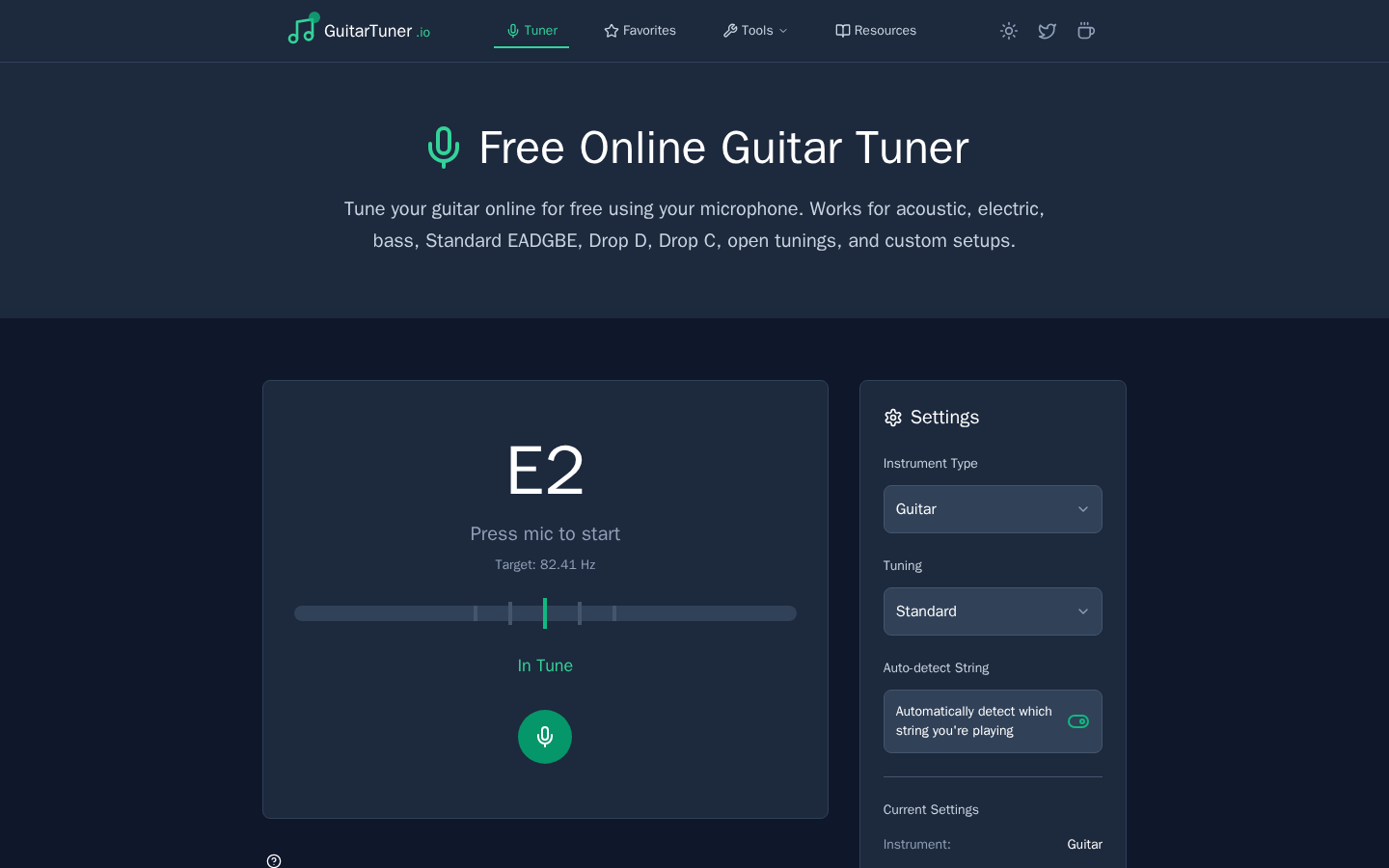
Desktop homepage first screen: H1 'Free Online Guitar Tuner', live tuner widget (E2 string, Press mic to start, Target 82.41 Hz, Start listening, string selector, Settings panel) a
Quick checklist
- Microphone allowed and the tuner listening - one string at a time.
- Target set to 7-string standard: B1, E2, A2, D3, G3, B3, E4.
- Low B tuned first with firm, even plucks and small peg moves, finishing upward.
- Strings tuned upward in order, then the low B rechecked.
- Final pass complete: all seven strings hold, the low B sits on B1, and the E2 to E4 octave is clean.