Where Is the String Actually Stuck?
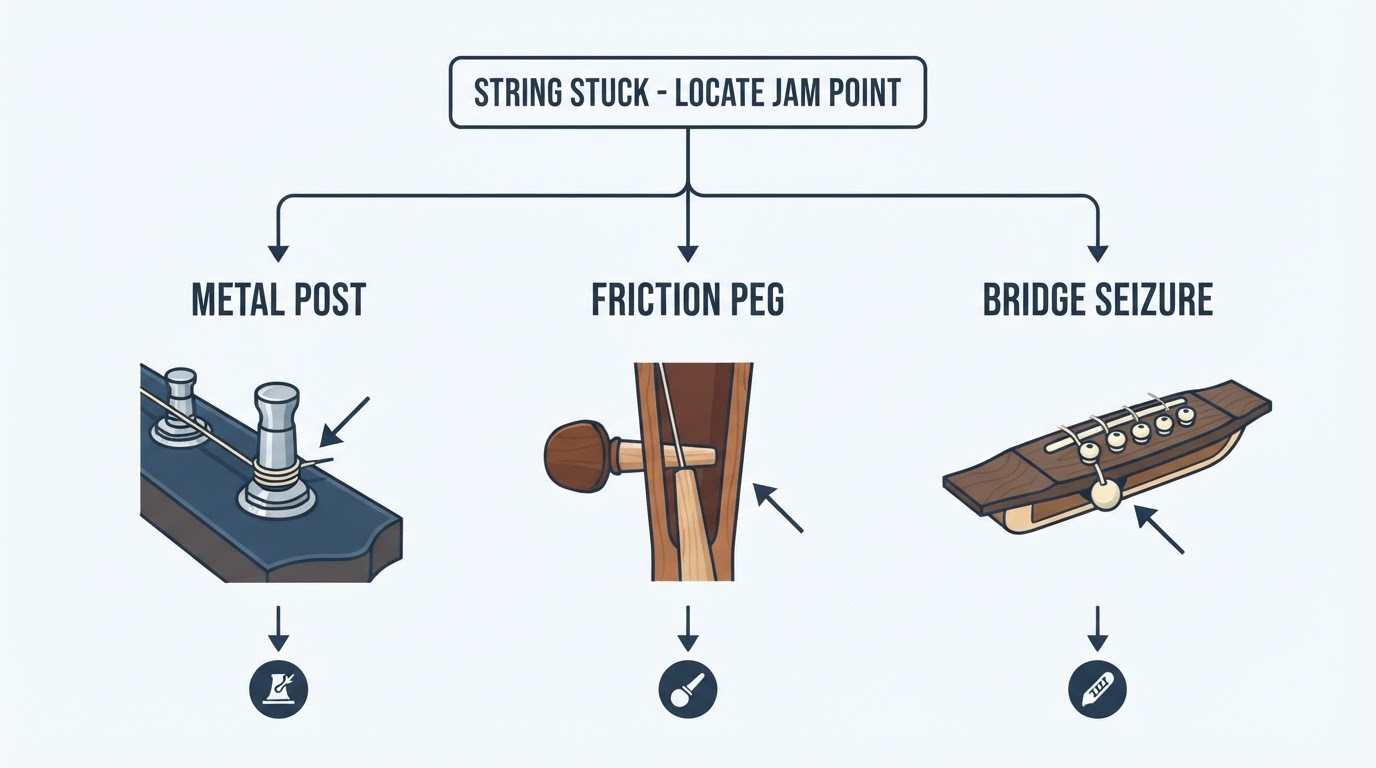
The fix depends on which part is holding the string:
- A machine-head post. Metal posts with a hole for the string, turned by a button behind the headstock, trap a string in its own wraps, a kinked tail, or a locking clamp that is still engaged.
- A wooden friction peg. Violins, many ukuleles, and older folk instruments use tapered wooden pegs that hold pitch by friction in a pegbox, and wood does not tolerate force.
- The bridge end. A rusted ball end can wedge into a bridge plate or pin, so the string feels stuck at the peg while the real resistance is at the other end.
Slack first, then identify the jam. That order alone prevents most of the damage this job can cause.
Slack the String Before Anything Else
Never pull, pry, or cut a string that still holds tension. Detune until it is completely slack; StewMac's tuning-machine instructions start every removal that way.
Turn the button in small steps, not one hard twist. A broken string's remaining piece may still be hooked under the wraps, so stay gentle.
Free a String Trapped on a Machine-Head Post
Match the tuner type first
Look at the back and top of the post: three locking designs are common, and each releases differently (StewMac):
- Rear thumbwheel or screw clamp — a knurled wheel on the back.
- Top-locking cap or collet — a knurled cap on top, with no wheel behind it.
- Auto-locking cam or pin — no wheel and no cap; the post grips the string internally as you tune up.
A standard split post has no clamp; match the hardware first, because the wrong move can damage a working mechanism.
Release the clamp, then unwind
- Rear thumbwheel: loosen the wheel by hand until it lets go, then pull the string free.
- Top-locking cap: unscrew the cap a few turns, then slide the string out.
- Auto-locking post: push the string end down into the post to release the cam, then pull it out.
- Standard post: there is nothing to release. Guide the kinked tail back out through the hole instead of dragging the wrap down the post.
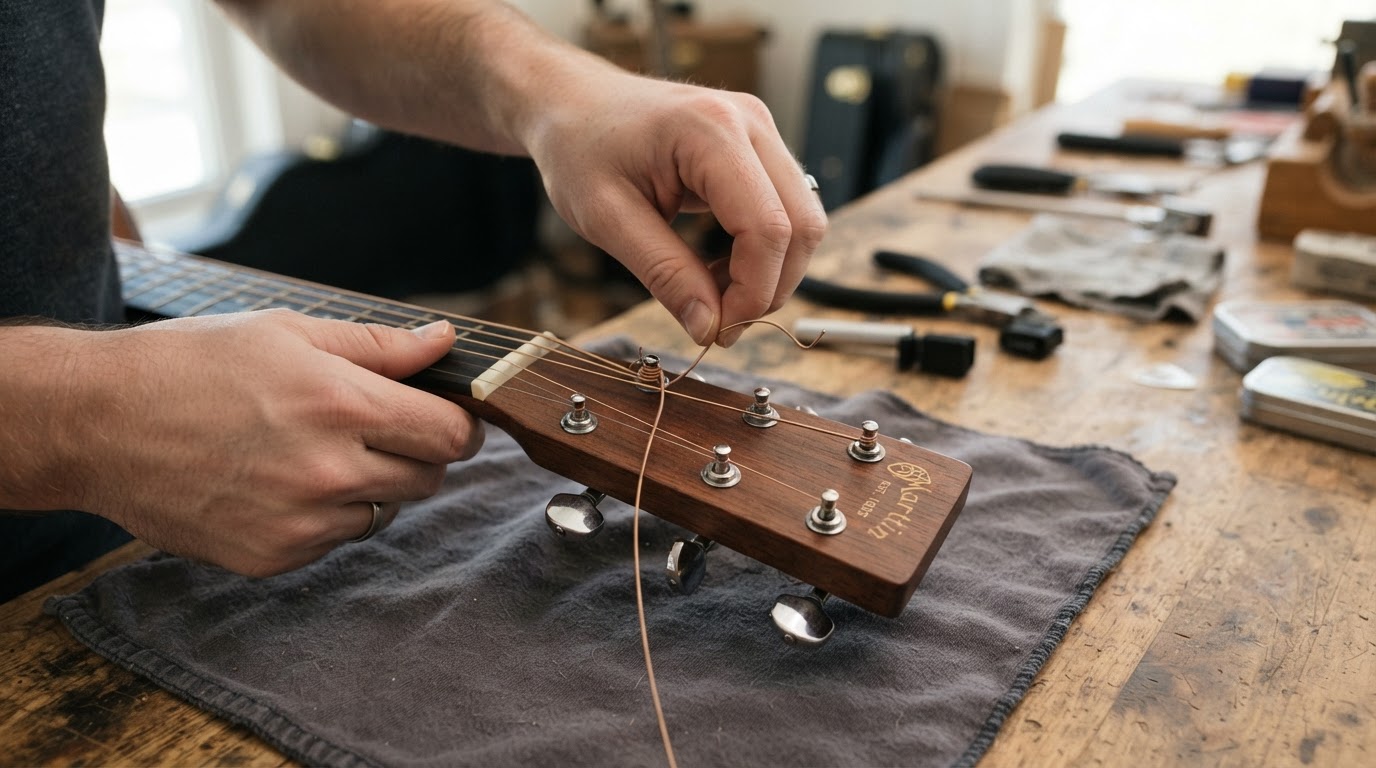
StewMac's instructions draw one useful distinction: if the string is not broken, loosening the tuner releases the lock. If it is broken, loosen a slotted cap with the screwdriver or coin it was designed for. Support the tuner body with your free hand, and keep a cloth under the headstock.
Know when to stop
Hand the guitar to a technician when the cap or thumbwheel will not release with finger pressure, the button feels gritty or binds, the post flexes, a bushing lifts, or the wood around the tuner moves. More force is not a diagnostic test; a bent post or cracked headstock costs far more than a professional look.
Wooden Friction Pegs and Bridge-End Jams
Friction pegs hold by contact with a tapered hole, so the pegbox, not the string, sets the limit. Support the pegbox with one hand, unwind with the other, and never lever the peg sideways against the wood. A jammed peg is a wood-repair job, not a string job.
At the bridge, keep the string slack and ease the ball end out in a straight line. Prying at an angle can chip a bridge plate, crack a pin, or scratch the top.
What Not to Do
- Do not pull or cut a string while it is under tension.
- Do not use pliers on a locking thumbwheel, cap, or button; finger-tight is enough.
- Do not drill, heat, or lever a bushing to free a string.
- Do not assume one extraction method fits every tuner design.
- Do not force a stiff tuner; stiffness is a symptom, not an invitation.
Quick Diagnostic: Match the Symptom to the Cause
Symptom | Likely cause | Safe first move | Stop when |
|---|---|---|---|
String will not leave a locking post | Clamp still engaged or auto-lock cam biting | Match the release type and loosen by hand | The cap or wheel will not release with finger pressure |
Tail catches on a standard post | Kinked end hooked under a wrap | Slack fully, then guide the tail back through the hole | The post flexes or the hole catches every attempt |
Resistance comes from the bridge | Ball end seized or wedged in the plate | Keep tension off and ease it straight out | Prying starts to mark the wood |
New string will not hold pitch | Binding or grime in the nut slot | Check and clean the slot before retuning | You are forcing the tuner to compensate |
After the String Is Out
Inspect the post before fitting a new string. A fingertip around the hole will find the burr or rough edge that would snap the next string in the same place. Wipe off grime, and check the nut slot if the old string was binding.
Fit the string for your tuner type. Standard posts want two or three neat downward wraps; locking posts want almost none, because extra wraps defeat the clamp (StewMac). Tune up, stretch two or three times, and retune until it holds.
Use a tuner to bring the new string back to pitch, then check whether the post holds it. If the post itself moves, see the separate loose tuning peg guide.
See a technician if the post is bent, the button turns roughly, a bushing has lifted, or the surrounding wood has moved.
FAQ
Should I cut a stuck string to get it off faster?
No. Detune it to slack first. Cutting a string under tension is unsafe, and even a broken string can be wrapped tightly enough to need the clamp released first.
Why won't my locking tuner release the string?
Check which release your tuner uses. A rear thumbwheel, a top cap, and an auto-locking cam each let go differently, and a broken string may need a slotted cap loosened with its intended tool. If it still will not release by hand, stop.
Do I need a new tuner after a string gets stuck?
Usually not. Most stuck strings leave no damage once the trapped end is out. Repair or replace the tuner only if the post is bent, the mechanism feels gritty, or the wood around it has cracked.