Start With the Symptom That Moves
With the guitar at pitch, hold the button of the suspect tuning machine and press it gently in every direction. If the whole tuner shifts, rocks, or rattles against the headstock, the looseness is mechanical and external: a button screw, a mounting screw, or a bushing. If the body feels solid but the string loses pitch when you bend or strum, the peg is probably not the loose part. Good tuning machines rarely slip on their own; most drift comes from how the strings are wound, friction at the nut, or a loose screw in the chain (StewMac).
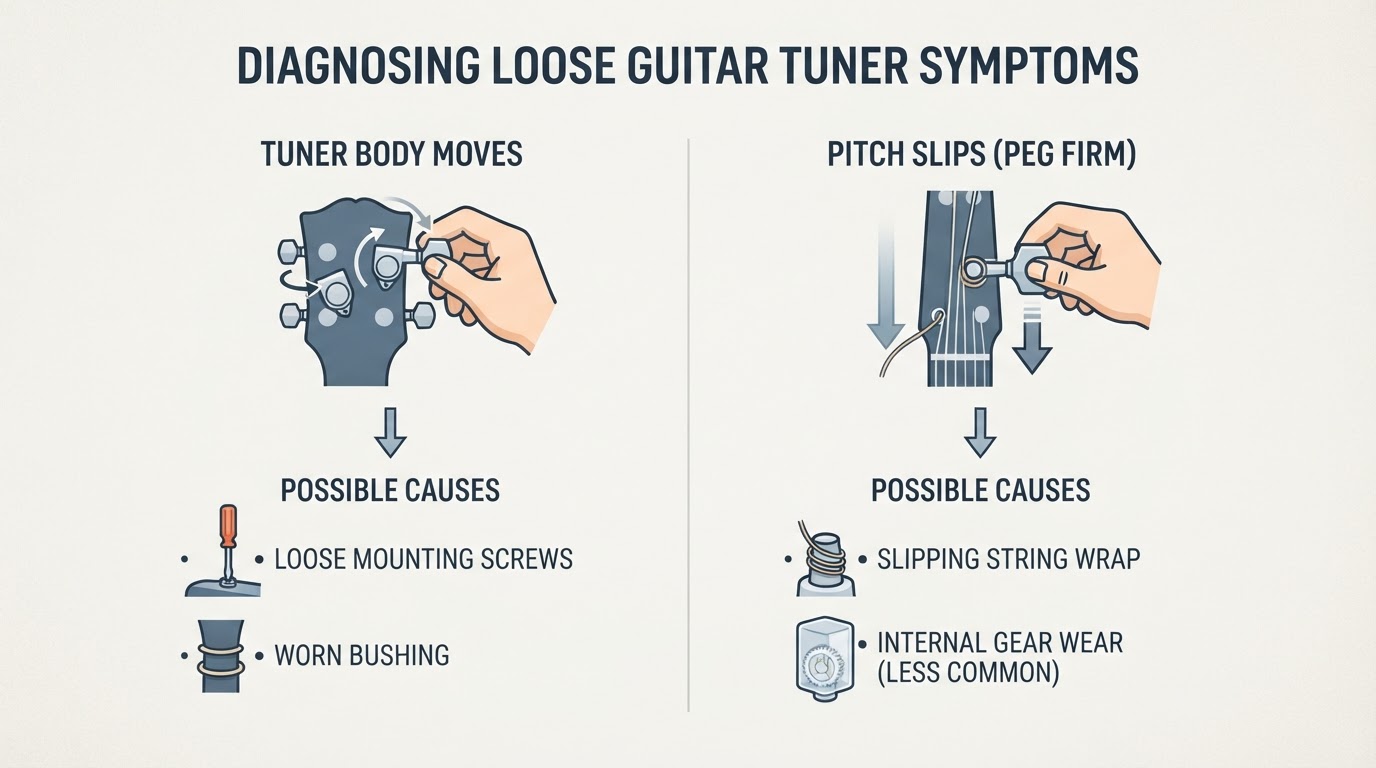
A second test separates friction from normal play: tune the string slightly flat, then bring it up to the note. Slack in the gear train, which luthiers call backlash, is normal and string tension should take it up. If the button turns but the pitch refuses to follow, something inside the machine is binding or slipping (lutherie.net).
The Five Parts Behind a "Loose" Tuning Peg
What you notice | Probable part | First check |
|---|---|---|
Button wobbles before the string moves | Button (knob) screw | Snug the button screw until the wobble stops |
Whole machine shifts or rocks against the back of the headstock | Mounting screws | Snug each mounting screw a little at a time |
Post has play, or a rattle near the face of the headstock | Bushing and bushing nut | Check the bushing is seated and its nut is snug |
Button turns with a lag and the pitch responds late or not at all | Cog (gear) adjustment screw | Check cog screw tension on an open, serviceable machine |
Pitch drops while the peg feels firm | String slip at the post | Inspect the winds for slack, wraps, and direction |
That is why "how to tighten tuning pegs" is the wrong first question on its own. Sealed, die-cast machines on an electric guitar usually expose only the button screw, the mounting screws, and the bushing nut where fitted; an acoustic's open tuners also expose the cog screw. Either way, tighten only the part that moved.
How to Fix a Loose Guitar Tuning Peg Safely
Work down the list and stop as soon as the looseness is gone.
1. Button (knob) screw. If the button wobbles before the string moves, snug its screw until the wobble disappears and the button still turns freely. Too loose and the tuner can slip; too tight and it becomes hard to turn (StewMac).
2. Mounting screws. Press the machine flat against the back of the headstock and snug each mounting screw a little at a time. If a screw keeps spinning without feeling firm, the hole is stripped; stop and read the repair section below.
3. Bushing and bushing nut. Where a threaded bushing sits on the face of the headstock, the nut should be snug against the face, not cranked down. If the bushing rocks or the post leans, that is an alignment problem, not a torque problem.
4. Cog adjustment screw (open, serviceable machines). If your tuner maker documents an adjustment, follow that model's instructions. Do not turn an exposed gear screw blindly; overtightening can bind or damage the gear. If the button turns but the cog does not, ask a repair tech to inspect it (lutherie.net).
5. String slip at the post. If the peg feels firm but the pitch drops, suspect the winding. Follow the string or tuner maker's winding guidance, keep wraps neat, stretch a newly fitted string gently, then tune up to pitch rather than down to it. Locking and conventional tuners need different winding approaches (StewMac).
Use a tuner to check whether the pitch actually changes while the hardware moves. If the hardware feels solid but a new string still will not hold pitch, see our guide to a guitar that will not stay in tune after restringing.
What Not to Do
Do not tighten every fastener you can reach. The screws and nuts around a tuning machine are a tension adjustment, not a clamp: an overtightened cog screw binds the gear, an overtightened bushing nut distorts the fit it should secure, and a screw driven hard into a stripped hole will not hold. There is also no universal torque value to aim for, because tuner designs differ. Aim for firm and stable, with the button still turning smoothly; if you have to force anything, stop.
When a Guitar Tech Is the Safer Choice
Hand the guitar to a repair tech when:
- A post or bushing leans or wobbles, especially with the strings off. That points to a fit problem whose usual fix is plugging and redrilling the holes (StewMac).
- A mounting screw spins because the hole is stripped.
- Gear teeth are worn, chipped, or cracked, or the machine stays stiff after cleaning and adjustment. A tuner that will not turn freely even without string tension has a structural problem, not a lubrication problem (lutherie.net).
- The headstock face is cracked, or a tuner has been forced and damaged.
The same caution applies when the peg looks fine: if it is firm, the winds are neat, and the guitar still drifts after a restring, the instability is usually in the nut, the bridge, or how the strings were stretched.
FAQ
Can I just tighten the screw on the back of the tuning peg? Only if something is actually loose. Match the symptom to the part: the button screw if the knob wobbles, the mounting screws if the machine shifts, the cog screw if an open machine lags. Tightening the wrong fastener can bind the gear or strip a hole.
Why does my guitar tuning peg keep slipping even after I tighten it? If the machine is snug, the pitch loss is usually elsewhere: check the winding at the post, friction in the nut slots, and whether the strings were stretched, then look for worn gear teeth.
How do I know the tuning peg needs replacing? A firm body, clean winds, and a string that still drifts, or a button that turns without moving the cog, points to internal wear or damage. A wobbling post or a hole that will not hold points to structural damage. Either case is a repair-tech job.