Confirm the sound is friction, not fret buzz
A sliding squeak is friction. As the fretting fingertip travels along a wound string, the ridges of the winding catch the skin and produce a short, high scrape. The wound strings on your own guitar are the ones that can make this sound; a plain, unwrapped string has no winding for the fingertip to catch. On many acoustic sets the lower four strings are wound, while many electric sets use a plain G, so look at the set that is actually on the instrument instead of assuming a fixed list. The noise is most obvious during position changes, when the hand has to move while the fingertips are still touching the strings.
Fret buzz sounds different: a metallic rattle that continues while the note is ringing, because a vibrating string is touching a fret it should clear. A ringing open string is different again. That is a pitch, not a scrape, and it usually appears after you leave a string you did not intend to play. The sound of fingers sliding on guitar strings belongs to the first group: short, tied to movement, and gone as soon as the hand stops.
A quick listening test separates them. Play a single note and hold it. If the noise happens only while the hand is traveling and stops once the new note is fretted, you are dealing with finger friction. If the rattle continues under the sustain, stop chasing squeak and check the guitar's setup instead. The same split applies after a string change, and this guide to guitar string buzzing after restringing walks through the order of checks, one string or all strings, open or fretted, before anyone reaches for a truss-rod wrench.
Reduce pressure before you change anything else
The most useful adjustment is the one under your fingers. Guitar World editor Jamie Dickson describes slides that sounded tolerable in the room but intrusive on tape, and in his interview with Martin Simpson the advice he passes on is to fret as close behind the fret as possible, where the note needs less pressure to sound. Less pressure means less friction when the finger moves. That is a limited professional recommendation rather than a measured result, but it points at the variable you can change immediately: how hard the fingertip presses.
Fretting closer to the fret also makes it easier to sound a note without gripping hard, so the habit of pressing harder to compensate for a finger that sits too far back becomes less necessary. If your fingertips are landing in the middle of the fret space, try moving them closer to the fret before changing anything on the guitar.
Release, move, then refret
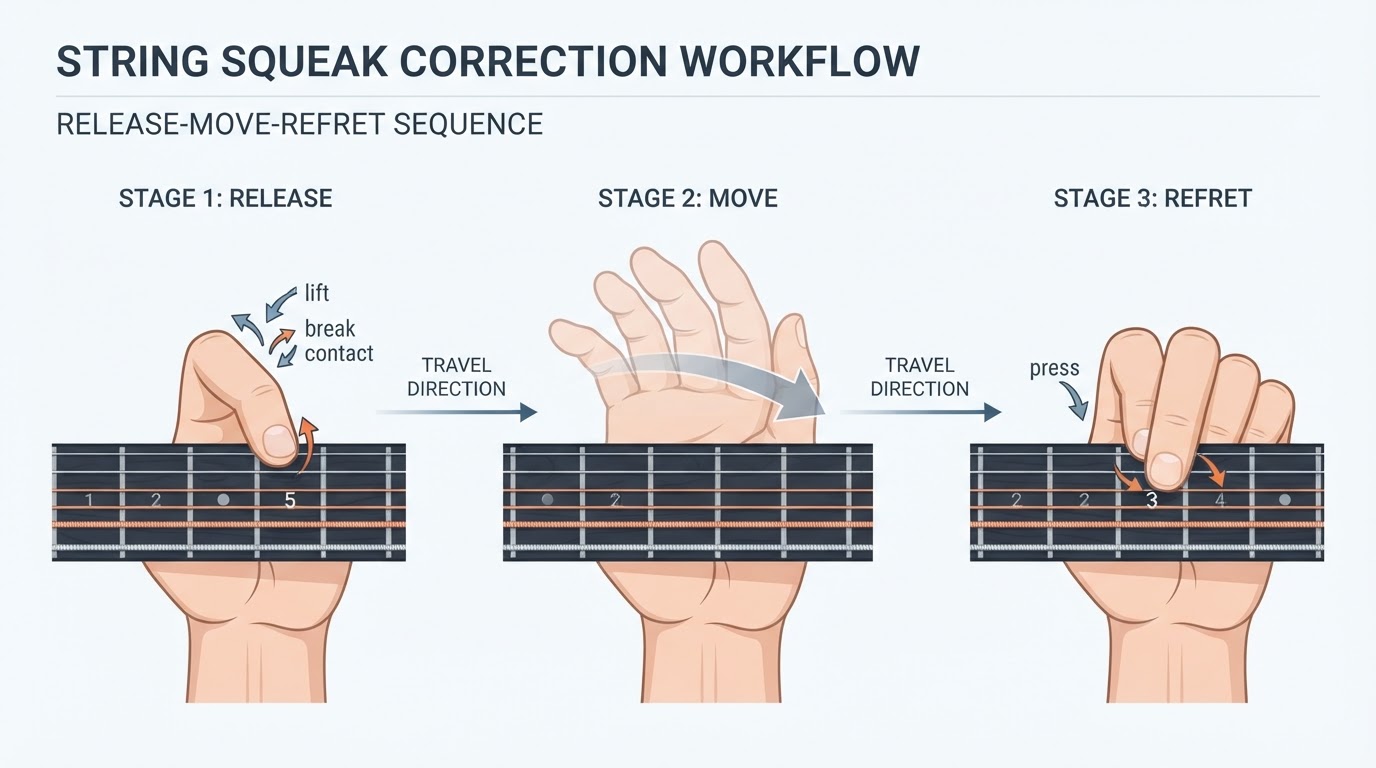
Treat each noisy position change as three separate actions instead of one slide:
- Release. Let the fingertip come off the winding just enough to break contact. You do not need to lift the whole hand, and on a continuous musical slide you should not.
- Move. Travel to the new position with the hand while the fretting fingers are light or clear of the strings.
- Refret. Land close behind the new fret and add back only the pressure the note needs.
The fingertip comes off the winding instead of dragging along it. That is the whole mechanism: friction needs contact, and the release removes contact for the fraction of a second the hand is in motion, which is where a lot of the scrape is generated.

To calibrate the refret, start at the ordinary pressure you would use for a comfortable, clean note, then ease off gradually until the note just begins to rattle. Add back only enough pressure for the note to sound cleanly again. That is your working pressure for that fret and string, a repeatable self-check rather than a measurement.
The sequence is small enough to rehearse without a guitar in your hands and specific enough to aim at the source of the noise. Run it slowly on the one chord change that squeaks most, then on the next.
Keep the slides the music actually needs
A continuous slide is supposed to keep the finger on the string. That contact is what makes a slide sound like a slide, and on wound strings it will produce some noise no matter how tidy the technique is. The goal is not a silent guitar; it is control over which noises reach the listener.
Where a slide is essential, the finger has to stay in contact, so the useful question is which fingers really need to travel and whether a different fingering can carry the moving line on a plain string. A momentary lift of the fingers that fret the wound strings, while the slide itself continues on the plain strings, is one option when the music allows it. Rewriting the passage so it does not need the slide at all is another, provided the slide is not part of the character of the piece. Both are fingering decisions, not a rule to lift every finger whenever the hand moves.
Then deal with what should not ring at all. If an open string sounds after you leave it, rest a free finger or the edge of the picking hand on it. Listen for two separate problems, the scrape of a slide and the unwanted ring of a vibrating open string, because they have different fixes. Some handling noise is normal and often appropriate; the judgment is musical, not mechanical.
A short symptom-and-action table
What you hear | Likely source | First action |
|---|---|---|
High scrape only while the hand moves on wound strings | Fingertip dragging on the winding | Release contact, move, refret behind the new fret |
Metallic rattle that continues while the note rings | A vibrating string touching a fret | Check setup causes before adjusting anything |
A pitched ring after you leave a string | An unmuted open string | Mute it with a free finger or the picking-hand edge |
A click as the finger lands | Landing hard from too far away | Land close behind the fret with less force |
Squeak on one chord change only | Fingering forces a slide you do not need | Refinger the change, or lift the wound-string finger |
Where the exercise fits in your practice session
This is a suggested exercise rather than a tested cure, and it does not come with a prescribed number of minutes or repetitions. The site's practice routine for guitar already sets aside a block for one specific weakness at a time, which makes it a natural place to try the sequence.
Pick one or two noisy shifts from music you actually play. At a slow tempo, run release-move-refret on each one, listening for a note that speaks and for less scrape than before. If a shift is a deliberate slide, keep the finger in contact and accept the sound that contact makes; the sequence is for moves that do not need a continuous slide. Where an open string rings on after you leave it, add a mute with a free finger or the picking-hand edge and listen again.
Judge the result in musical context: fewer interruptions, a note that still sounds, and a transition that no longer pulls attention away from the phrase. Some friction may survive a good take. A scrape that stays audible in a dense arrangement is not by itself proof that the technique is wrong; it may mean the passage needs a different fingering, a quieter moment, or a decision that the noise is part of the performance.
If technique is not enough: one coated-string option
Strings are the second lever, and the honest version is narrower than a shopping list. Elixir states on its product page for Acoustic Phosphor Bronze with NANOWEB Coating that the set reduces finger squeak for performance and recording, alongside a smooth feel and a coating that covers the gaps between the windings. That is the manufacturer's product claim, not a measured reduction that this article verified, and it is not a promise of silence. The claim is scoped to that product line, and it says nothing about how every coated string behaves.
If you want to test the claim on your own guitar, change one variable: keep the same gauge. Elixir publishes a gauge chart from Extra Light .010 to .047 up to Medium .013 to .056, so match the gauge you already play unless you deliberately want a different feel and tension. Compare the coated set with your current strings across a few sessions rather than on the first chord, and judge it in the same musical context you care about.
Recording: compare one take with a processed copy
Recording is a secondary branch, and it works best after the playing has settled. What follows is a suggested listening workflow, not a result demonstrated here. Record one take of the passage with the microphone where you normally place it. Keep that raw file untouched, duplicate it, and process only the copy, for example by gently reducing the narrow band where the scrape sits with a tool you already know. Match the two versions at a similar loudness so the comparison is not decided by the copy simply being louder, then compare the same short segment of the same phrase in both.
The point is to hear what the processing changes, not to prove that processing solves the problem. There is no universally correct microphone, EQ or plugin setting for this, and any number presented as one would be invented. What you can judge is whether the copy still sounds like a guitar and whether the scrape you still hear matters in the arrangement. If the raw take already works, leave it alone; natural handling noise often reads as part of a real performance, and a take scrubbed until nothing remains can sound synthetic.
What not to do
- Do not lubricate your fingertips or the strings with household oil. It attracts dirt and changes feel without solving the contact problem.
- Do not file hardware or adjust the truss rod because of an intermittent squeak. A squeak alone is not evidence of a setup fault.
- Do not change string gauge as a universal cure. Gauge changes tension and feel, and it is a separate decision from squeak control.
- Do not buy a new set before you have tried the release-move-refret sequence. Technique is free and reversible.
- Do not lift every finger on every slide. Intentional slides need contact, and the music will tell you when the noise matters.
Controlling string noise on guitar is mostly a matter of contact: how much pressure you use, when you release it, and where you land. Those choices will not remove every scrape from a wound string, and a continuous slide still needs contact. The realistic goal is a performance where the notes stay clear and any remaining friction sits low enough that it stops competing with the phrase rather than with the player.