The direct answer: what most often causes buzz after new strings
Buzz that appears right after a restring usually comes from one of three places: a string that is not seated cleanly or is faulty out of the pack, a neck that moved when the old string tension came off, or a change in string gauge or tuning that altered how much room the strings have over the frets. Taylor Guitars' string-buzz checklist begins with the split that saves the most time: when the noise is isolated to one string, replace that string first, because a string can be worn, kinked, or carry a loose section of wraps on its core that you cannot see, and that alone can cause a buzz (Taylor Guitars).
The fastest way to make the problem concrete is a five-minute map. Tune to the pitch you actually play in, then play each string open and fretted at every position up to the twelfth fret, and note where the rattle appears. A buzz that shows up in one spot and nowhere else is a different problem from a guitar that rattles on every note.
Tune to the intended pitch before you judge anything
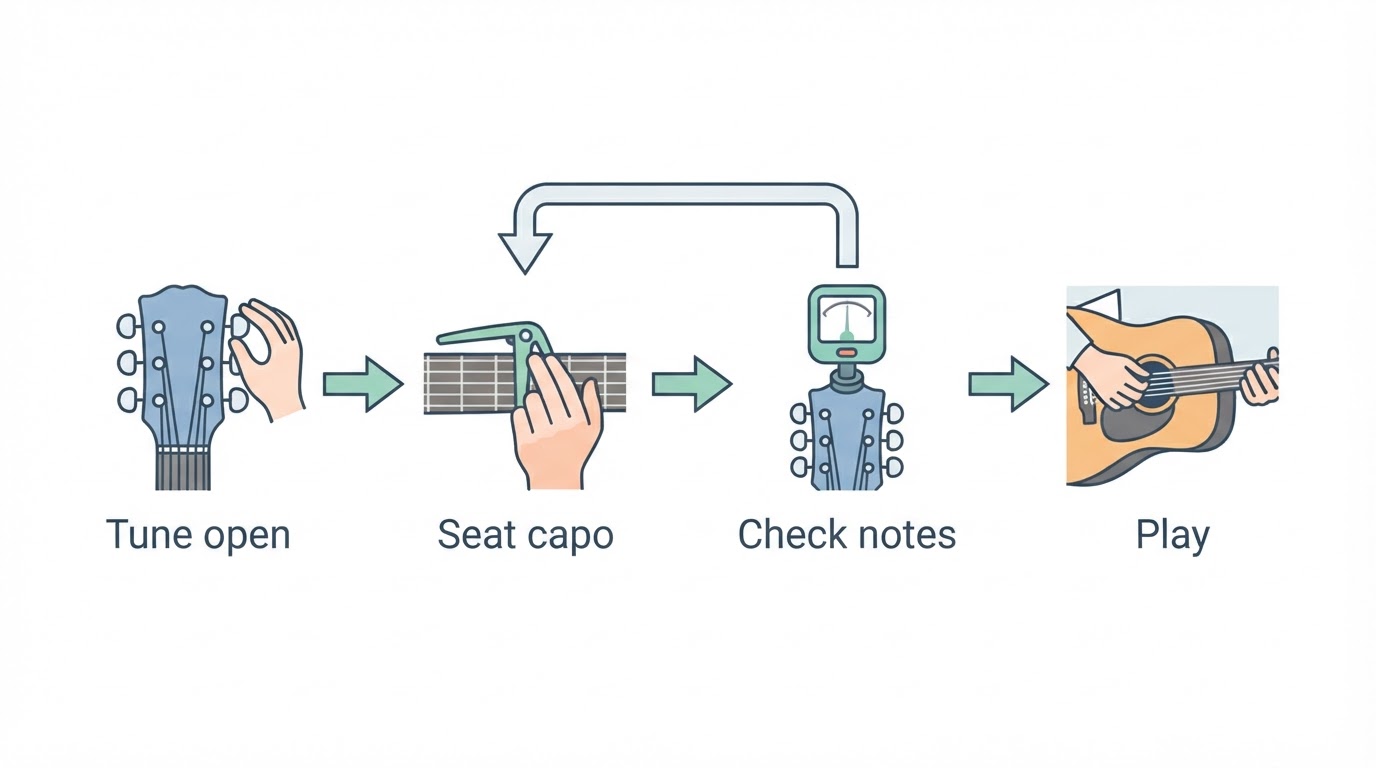
A guitar that is slightly flat will behave differently from one at concert pitch, and if the new set is still settling, the pitch you hear is still moving. New strings stretch and equalize tension during the first session, drifting flat until they are seated (StewMac). Stretch each string gently along its length, retune, play for a few minutes, and repeat until the reading holds steady. That routine removes the most common false alarm.
Pitch drift and buzz are different faults. A string that slips flat during a bend or drifts between songs has a tuning-stability problem; read this site's guide to a guitar that will not stay in tune after restringing for that task. A metallic rattle while the note remains at pitch calls for the buzz checks below. Use a trusted tuner to confirm the pitch before adjusting hardware.
One string or all strings?
This single question splits the likely causes, because strings fail individually while necks move as a unit.
One string buzzes while the rest ring clean
The string itself is the first suspect. Taylor's guidance is to replace that individual string rather than the whole set when the problem is isolated to one string, since a bad string can arrive with a hidden kink or loose wrap. Before opening a new pack, inspect visible seating at the bridge and saddle and check whether the winding at the post is tidy. For the separate winding task, see the site's tuning-peg wrapping guide. Do not assume every buzz comes from the post.
All strings buzz
When every string rattles, look at what changed globally. Taylor notes that taking all strings off can let a neck relax, while a gauge or tuning change alters tension. These can affect clearance across the fretboard. Do not assume the neck is the cause without checking the actual pattern and setup.
Open-string buzz versus fretted buzz
Where the note is played narrows the search further. The map below is a transparent framework rather than a measurement substitute: it tells you which zone to describe if you decide to hand the job to a tech.
If open strings buzz
Open-string buzz points toward the nut end or toward hardware that can rattle. Check how each string sits in its nut slot and on its saddle before you assume the neck has moved: a string that is sitting high, pinched, or not fully down in the slot can buzz on an open note while fretting the same string clears it. Loose parts are the other open-string culprit, because tuner bushing nuts, mounting screws, and saddle screws can vibrate sympathetically at the same frequency as the note. Snug them gently — firm, not overtight — and listen again. Do not reach for a nut file at this stage; slot depth is a measurement, not a guess.
If fretted notes buzz
Fretted buzz is about clearance between the string and the frets. Buzz concentrated in the lower or middle frets can suggest too little relief; an isolated fret can indicate a localized fret issue; upper-register buzz may involve action or fret geometry. These are clues for a setup check, not a diagnosis from location alone. The nut is a more plausible cause when an open string buzzes but the same string plays cleanly when fretted.
A short decision table
What you hear | Most likely cause | Safe next step |
|---|---|---|
One string buzzes, the others ring clean | Kinked or faulty string, poor seating at the nut or saddle | Replace that string, reseat the ball end and saddle contact, then retest |
All strings buzz after the restring | Neck relaxed when tension came off, or a gauge or tuning change reduced relief | Tune to pitch, then have neck relief checked before adjusting anything |
Open strings buzz, fretted notes are clean | Nut slot or saddle seating, loose tuner or saddle hardware | Check seating and snug loose hardware; do not file nut slots yourself |
Buzz in the first few frets when fretted | Relief, action, or a local fret issue | Have relief and fret clearance measured before adjusting hardware |
Buzz only in the upper register | Action at the saddle, or one high fret | Have the action checked; a single high fret needs fret work |
Pitch drifts flat, with no metallic rattle | New strings still stretching at the post and the bridge | Stretch gently, retune, and repeat until the pitch holds |
Use the table as a checklist rather than a diagnosis you have to finish yourself. Its job is to tell you which category you are in, and the last column is deliberately conservative: the checks you can do safely at home are seating, winding, tuning, and snugging hardware.
What the new strings changed: gauge, tension, and relief
Relief is the slight forward curve built into a neck so the strings have room to vibrate. Strings pull the neck forward, the truss rod pulls it back, and the two forces are balanced around a particular set of strings. Change the strings and you can change that balance. Taylor notes that taking all the strings off at once allows the neck to relax, and that restringing does not always bring the neck back to exactly where it was. Switching to a different gauge or tuning also changes the tension, and a neck that backbows slightly will buzz along its length.
If the neck has moved, a truss-rod adjustment may be part of the repair, but relief must be measured before turning anything. Do not crank a truss rod to chase a buzz. If you have not measured relief or have not adjusted this instrument before, ask a qualified repair tech.
Humidity and the neck: the slow variable
Wood moves with moisture, and a neck can change even without a string swap. Taylor includes dry conditions in its buzz checklist. If the season or room humidity changed, note that context and follow the guitar maker's care guidance rather than adjusting hardware immediately.
When to stop and let a qualified tech handle it
Stop and seek a setup when the buzz survives tuning and reseating, is isolated to one fret, appears without a string change, or you are considering filing a nut slot or turning a truss rod without measurements. Taylor notes that persistent buzz can require fret or other setup work; that should be evaluated on the instrument rather than inferred from this checklist.
Start with the reversible checks: tune, locate the buzz, inspect seating, and compare the new string gauge with the old set. If the pattern points to relief, fret, nut, or saddle work, bring those observations to a repair tech rather than guessing at an adjustment.