What goes into a complete practice session
Every useful guitar session is built from the same six blocks, whether you have fifteen minutes or an hour. Only the time each block gets changes.
- Tuning check. Confirm the guitar is in tune before you train your fingers or your ear.
- Warm-up. Loosen your hands and set a slow, even standard for everything that follows.
- Chord changes. Drill the movements that songs are actually made of.
- Rhythm work. Practice holding steady time, with or without a metronome.
- Technique. Work one specific weakness, slowly and correctly.
- Song practice. Apply all of it to real music while your attention is still fresh.
The order above is not arbitrary. Tuning comes first because playing in tune is how your ear learns what right sounds like. The warm-up comes second because cold hands play unevenly and grip too hard. Songs come last because they need the pieces you just rehearsed — but the song block is the one that must not disappear, since playing music is the reason the other five exist.
When a day gets cut short, protect the tuning check and the song block. The middle blocks can rotate from session to session.
Tune first: a two-minute check that protects the rest of your practice
An out-of-tune guitar teaches your fingers to grab the wrong places and your ear to accept the wrong pitch. Two minutes now saves a lot of confusion later.
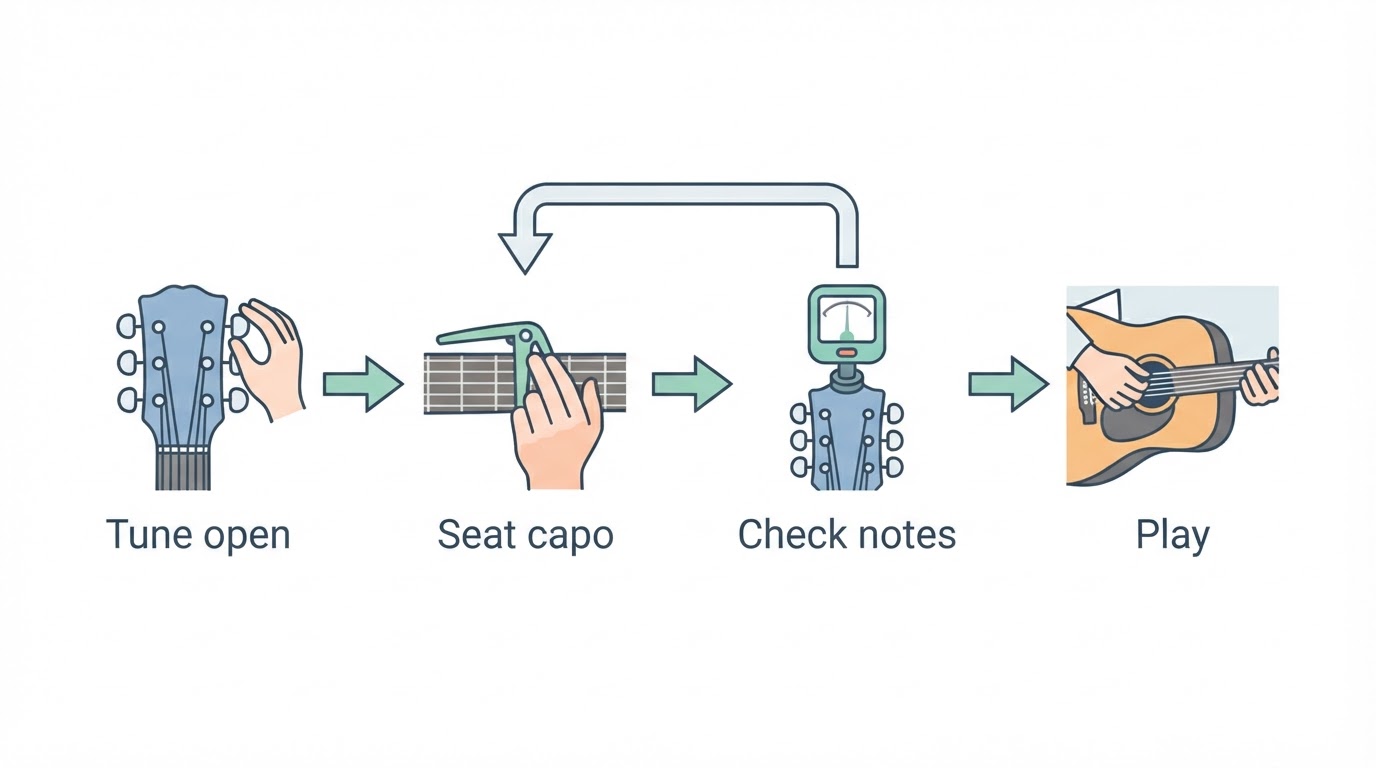
You can do this without buying anything. If you have a reliable reference pitch — another in-tune instrument, a keyboard, a pitch pipe, a tuning fork, or a reference tone you trust — compare one string at a time against it and turn the peg until the wobble disappears. With no reference at all, you can still bring the strings into tune with each other using the relative method: match the fifth fret of the low E string to the open A string, the fifth fret of the A to the open D, the fifth fret of the D to the open G, the fourth fret of the G to the open B, and the fifth fret of the B to the high E. The guitar will feel right and play right, though it may sit slightly away from concert pitch, which matters if you plan to play with other people or with a recording.
Finish by playing an open chord and listening. A tuned guitar rings steady; an out-of-tune one shimmers and beats. If you put on new strings recently, expect to repeat this check once or twice during the session, because new strings stretch as you play.
A five-minute warm-up that gets your hands ready
A warm-up is not a workout. Its job is to bring your hands up to playing temperature without tension, so the rest of the session starts from a calm place.
Spend the first minute away from the strings: shake your hands loose, stretch your fingers gently, and roll your wrists. Then play something slow and even — a chromatic walk up a single string, a one-finger-per-fret pattern, or open strings picked at a steady pace. Keep it quiet and clean, because speed here defeats the purpose. Finish with two chord changes you already know, switching slowly enough that both chords ring clearly.
If your hands still feel stiff at the end, the room is probably cold or your fretting grip is too tight. Ease off until the notes sound with less pressure, then keep going.
Chord changes: how to drill them so songs get easier
Most songs are chord changes with decoration. The cleaner and faster your changes get, the more songs open up.
Pick two chords, set a steady pulse by counting out loud or with a metronome, and change on the first beat of each bar. Play the pair for one minute and count how many changes land cleanly. That count is your baseline, so write it down — the same count next week is how you measure progress. Keep your fingers low and close to the strings between chords; big flying movements waste time and land sloppily. When the pair feels automatic, add a third chord and play the set as a short loop.
Set the tempo where you never miss. A clean change at a slow tempo builds the movement; a sloppy change at a fast tempo builds the mistake.
Rhythm work that builds steady time
Steady time is the skill; the metronome is a mirror. Use it if you have one. If you do not, count out loud, tap your foot, or play along with a recording whose tempo you trust.
Start with a single chord and quarter notes. Count one, two, three, four aloud so your voice, hand, and foot agree. When that feels locked, subdivide: eighth notes (one and two and), then sixteenths, then triplets. Clap the pattern first, then play it on one chord, then move it to a progression. If the click and your hand drift apart, halve the tempo instead of pushing through. Tempo is the reward for steadiness, not the starting point.
Once a simple pattern is secure, drop the click for a minute and bring it back. Landing on the beat when it returns tells you your internal clock is getting better.
Technique: how to fix one weak link at a time
A technique block is five to ten minutes on one specific problem, not a general workout. Choose one item and keep it for the week:
- Alternate picking that catches the wrong string
- Fretting that buzzes because the pressure is uneven
- Barre chords where one string refuses to sound
- String changes and string skips that stumble
- Hammer-ons and pull-offs that fade out
Play the movement slowly enough to watch and hear every repetition, and stop when tension builds in your forearm or shoulder. Ten correct repetitions in a row is a better target than ten minutes of guessing, and one focused fix per week beats five half-learned ones.
Song practice: how to turn the routine into real music
Choose a song that sits slightly below your ceiling — one you can mostly play, not one that defeats you. Split it into sections of two to four bars and loop each section slowly until it feels easy, then join the sections in pairs. Resist starting from the top every time, because that is how the first eight bars get polished while the rest stays rough. Near the end of the session, play a section you enjoy just for the sound of it.
Finish the week by playing one full song without stopping, even if a chord goes wrong. Stumbling through and recovering is a skill that only comes from playing music end to end.
Build a 15-, 30-, or 60-minute routine that fits your day
The blocks scale with the clock: the shorter the session, the fewer minutes each block gets, but none of them disappear.
The 15-minute routine
Block | Minutes | What to do |
|---|---|---|
Tuning check | 1 | Check each string, then play an open chord. |
Warm-up | 2 | Shake out, then a slow single-string pattern. |
Chord changes | 3 | One chord pair at a slow, steady pulse. |
Rhythm | 3 | Count aloud and play quarter notes on one chord. |
Technique | 3 | One weak link, ten clean repetitions. |
Song | 3 | Loop one short section and play it twice. |
The 30-minute routine
The 30-minute routine is the one most players can keep on a weekday, with three minutes of warm-up, five minutes each for chords, rhythm, and technique, and the largest share going to a song.
Block | Minutes | What to do |
|---|---|---|
Tuning check | 1 | Check each string, then play an open chord. |
Warm-up | 3 | Shake out, slow pattern, two easy chord changes. |
Chord changes | 5 | One chord pair, then add a third chord. |
Rhythm | 5 | Quarters into eighths on a short progression. |
Technique | 5 | One weak link, ten clean repetitions. |
Song | 8 | Loop one section, then join two sections. |
Buffer | 3 | Absorb overruns so the song block survives. |
The 60-minute routine
The 60-minute routine is for days when you have real time. It gives the biggest share to songs and rhythm, the two blocks that take the longest to improve.
Block | Minutes | What to do |
|---|---|---|
Tuning check | 2 | Check each string, then recheck after the warm-up. |
Warm-up | 5 | Stretch, slow pattern, two easy chord changes. |
Chord changes | 8 | Two pairs, then a four-chord loop. |
Rhythm | 10 | Subdivisions and a progression at a steady tempo. |
Technique | 10 | One weak link, with a slow drill and a tempo check. |
Song | 20 | Loop two sections, then play the whole song once. |
Buffer | 5 | Absorb overruns or add a short ear-check. |
Set one weekly goal you can actually hit
A weekly goal turns the routine into one checkable target. Without it, six weeks of practice can pass with nothing specific getting better.
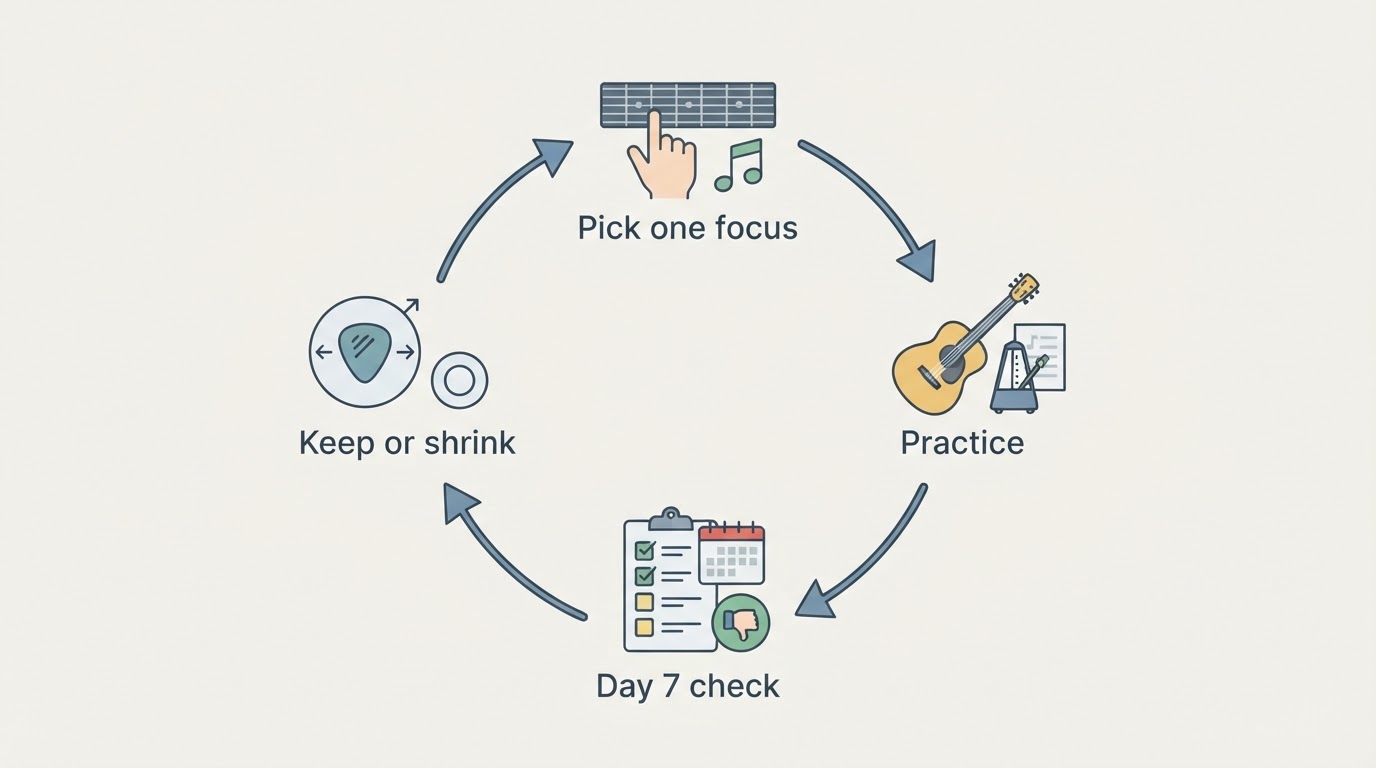
Choose one block, one outcome, and one check. Keep the goal small enough that seven days is enough time to reach it, and keep the rest of the routine steady so you can tell what caused the change. Write the goal somewhere you will see it, and decide now how you will test it at the end of the week. Three examples:
- Land 30 clean C-to-G changes in one minute.
- Play the intro of a song at a steady 70 BPM without stopping.
- Play a barre chord on all six strings without a buzz.
At the end of the week, spend five minutes reviewing. If you hit the goal, raise it a little or move to a new weakness. If you did not, shrink it — halve the tempo, cut the section in half, or pick a simpler song. A goal you keep missing is a goal that was set too large, not proof that you cannot improve.
How to stay consistent when motivation drops
Motivation follows action more often than it comes first, so consistency is mostly about lowering the cost of starting.
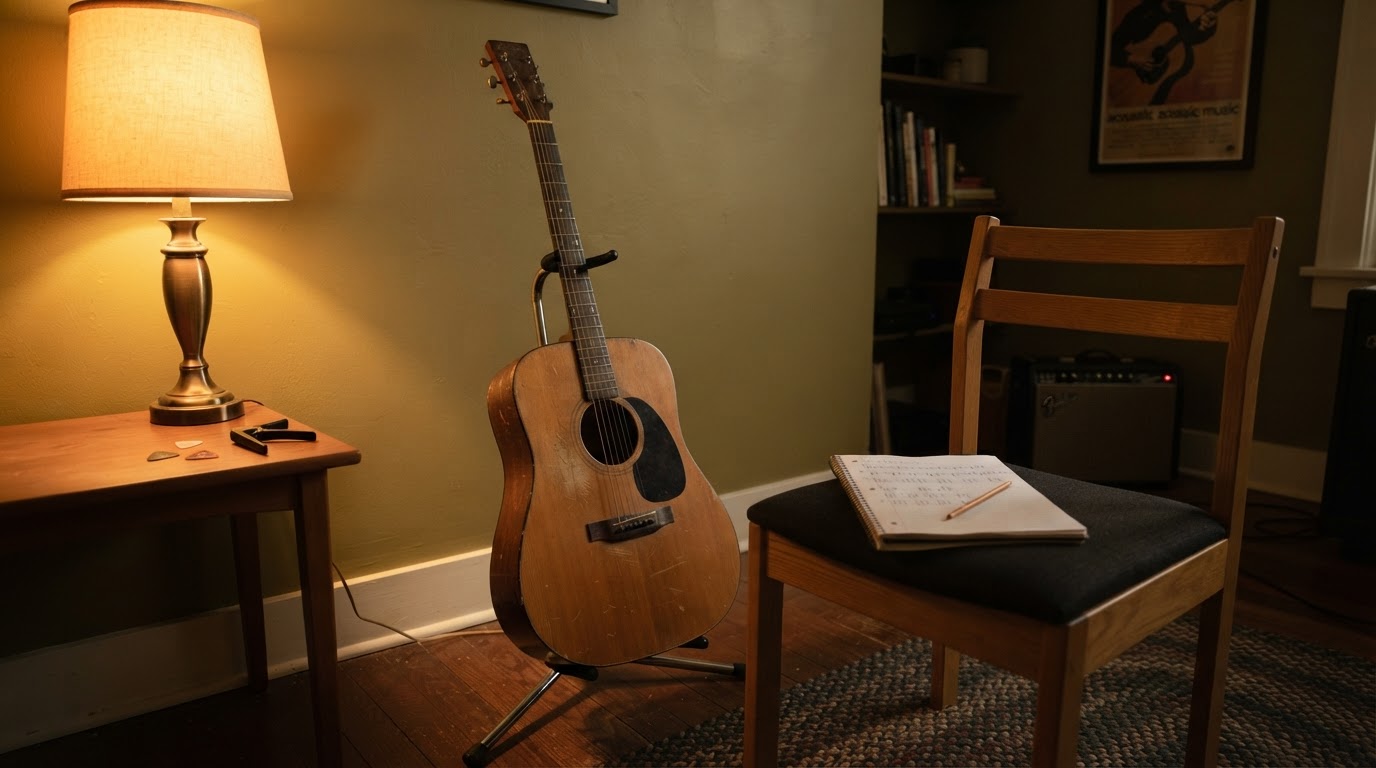
Make starting the session as easy as possible. Leave the guitar out of its case on a stand, keep the picks and notebook in the same place, and practice at roughly the same time each day so the decision is already made. On low-energy days, do the 15-minute version and stop; a short session keeps the habit alive, while a skipped day starts a slide. If you do miss a day, do not double the next session to catch up — just resume the normal routine. A calendar with one mark per practice day gives you a visible streak that is surprisingly hard to break.
Rest is part of the plan. Sore fingertips and tired hands need a day off, and a planned rest day is not the same as falling off. If practice feels like a chore for more than a week, the routine is probably too long or too repetitive; shorten it and put the song you most want to play back into the plan.
Common mistakes that quietly waste practice time
Most wasted practice is not laziness. It is a handful of habits that feel productive.
- Practicing at performance tempo before the notes are secure, which builds hesitation instead of speed.
- Playing through mistakes instead of stopping to loop the two beats that keep failing.
- Starting every song from the top, so the opening gets polished and the ending never does.
- Skipping the tuning check, then wondering why the chord shapes sound wrong.
- Practicing without any pulse, which makes timing a surprise in front of other people.
- Changing the routine every few days, which resets progress and hides what is working.
- Drilling what you already play well because it feels good.
- Practicing with tense hands, which limits speed and invites strain.
- Spending practice time hunting for tabs and gear instead of playing.
None of these habits are dramatic, and that is exactly why they last. Fixing one of them usually does more than adding a new exercise.
What progress looks like after a month
Progress in guitar is uneven, so it helps to know which signals to watch.
- Your chord-change count goes up without the tempo feeling harder.
- One section of a song holds together at a steady tempo, and the whole song survives when you play it through.
- The routine runs without you checking the time every few minutes.
- Your hands hurt less at the end of a session because you press the strings more lightly.
- The technique item from this week shows up in a song you are playing, which is the point of the block.
A flat week is normal and usually means the goal is too big or the routine too long, not that you stopped improving. Shrink the goal, keep the song block, and give it another week.
Where GuitarTuner.io fits into this routine
Everything above works with a guitar and a bit of time. If you would rather keep the tuning check and the practice tools in one place, GuitarTuner.io is a free browser tuner that listens through your microphone and shows whether a string is sharp, flat, or in tune, so you know which way to turn the peg. The pitch detection runs in the browser, and there is no account, no paid upgrade, and no app to download, so it opens on a phone, tablet, or computer, and it keeps working without a connection once the page has loaded. The same site also keeps a metronome and a chord reference alongside the tuner, so you can move from tuning into the rhythm or chord block without switching tabs. If you already have a tuner and a metronome you like, keep using them — the routine works either way, and the song block is where the real progress happens.
Start tonight with the shortest version
Pick the 15-minute routine, run it three days in a row, and see what gets easier. Once the order feels natural, move to 30 minutes and add time to the block that needs it most. The schedule matters far less than showing up with a guitar that is in tune and one section of a song you want to play.