Stop Tightening and Detune First
When a string snaps at the tuner, stop adding tension. A detached string no longer holds normal tension, so there is nothing to slacken on the loose wire; detune the intact replacement or the other tensioned strings before you inspect anything under load. Turning the peg harder to chase a pitch that will not arrive concentrates stress at the weakest point between post and nut, which is where the next break happens. Keep your face clear of the string line while you release tension; a plain string can move quickly when it lets go.
This matters most with a brand-new string: if one snapped while tuning, do not fit another and lean on the peg until it sounds right. New wire settles after fitting, and the failed string shows where the last one parted.
Find the Exact Break Point Before You Restring
Stretch the broken string out and find where it parted. That location is your strongest clue: the post, nut, string tree and bridge each ask for a different response.

Illustrative editorial image, not a photograph of a real test.
Where it broke | What it points to | Safe next step |
|---|---|---|
At or inside the post hole | A burr at the hole, or a kink or overlapping wind | Detune, inspect the hole, restring with clean wraps; see a technician if it recurs |
At the nut or string tree | A slot too tight, dry or worn for the gauge | Check the gauge fits; do not file the slot |
Near the ball end, at the saddle | A sharp or burred saddle edge | Inspect it; a technician can smooth it |
Over the frets, mid-string | A burred fret, or an old and corroded string | Check the string's age and the fret under the break |
A burr is a possible cause, not a diagnosis from a break elsewhere.
Four Checks Before You Blame the String
1. Confirm the Pitch and the Octave
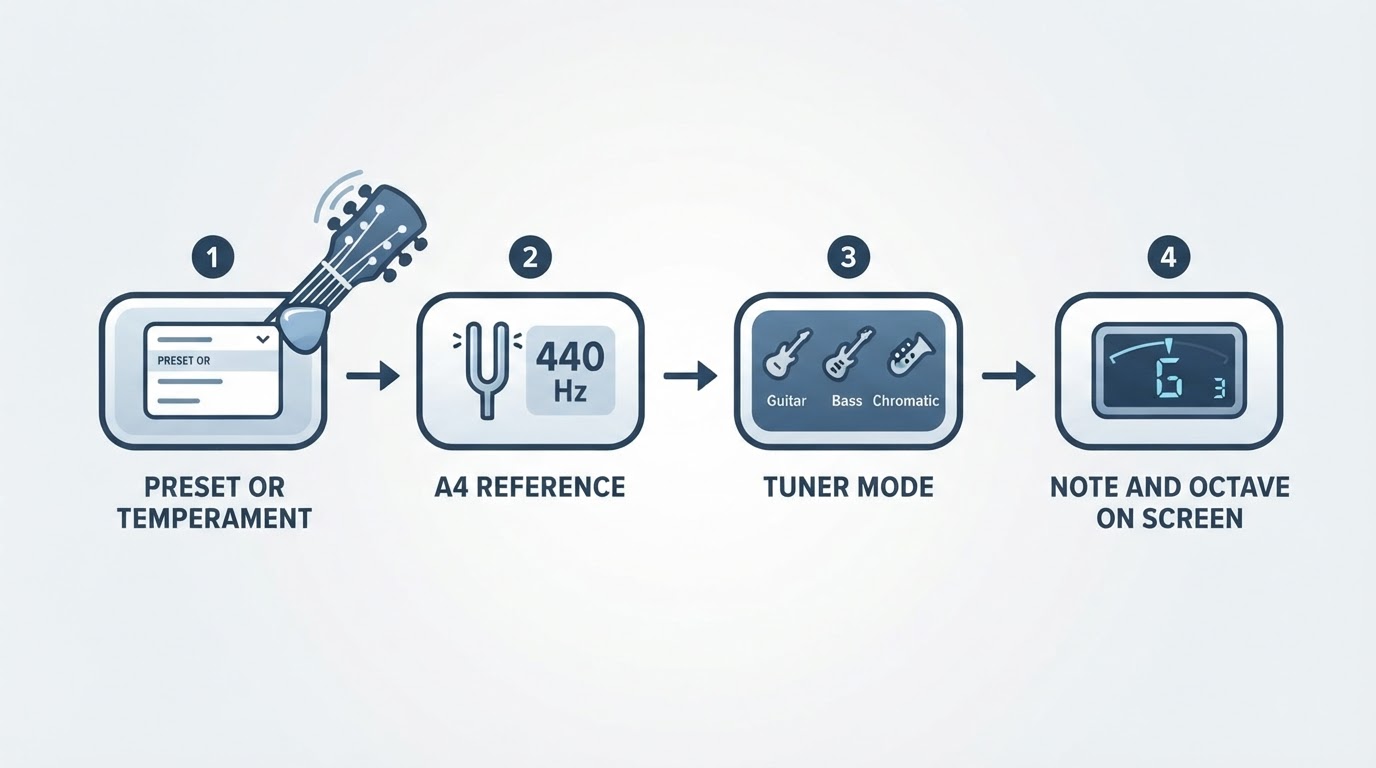
A string tuned to the wrong octave can carry greatly increased tension and break at the post even when the hardware is fine. Check the note you are aiming for against a suitable reference rather than trusting your ear at the peg, and stop if the string feels unexpectedly taut. Some tuners show only the note class, so an E reading alone does not confirm the octave; verify the octave against a reference you trust, and never keep tightening to chase a note you may be misreading. If a clip-on tuner is giving unstable readings, it is worth checking the usual clip-on tuner problems before you blame the string.
2. Compare the String Gauge With the Nut
Heavier gauge strings wear on the nut and leave rough spots, as Fender notes, and Ernie Ball's guidance agrees: slots must be sized for the strings you use. If you changed gauge recently and the break is at the nut, suspect that mismatch before the tuning machine.
3. Look at the Winds and the Bend at the Post
Ernie Ball advises at least three-quarters of a turn around the post so tension does not terminate at a kink; kinked wire is weakened at exactly that point. Inspect the removed string's end for a sharp kink, and check the coils left on the post for crossing or overlap. How the string is wrapped around the tuning peg decides whether the load spreads along the post or concentrates in one spot. If your guitar has locking tuners, follow the clamp instructions for that model. Fender explains that a locking tuner holds the string in place, so it needs no more than a single wind; that is not a reason to over-tighten the clamp, which can mark or kink the string.
4. Inspect the Post Hole Without Filing It
Fender notes that burred edges inside the tuning posts, along with dirt buildup, can cause breakage. A cotton swab through the hole is a reasonable check, but stop at inspection: smoothing a burred post is a technician's job, and freehand filing or drilling can ruin it. A break far from the post does not prove it is burred.
Preventing the Next Break
Fit new strings cleanly, then stretch them so they settle into the nut and saddle slots. Ernie Ball warns that overshooting the stretch can break or dull the string. Wipe strings down after playing and replace them when they look or sound dead; Fender points out that steel rusts, and finger residue and humidity speed that up. A new set drifting flat as it settles is no signal to keep cranking the peg.
When to Hand It to a Technician
Repeated breakage at the same tuner, a suspected burr, or a nut slot that needs adjusting belongs with someone who can measure and dress it. Ernie Ball recommends a professional luthier or technician for nut or saddle repairs unless you have solid experience, because improper filing or sanding can permanently damage the instrument. If a fresh string keeps breaking at the post despite clean winds, the correct gauge and a confirmed pitch, stop replacing strings and have the hardware inspected.