What D Standard Tuning Is on a 6-String Guitar
On a six-string guitar the open notes become D2 G2 C3 F3 A3 D4, counted from the thickest string to the thinnest. Standard tuning is E2 A2 D3 G3 B3 E4, so each string sits two semitones lower while the interval pattern between strings stays the same. Fender's alternate tuning guide describes D standard as tuning the guitar down a full step.
Because the intervals do not change, familiar chord and scale shapes still work; they simply sound a whole step lower. A shape that reads as an E chord in standard tuning sounds as a D chord in D standard. If you follow tab written for standard tuning, the music comes out a step low unless you transpose it or tune back up.
String | Standard | D standard | Calculated target |
|---|---|---|---|
6 (thickest) | E2 | D2 | 73.42 Hz |
5 | A2 | G2 | 98.00 Hz |
4 | D3 | C3 | 130.81 Hz |
3 | G3 | F3 | 174.61 Hz |
2 | B3 | A3 | 220.00 Hz |
1 (thinnest) | E4 | D4 | 293.66 Hz |
Those frequencies are calculated for 12-tone equal temperament with A4 = 440 Hz, as reference targets rather than measured readings.
How to Tune a 6-String Down to D Standard
Tune one string at a time with the others muted, lowering the pitch toward each target.

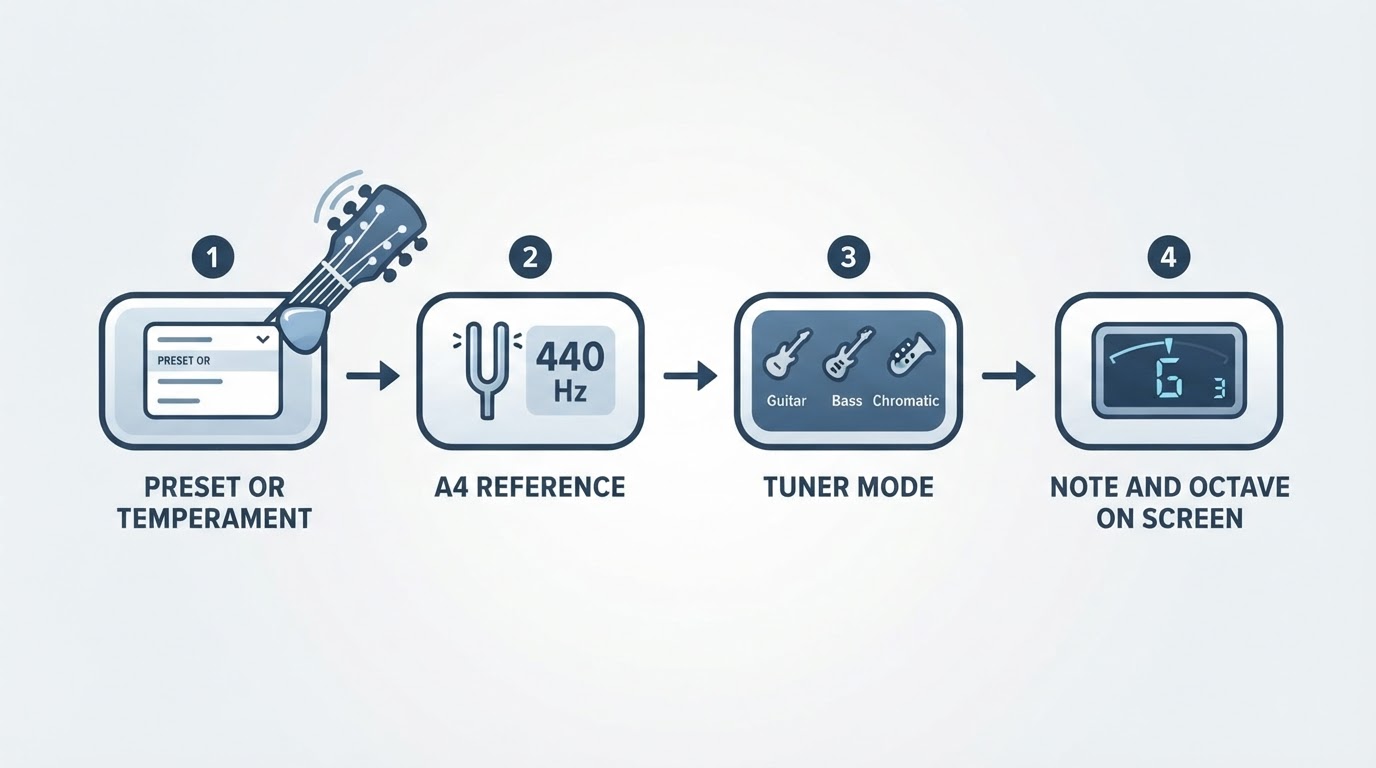
- Set the reference. Use a chromatic tuner, or another trusted reference, and confirm the tuner is set to A4 = 440 Hz if that option exists.
- Drop the sixth string first. Lower E2 to D2, two semitones, and let the reading settle before moving on.
- Continue up the strings. Take A2 to G2, D3 to C3, G3 to F3, B3 to A3, and E4 to D4. Every move is one whole step.
- Recheck the whole set. Go back through all six strings once more and correct any that moved while you tuned the others. If a string keeps drifting, follow the string maker's or guitar maker's guidance on settling and stretching rather than inventing your own routine.
- Finish with a sanity check. The sixth and first strings should both read D, two octaves apart as D2 and D4.
Reading a Tuner Below Standard Pitch
Many clip-on and app tuners default to standard tuning, so a preset may still look for E2 when the string is heading to D2. Switch to chromatic mode, or pick each target note by hand, and check the octave number on the display. In D standard the fourth string is C3, not D3; a display showing D3 there means that string is a whole step sharp. The thickest string should read D2 and the thinnest D4, two octaves above it.
If you are unsure which tuning you landed in, you can check it with the tuning identifier.
D Standard vs Drop D vs Open D
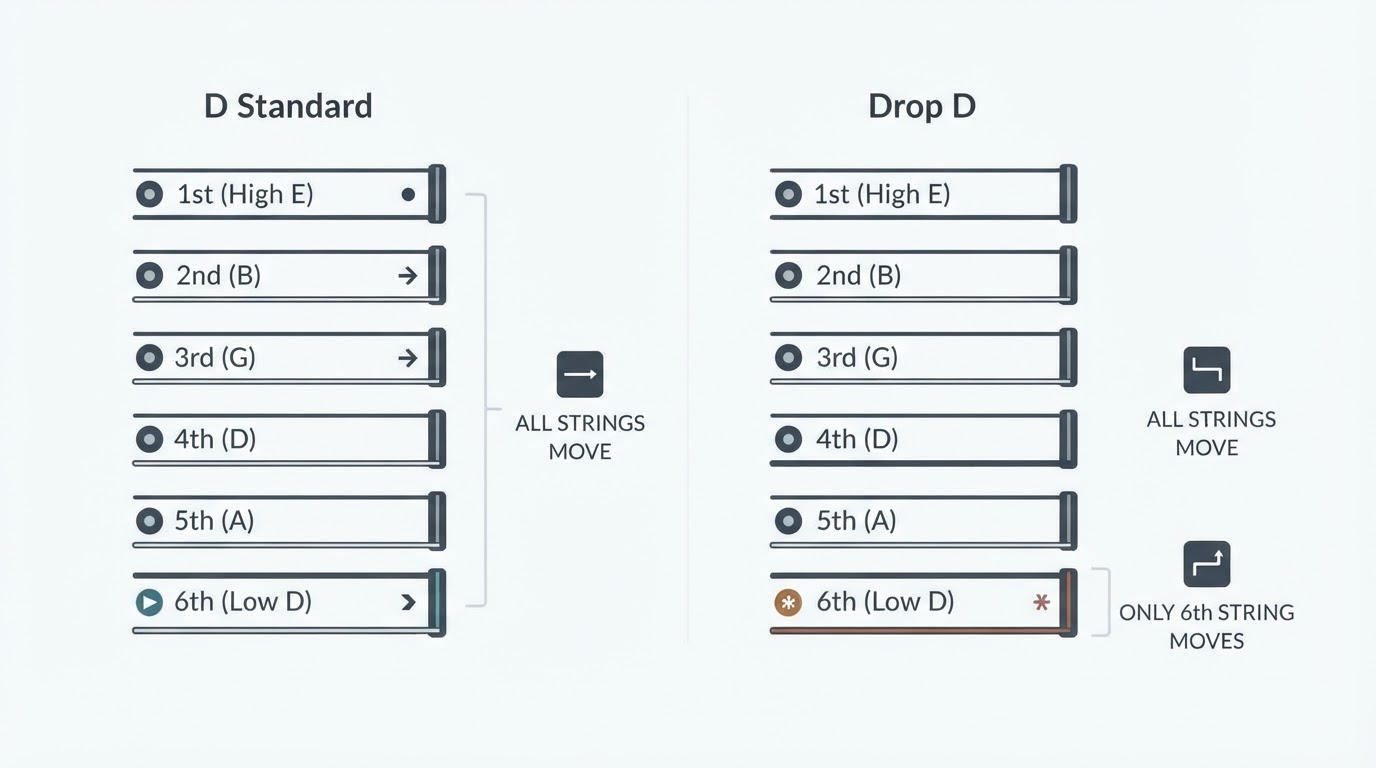
The three names get mixed up because all of them put a D in the bass, but the other strings tell you which one you are in.
Tuning | Open notes, low to high | What moves |
|---|---|---|
D standard | D2 G2 C3 F3 A3 D4 | All six strings down a whole step |
Drop D | D2 A2 D3 G3 B3 E4 | Only the sixth string drops |
Open D | D2 A2 D3 F#3 A3 D4 | Sixth, second and first drop a whole step; third drops a half step |
Drop D keeps five strings in standard tuning, which is why the one-finger power chord works; the Drop D guide walks through the peg-by-peg check. Open D retunes four strings so the open strum is a D major chord, a different job from lowering the whole instrument, and the Open D guide lists its reference notes and a no-tuner method. In D standard the open strings do not spell a D major chord, so do not expect the same open strum.
Setup Checks After Tuning Down a Whole Step
At the same scale length and string gauge, a lower target pitch means lower tension on every string. That is a prediction from how strings behave, not a verdict on your guitar, and it does not guarantee buzz or require a particular fix.
Play before changing anything. Check the lowest strings for fret buzz when you pick firmly, listen for a ping at the nut while turning a peg, compare a fretted note at the 12th fret with the harmonic above it, and, if the guitar has a floating tremolo, see whether the bridge still sits level. Each result is a clue; none of them, on its own, tells you to turn the truss rod.
There is no universal string gauge for D standard. A heavier set can bring tension back toward what you feel in standard tuning, but it can also bind in nut slots cut for lighter strings and change relief and intonation. If you change gauge, have the nut, relief and intonation checked rather than assuming the swap is complete.
When to Stop and Have the Guitar Checked
Persistent open-string buzz, notes that will not intonate at the 12th fret, a nut that pings when you tune, or pitch that keeps drifting after the strings settle are reasons to see a technician. A setup can measure relief, nut slot height and saddle height, and set intonation for your gauge and tuning. Returning to E standard does not guarantee the original setup comes back: a floating bridge may need rebalancing, different strings change tension and relief, and adjustments made for D standard remain until undone.