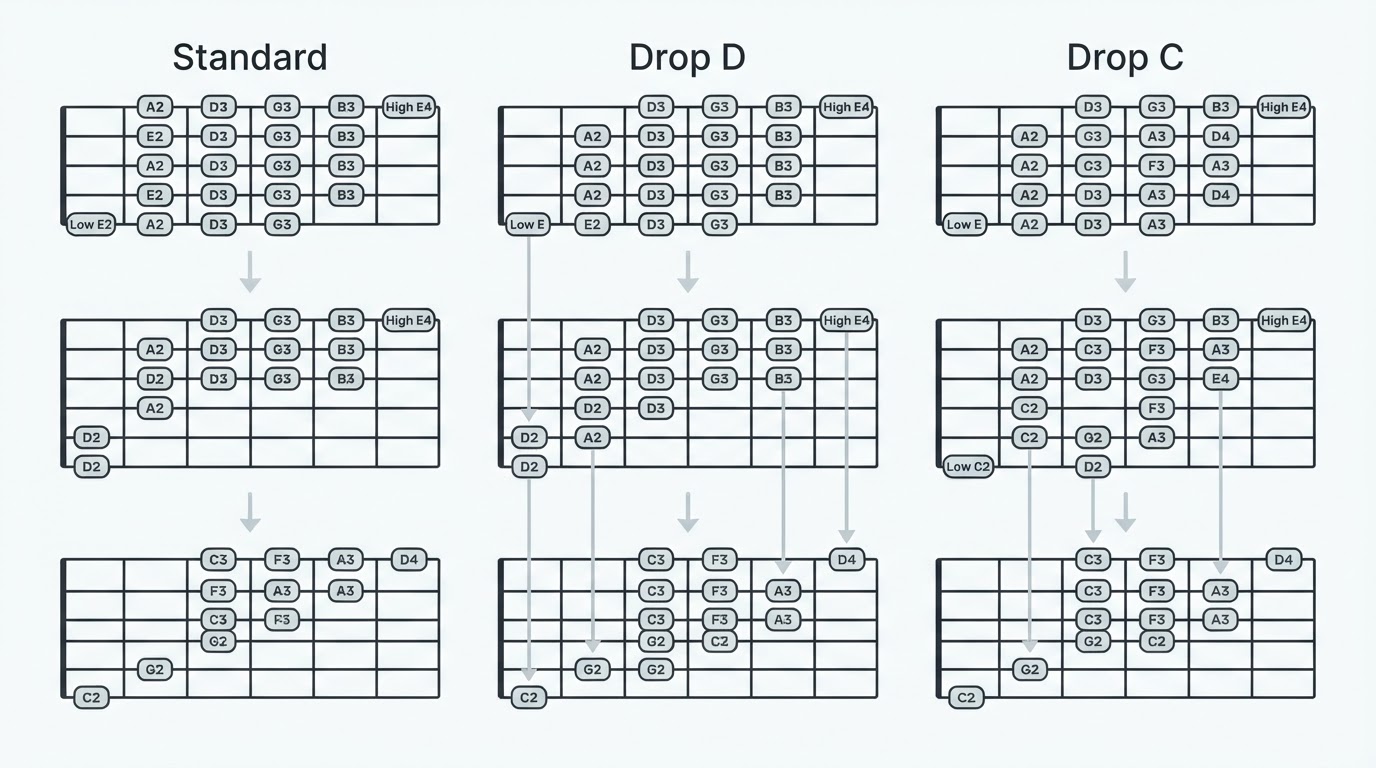
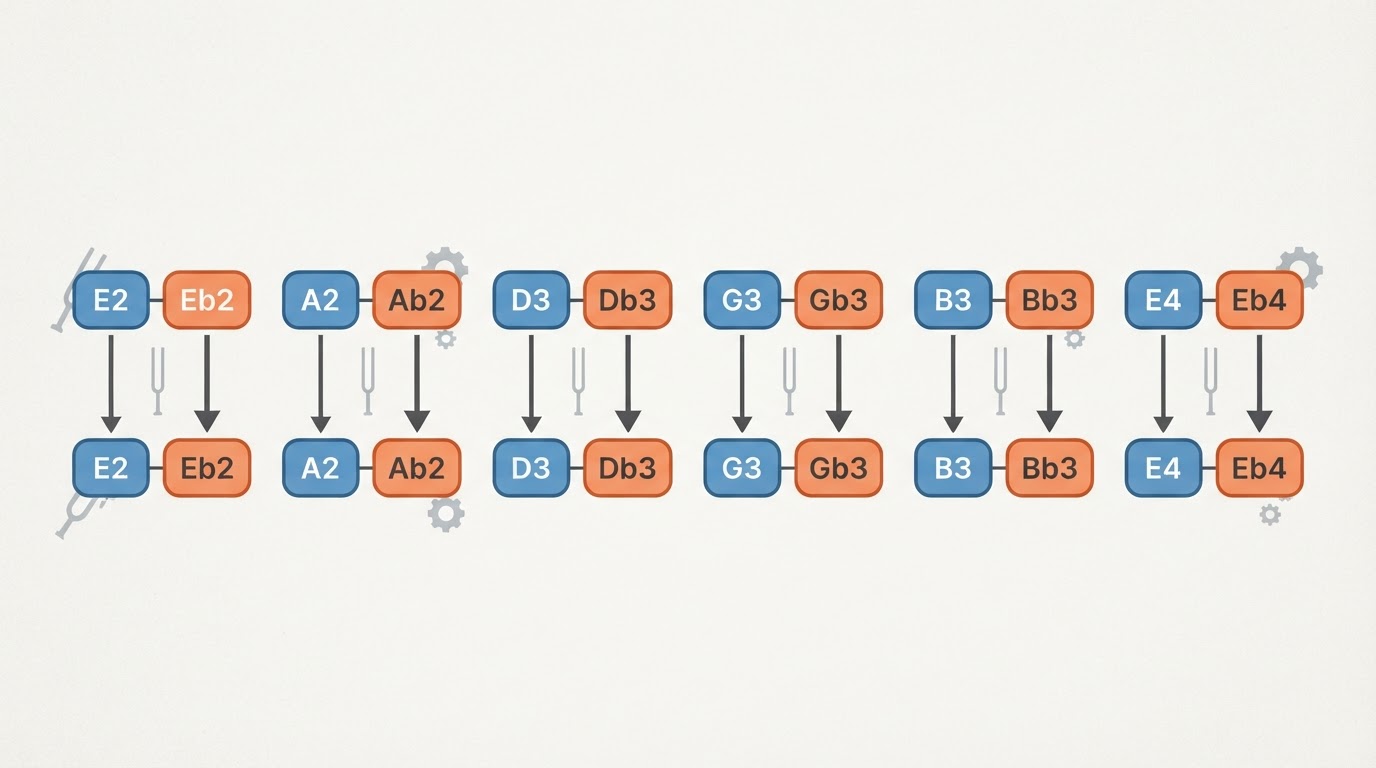
Drop D tuning notes, low to high
Drop D changes exactly one string. The other five stay in standard tuning, and the sixth string - the thickest one - drops a whole step, from E2 to D2.
String | Standard tuning | Drop D |
|---|---|---|
6th (thickest) | E2 | D2 |
5th | A2 | A2 |
4th | D3 | D3 |
3rd | G3 | G3 |
2nd | B3 | B3 |
1st (thinnest) | E4 | E4 |
The full low-to-high reading in drop D is D2 A2 D3 G3 B3 E4. On a tuner, the target is D2, about 73.4 Hz, a little under the 82.4 Hz of the standard low E.
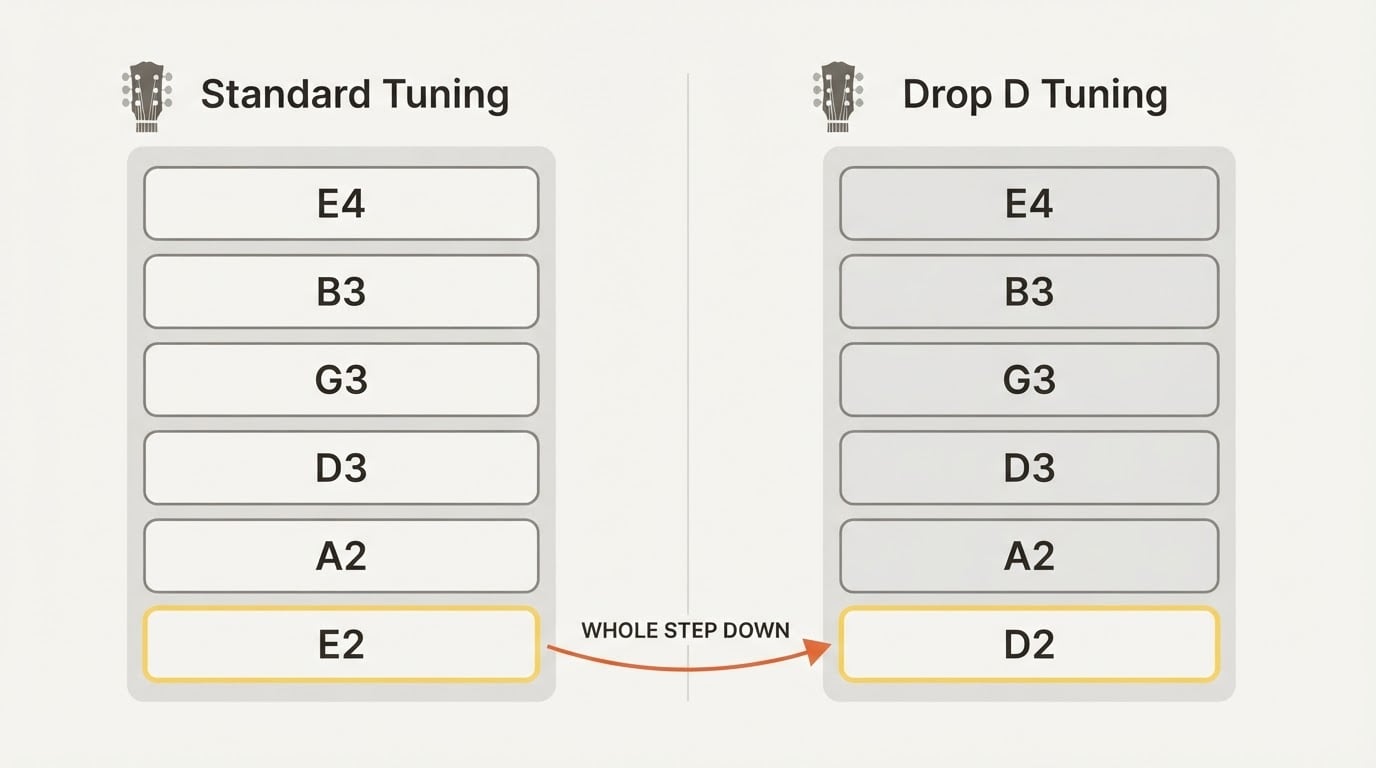
A whole step is two semitones, or two frets. Because only the sixth string moves, it lands on the same pitch class as the fourth string, an octave below it. That one detail explains why the no-tuner check works and why a power chord needs a single finger.
Drop D is not the same as open D. Open D is D A D F# A D, a full D major chord with every string retuned. Drop D keeps a standard layout on five strings and only moves the bass note.
How to drop the sixth string
Start in standard tuning, with the other five strings already in tune. Then work through these steps:
- Find the peg for the sixth string. Pluck the thickest string, touch a tuning peg, and turn it a few degrees. If the pitch moves, that is the right peg. If nothing happens, try the next one.
- Loosen, never tighten. Turn toward the direction that makes the pitch fall. Go slowly and keep plucking the string as you turn.
- Stop on D, not C or C#. You are dropping two semitones, no more. Overshooting by one fret gives you a muddy note that will not sit right against the other strings.
- Check against the fourth string. The open fourth string is D3, exactly one octave above your target. The low string should sound like that note, only deeper.
- Recheck all six strings. The neck relaxes slightly when the low string loses tension, so the other strings can drift a little. Tune them again, then play a chord.
You are done when the low string rings clearly on its own, a power chord across the three lowest strings sounds even, and nothing buzzes. If the low D feels rubbery or rattles against the frets, the string is probably too light for the tuning. A heavier sixth string, or a set sold as a drop-tuning set, fixes most of it. New strings also keep stretching while you play, so expect to touch up the low D a few times before it settles.
How to check drop D without a tuner
You only need the fourth string that is already on the guitar.
Touch a fingertip lightly on the sixth string directly above the 12th fret, pluck the string, then lift the finger away. You will hear a bell-like harmonic one octave above the open string: D3. Now play the open fourth string. The two notes should match, with no slow wobble between them. If the harmonic is lower, the sixth string is flat; if it is higher, the string is sharp.

A second check uses a higher harmonic. The harmonic at the 5th fret of the sixth string should match the harmonic at the 12th fret of the fourth string; both ring at D4. Matching harmonics is more accurate than matching open strings by ear, because the beating between two nearly identical pitches is much easier to hear.
If you would rather skip the ear work, GuitarTuner.io is a free browser tuner with a page for Drop D that lists the target notes and listens through your microphone.
One warning about octaves: the sixth string's D is always the lower one. If you tune the sixth string up to match the open fourth string exactly, you are raising it a fourth above standard, which can snap a string.
The one-finger power chord
In standard tuning a power chord takes two or three fingers. In drop D, lay your index finger flat across the three lowest strings. Those strings now read D2, A2, D3 - root, fifth, and octave - so any fret you press sounds a complete power chord rooted on the sixth string.
Slide that one finger around and the chord changes:
- open strings: D5
- fret 3: F5
- fret 5: G5
- fret 7: A5
- fret 10: C5
- fret 12: D5, one octave up
Strum only the three strings under your finger. Let the edge of the finger lean into the third and second strings to mute them, or rest the side of your strumming hand across those strings. Once the shape is clean, you can move between chords with a single finger, which is why drop D turns up in so many riff-based songs.
Chord shapes and progressions that work
Open chords change more than beginners expect, because the sixth string is no longer an E. These shapes cover most songs in drop D:
Chord | Frets (6th to 1st) | Notes |
|---|---|---|
D | 0 0 0 2 3 2 | D2 A2 D3 A3 D4 F#4 |
D/F# | 4 0 0 2 3 2 | F#2 A2 D3 A3 D4 F#4 |
G | 5 5 0 4 3 3 | G2 D3 D3 B3 D4 G4 |
A | 7 7 7 6 5 5 | A2 E3 A3 C#4 E4 A4 |
B5 | 9 9 9 x x x | B2 F#3 B3 |
The A shape can also be played the standard way (x 0 2 2 2 0), because it sits on the fifth string and never touches the dropped one. The G shape needs a small barre, but it keeps the low root that makes the tuning sound big.
The shapes that stop working are open E major, open E minor, and every E-shape barre chord. In standard tuning those shapes get their root from the sixth string; in drop D that string sits a whole step lower, so the chord underneath changes into something else. If you need a chord with its root on the sixth string, use a power chord or move the shape to the fifth string.
Progressions to try, written as chord names rather than tab:
- D - G - A: the I-IV-V in D, the backbone of countless rock songs
- D - A - Bm - G: I-V-vi-IV, with B5 in place of Bm if the barre is not ready
- D - D/F# - G: a walking low line that uses the open D, then F# on the sixth string
- Pedal riffs: 0 - 0 - 0 - 3 - 3 - 3 - 5 - 5 - 5 on the three lowest strings
Genres that use drop D
Drop D lives wherever a band wants a lower root note without retuning the whole guitar, and wherever a one-finger power chord helps. That includes hard rock and metal, especially nu-metal, metalcore, and progressive styles; grunge and alternative rock, where the open low string carries the riff; punk and hardcore, where fast chord changes favor simple shapes; and slide and blues playing, since the bottom three strings now give a root-fifth-octave stack that suits a slide on the low strings.
It also turns up outside rock. Fingerstyle players use it for a drone bass, and it is a common first step toward wider dropped tunings. Related tunings a step or two lower include double drop D (D A D G B D, with both E strings lowered), drop C# (C#2 G#2 C#3 F#3 A#3 D#4), drop C (C2 G2 C3 F3 A3 D4), and drop B. On a seven-string guitar, drop A is the same idea one string lower.
Common mistakes
- Turning the peg the wrong way. If the pitch climbs, you are tightening the string. Stop and reverse, because two semitones in the wrong direction is a broken string waiting to happen.
- Overshooting. C or C# is one or two frets too low. Check against the fourth string instead of trusting your ear on a low, muddy note.
- Matching the wrong octave. The open fourth string is D3; the sixth string must land on D2, an octave below.
- Tuning only the sixth string. Recheck the other five strings after the drop, because small tension changes move them.
- Playing E-shape chords out of habit. Open E, open Em, and E-shape barres all change meaning when the sixth string moves.
- Blaming the guitar for a floppy low string. Slack tension buzzes and warbles. A heavier low string or a lighter picking hand solves most cases.
- Expecting a capo to keep the name. Put a capo on the second fret and the same shapes sound a whole step higher, so a D shape becomes E.
- Tuning by ear in a noisy room. Use the 12th-fret harmonic against the fourth string. It is faster and more accurate.
Drop D FAQ
What are the notes in drop D?
From low to high: D2, A2, D3, G3, B3, E4. Only the sixth string differs from standard tuning.
Is drop D the same as open D?
No. Open D is D A D F# A D, so every string changes and the open strings sound a D major chord. Drop D retunes one string.
Do I need different strings?
Not always. A standard set works, but a heavier sixth string holds the low D with less buzz and steadier pitch.
Does drop D damage the guitar?
No. You are lowering tension rather than raising it, and you can return to standard tuning at any time.
Can I tune to drop D by ear?
Yes. Match the 12th-fret harmonic of the sixth string to the open fourth string; both should sound D.
What is drop C?
Drop D moved down another whole step: C2 G2 C3 F3 A3 D4. The shapes stay the same, only the pitch changes.