What open D tuning actually is
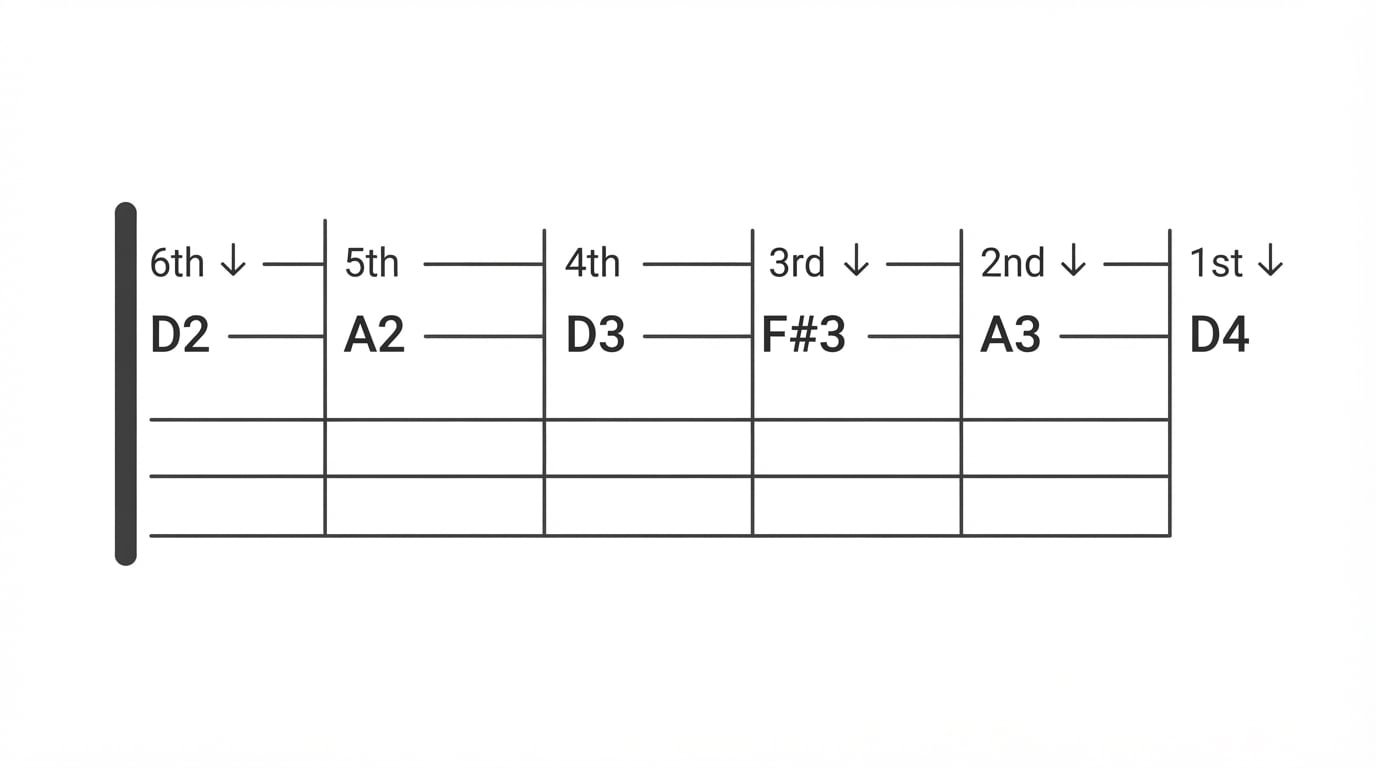
Open D is a six-string guitar tuning in which the open strings, played with nothing fretted, sound a complete D major chord. From the thickest string to the thinnest, the target notes are:
String | Standard note | Open D note |
|---|---|---|
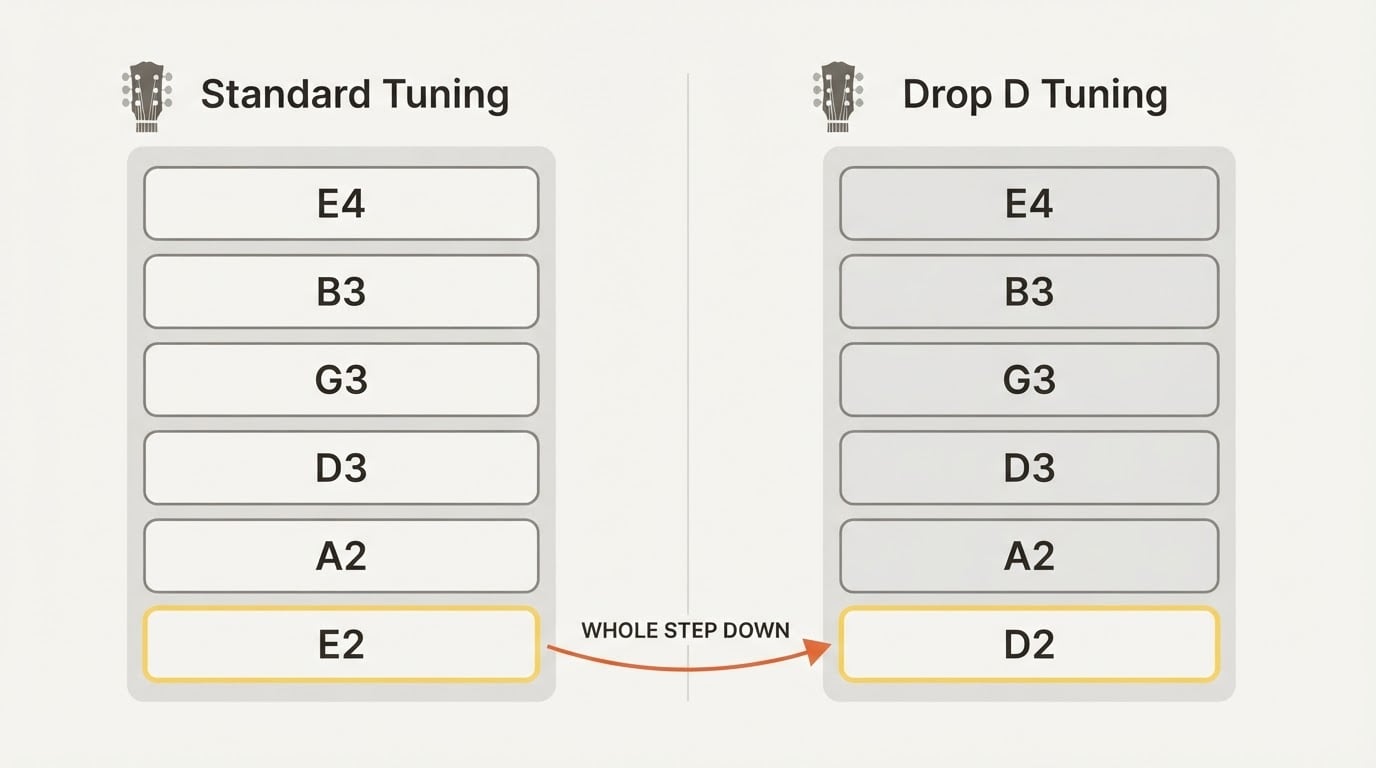
6th (thickest) | E2 | D2 |
5th | A2 | A2 |
4th | D3 | D3 |
3rd | G3 | F#3 |
2nd | B3 | A3 |
1st (thinnest) | E4 | D4 |
Read the three distinct notes and the tuning explains itself: D, F#, and A are the notes of a D major triad. The six strings spell that triad as D, A, D, F#, A, D, which is root, fifth, root, third, fifth, root.
That layout has two consequences worth understanding before you touch a tuning peg:
- The chord is already there. "Open" means you get a usable chord without fretting a single note, which is why open D suits slide playing and any part that needs a big, ringing sound.
- The low end is doubled. You get D in three octaves, and two of them sit on the 6th and 4th strings. Strumming across those two produces a thick bass, and a thumb that alternates between them holds a steady drone without much effort.
Open D vs standard tuning: what changes
Only four strings move, and every one of them moves down.
String | From | To | Change |
|---|---|---|---|
6th | E2 | D2 | Down a whole step (two frets) |
5th | A2 | A2 | No change |
4th | D3 | D3 | No change |
3rd | G3 | F#3 | Down a half step (one fret) |
2nd | B3 | A3 | Down a whole step (two frets) |
1st | E4 | D4 | Down a whole step (two frets) |
Because every change lowers pitch, open D sits at lower string tension than standard tuning. That is the most noticeable physical difference: the strings feel slacker under your fingers, bends get easier, and the guitar sounds darker because it is pitched lower.
The 5th and 4th strings are the useful part of this table. They do not move, so they stay at pitch while you work on the other four, and they become the reference notes you tune everything else against.
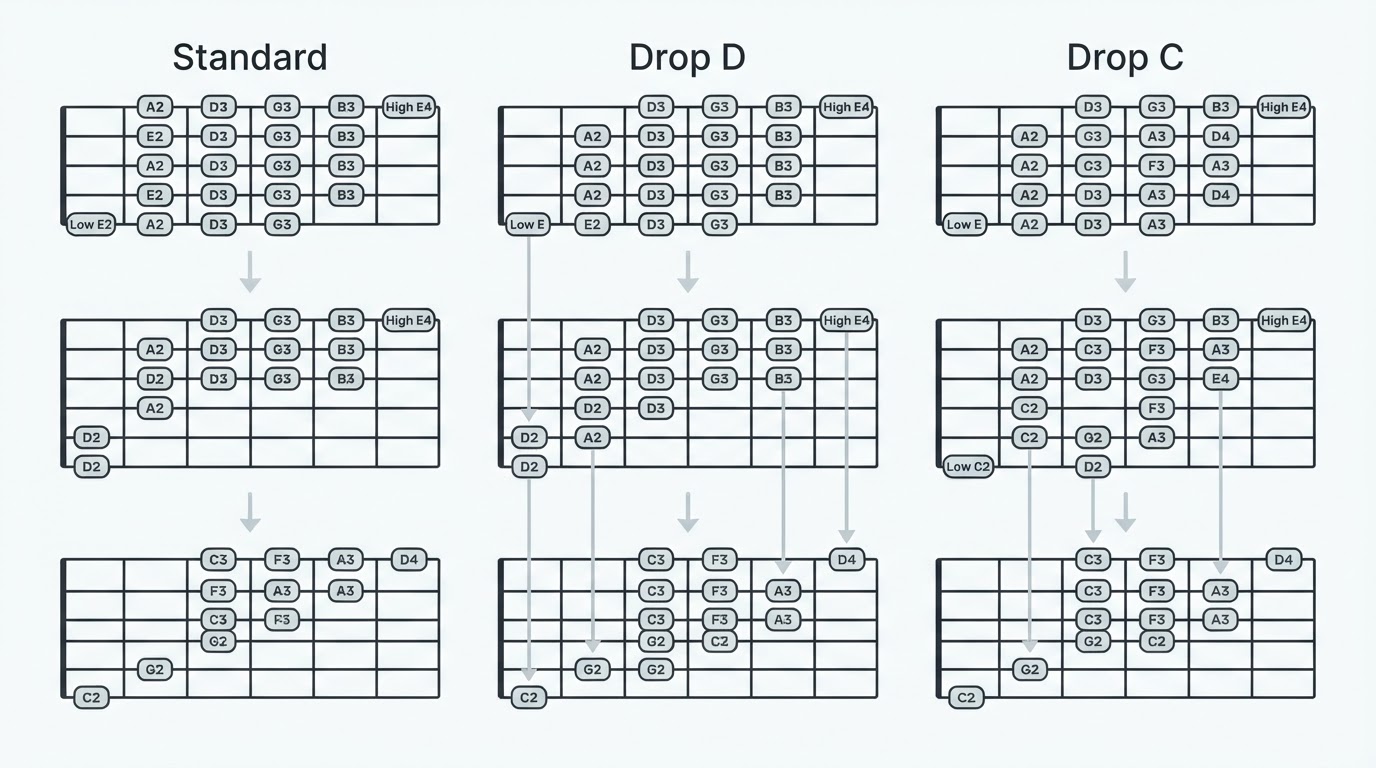
Open D is often confused with drop D, which is a different tuning. Drop D lowers only the 6th string and gives D A D G B E: you get a low D for power chords, but you still fret the rest of the chord as usual. Open D lowers four strings so the open strum is the chord itself. Tune only the 6th string down and the open strings will still carry G, B, and E on the top three, so the chord sounds wrong instead of ringing.
How to tune to open D, step by step
The reliable route is to treat the 5th and 4th strings as anchors and match everything else against them. Work at a moderate volume and pluck one string at a time with the others muted, because a chord ringing while you tune hides the string you are trying to hear.
- Check the anchors. Play the 5th string (A2) and the 4th string (D3) against a trusted reference such as a tuner, a piano, or another instrument that is already in tune. Both strings keep their standard pitches, so if they are right, every later step stands on solid ground.
- Lower the 6th string to D2. Play the open 4th string (D3) and lower the 6th until it sounds the same note one octave below. You are matching a pitch class rather than a unison, so the two Ds should feel like the same note with one clearly lower.
- Lower the 3rd string to F#3. Press the 4th string at the 4th fret, which sounds F#3, and lower the 3rd string until it matches. This half-step move is the one players most often forget.
- Lower the 2nd string to A3. Press the 4th string at the 7th fret, which sounds A3, and match the 2nd string to it.
- Lower the 1st string to D4. Play the 4th string at the 12th fret, or the 2nd string at the 5th fret, and lower the 1st string to match.
- Recheck each string on its own. Mute the other five, play one string at a time, and compare it with its reference. Small corrections are normal, and small peg movements are how you make them.
- Strum the whole instrument. All six open strings together should give a clean, stable D major chord. A slow pulsing between two strings means one of them is slightly off and needs another small adjustment.
- Let it settle, then verify again. Play for a minute, then recheck. Strings that have just been lowered drift a little before they come to rest.
If you would rather check each string against a displayed target note than match pitches by ear, GuitarTuner.io lists Open D among its 69 tunings and publishes the string-by-string reference D2 A2 D3 F#3 A3 D4 on the tuning's page, alongside its free browser-based microphone tuner. That is a quick way to confirm the target notes, and it stays optional: the steps above work with no tool at all.
Tuning open D with no tool at all
You do not need a tuner to reach open D, but you do need one trustworthy pitch to start from. Three practical options:
- An in-tune guitar. If the 5th and 4th strings already sit at A2 and D3, skip straight to the matching steps above.
- One reference pitch. A tuning fork, a piano key, or a keyboard that produces a steady A gives you the 5th string: match A2 two octaves below A4 at 440 Hz, then set the 4th string a perfect fourth above it at D3. From there the 4th string at the 4th, 7th, and 12th frets supplies every other target note.
- Your own ear and a remembered note. Hum or sing the D you expect, then lower the 6th string toward it. This is the least precise option, and the open strum will tell you how close you got.
Whatever starting point you use, the same checks confirm you have arrived:
- The open strum is a D major chord with no beating between the two D strings or between the two A strings.
- The 6th string (D2) and the 4th string (D3) are an octave apart, the 4th (D3) and the 1st (D4) are an octave apart, and the 5th (A2) and the 2nd (A3) are an octave apart.
- The 3rd string's F#3 matches the 4th string at the 4th fret.
What open D is good for
Open D earns its place in a few specific jobs:
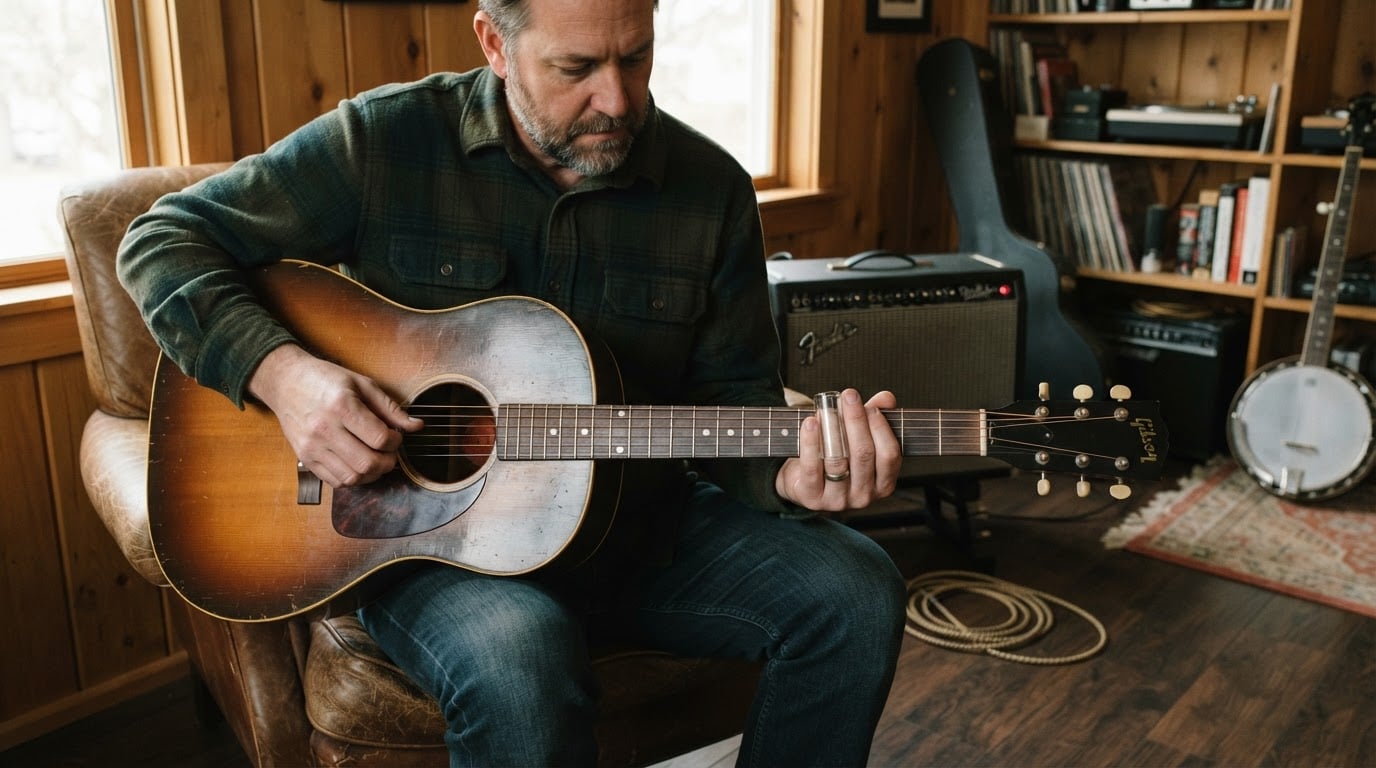
- Slide and bottleneck playing. Because the open strings already form a major chord, one slide across all six strings gives you a full chord. Move that barred position up five frets and you have G, seven frets gives A, ten gives C, and twelve gives D an octave higher. That single shape covers most of the harmony in a blues or folk song.
- Blues and fingerstyle. The three D strings and two A strings make droning and alternating-bass patterns easy, because the thumb can hold a low D while the fingers work the upper strings.
- Strummed accompaniment and songwriting. Open D rings longer and fuller than standard tuning on the same guitar, which suits slow songs and open-sounding arrangements, and a capo moves the whole chord up or down when a song needs another key.
- A quick, satisfying sound for newer players. One finger across six strings at the 5th fret produces a clean G major chord, which makes the tuning attractive to anyone who wants a big sound before they have learned a full set of barre shapes.
First chords to learn
Start with the shape that needs no fingers at all, then add one movable shape.
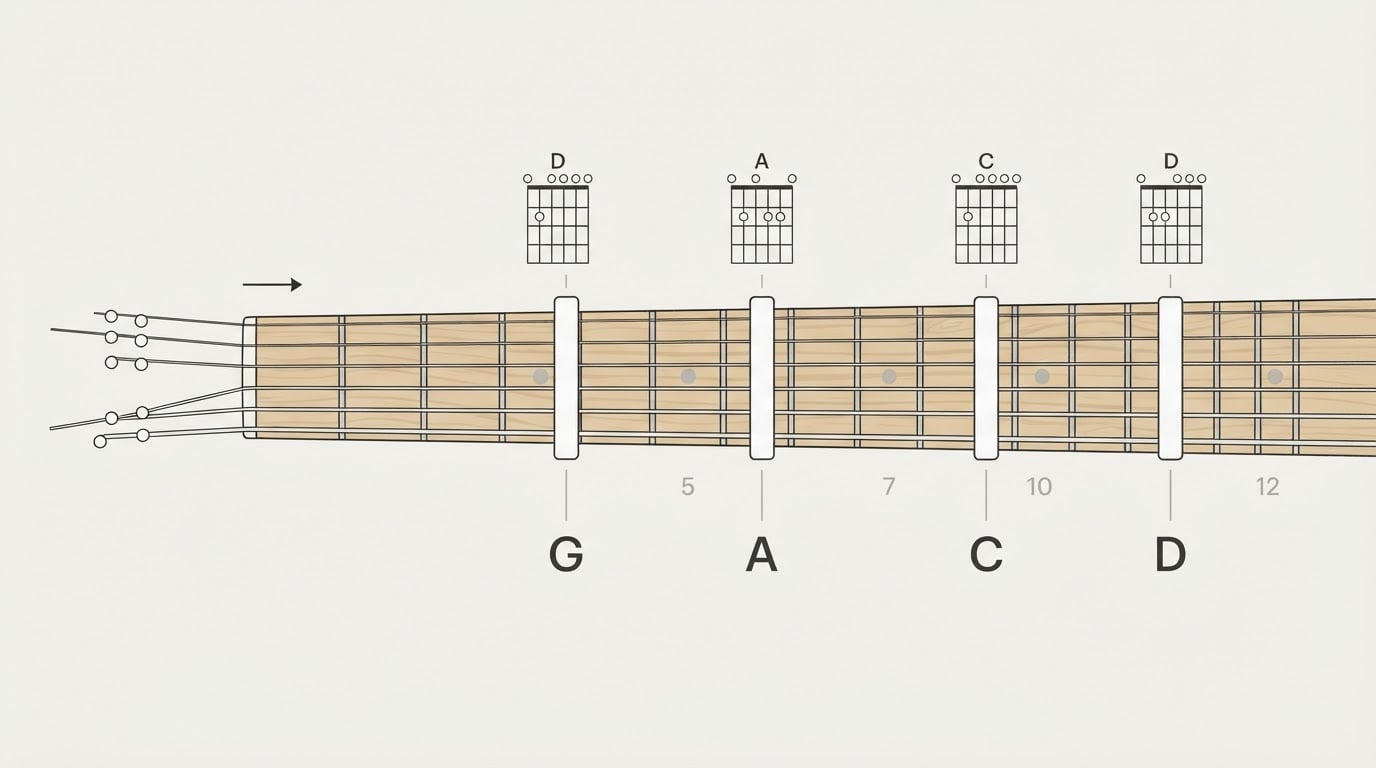
- D major: strum all six open strings.
- G major: barre all six strings at the 5th fret.
- A major: barre all six strings at the 7th fret.
- C major: barre all six strings at the 10th fret.
- D sus4: press the 3rd string at the 1st fret, so F# becomes G, and leave the rest open.
- D7: press the 5th string at the 3rd fret, so A becomes C, and leave the rest open.
A simple first practice loop: play D for four beats, D again for four beats, G for four, and A for four, at around 60 to 70 beats per minute. Strum slowly enough to hear every string, and stop if the open strings start to buzz. Once the loop is clean, slide into the sus4 on the 3rd string before returning to D, which shows you in one move why the tuning is popular with slide players.
Two completion checks before you move on: the open strum stays in tune for a full minute of strumming, and the movable barre at the 5th fret produces the same clean chord quality as the open strings.
Mistakes and trade-offs worth knowing
Open D is straightforward once you understand it, but a few things surprise players:
- Mixing it up with drop D. Drop D changes one string and open D changes four. If the open chord sounds wrong, check the 3rd string first, because it drops only a half step to F#.
- Tuning while all six strings ring. A strum hides individual pitches, so mute everything except the string you are adjusting.
- Overshooting, then yanking back. Big peg turns stretch and detune the string again. Move in small increments and settle on the note from the flat side when you can.
- Slack strings and buzz. Lower tension means the strings swing in wider arcs. Light-gauge strings can rattle against the frets in open D, especially when the action is already low. A heavier set or a setup from a technician fixes most of it.
- Fretted notes that sit slightly off. A guitar set up for standard tuning may not play perfectly in tune up the neck in open D, because the change in tension shifts intonation a little. Test the 6th and 4th strings at the 12th fret and note what you hear.
- Tuning drift after a big retune. Four strings take time to settle. Stretch each one gently, retune, and let the guitar sit for a few minutes before recording or playing live. If you switch between standard and open D during a set, expect to retune between songs or keep a second guitar nearby.
- Losing your standard shapes. Chords you know in standard tuning do not transfer cleanly. Expect more barres, slides, and open strings, and treat that as the point of the tuning rather than a problem with it.
FAQ
What are the exact notes in open D tuning?
From the 6th string to the 1st: D2, A2, D3, F#3, A3, D4. The chord tones are D, F#, and A.
Is open D the same as drop D?
No. Drop D lowers only the 6th string and gives D A D G B E. Open D lowers the 6th, 3rd, 2nd, and 1st strings and gives D A D F# A D.
Can I tune to open D without a tuner?
Yes, as long as you have one reliable reference for the 5th string. The 5th and 4th strings keep their standard pitches, so they anchor the tuning and supply the reference notes for the other four strings.
Do I need a slide or special strings to use open D?
No. Open D works on a standard acoustic or electric guitar with ordinary strings. Slide playing is a common use rather than a requirement, and a heavier set of strings only matters if the looser feel causes rattles.
Why does my guitar buzz after tuning to open D?
The strings are under less tension than in standard tuning, so they swing further when plucked. That can expose a low action or a high fret that was not audible before. Raising the action slightly or moving up a string gauge usually solves it.
Will staying in open D damage my guitar?
No. Total string tension in open D is lower than in standard tuning, so the neck carries less load rather than more. If you keep one guitar in open D for long periods, a setup matched to that tuning will make it play and intonate better.