Start With the Octave, Not the Word "Tuning"
Both setups are written GCEA and both put a G on string 4. The note name is identical; the octave is not. High G sounds G4. Low G sounds G3, one octave lower.
String | High G | Low G |
|---|---|---|
4th | G4 | G3 |
3rd | C4 | C4 |
2nd | E4 | E4 |
1st | A4 | A4 |
Only string 4 moves. Strings 3, 2 and 1 keep C4, E4 and A4. High G is re-entrant: the fourth string sits above the C next to it. Kala's tuning guide explains that re-entrant layout and notes that swapping in a low G puts the strings in pitch order.
What Low G Adds, and What It Does Not
Low G adds five chromatic pitches below C4: G3, G#3, A3, A#3 and B3. They sit under the open C, which lets players walk a bass line or start a melody lower without retuning anything else. It is not an extra octave of total range: the top of the instrument does not move, and the upper three strings are unchanged. Ukulele Magazine's player roundtable makes the same point in practical terms: one low G player counts five lower notes, while high G players describe tighter harmony and melodies on the high G and A strings.
Chord Shapes Stay, Voicings Change
A C chord is still a C chord, and basic fingerings for the same pitch classes generally stay put. What changes is the bass note and the voicing. An inversion that sounds balanced on high G can sound heavier on low G, and an arrangement that leans on a low bass note can lose its foundation on a re-entrant instrument.
Do not assume every tab is interchangeable. A melody note placed on the fourth string can jump an octave when you switch setups. Re-entrant high G suits campanella and open-string arrangements; low G extends the bass and gives linear runs a lower foundation. Neither layout is better for all fingerstyle or strumming; chord-melody works on either, and the arrangement decides whether it leans on a low bass note or the re-entrant strings.
Where Each Tuning Earns Its Place
If your priority is | Start with | Because |
|---|---|---|
Traditional strumming, campanella, open strings | High G | G4 keeps compact re-entrant voicings and familiar open-string melody notes |
Bass lines, low melodies, chord-melody | Low G | G3 supplies lower bass notes and the five pitches below C4 |
Playing an arrangement as written | Match its named tuning | A fourth-string note may sit an octave apart |
Not sure yet | Try both with the right strings | Preference follows repertoire, not a universal winner |
Why a Tuner Showing "G" Can Mislead You
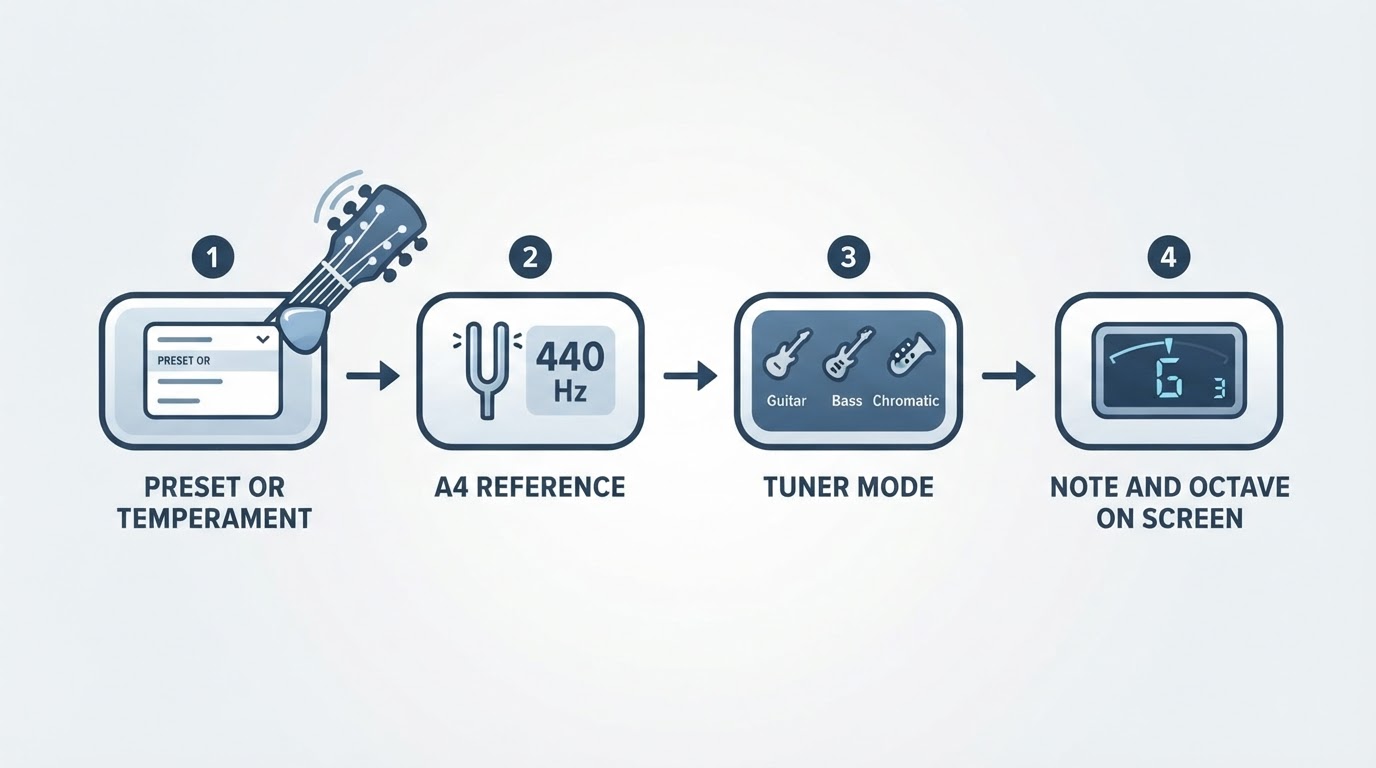
A display that shows only the letter G does not, by itself, tell you which octave you are in. G3 and G4 both read as G, so either one can look like success. Some tuners still resolve the registers internally, comparing against an expected pitch without printing an octave number. Check your specific tuner's instructions for the register it expects on string 4, and confirm with an octave-number display or a known reference pitch when the display does not show one. Do not assume every tuner has a dedicated low G mode; not every one does.
If you are setting up standard high G first, this step-by-step GCEA tuning walkthrough shows the G4, C4, E4 and A4 targets and the order to tune them in.
Choose the String Set Before You Touch a Peg
Do not loosen a regular high G an octave and call it a conversion. The string is too light for that pitch, and a slack, unplayable result is the usual outcome. Kala's guide warns against exactly that move, noting that detuning a nylon high G leaves an especially droopy string; the fix is a dedicated low G string rather than a retuned high G.
Use a dedicated low G string or set matched to the instrument's exact size, scale and tension, and to the bridge or tie-end type. Wound and unwound low G strings both exist; Ukulele Magazine's roundtable includes players who moved to unwound low G. Either construction is a valid starting point when the set is specified for your instrument, and neither is required by the tuning alone.
One verified example is the D'Addario EJ65TLG, a tenor low G tie-end set with a wound fourth string and G3, C4, E4 and A4 targets. It is not a universal fit for soprano or concert instruments, and no price is assumed here.
Fit depends on string diameter, the bridge and the nut. A set can match the scale and still sit poorly on one instrument. Do not force a binding string, and do not file or widen the nut yourself. If the string binds, sits visibly high or will not seat cleanly, stop and ask the maker or a luthier.
A Short Verification Sequence
- Confirm the string set and setup match the tuning.
- Confirm the register on string 4: G3 or G4.
- Pluck the strings individually and gently.
- Make small peg adjustments and check after each.
- Recheck every string, then compare a known arrangement.
- If pitch moves the wrong way, reverse; higher is not always clockwise because machines mount differently.
Keep Baritone and Extended-Range Instruments Separate
This guide covers ordinary four-string GCEA ukuleles in soprano, concert and tenor sizes. Baritone uses DGBE (D3, G3, B3, E4), a different linear tuning with different gauges; our baritone ukulele tuning guide treats it separately. U-bass and five-, six- and eight-string ukuleles are separate setups too.
The short version: high G and low G are the same G pitch class in registers one octave apart, not rival brands of tuning. Decide which octave your repertoire needs, verify the register with your tuner's expected setting or a reference pitch, and fit the right string set before you turn anything.