What a tuned baritone ukulele looks and sounds like
A baritone ukulele in tune holds four notes in ascending order, low to high: D3, G3, B3, E4. The fourth string is the lowest note on the instrument, and the strings climb from there. Written out as targets:
String | Note | Reference pitch |
|---|---|---|
4th (thickest) | D3 | 146.8 Hz |
3rd | G3 | 196.0 Hz |
2nd | B3 | 246.9 Hz |
1st (thinnest) | E4 | 329.6 Hz |
When all four are correct, each open string sustains a steady pitch with no slow waver, the low D sits clearly below the rest, and a slow strum across all four sounds even instead of leaning on one note.
That ascending order is the main thing to internalize, because it works differently from the ukulele most people learn first. On a standard soprano, concert, or tenor ukulele the fourth string is a high G that sounds above the string next to it, a re-entrant tuning where the strings do not move neatly upward in pitch. Baritone tuning is linear, commonly called low-D: the fourth string is genuinely the bass note of the instrument. If your ear expects that high G, the low D can sound wrong at first. It is not — that low D is the reason a baritone sounds deeper than its smaller relatives.
Step 1: Confirm the target tuning before you touch a peg
Confirm the four target notes before you touch a tuning peg: D3, G3, B3, E4, low to high, with the fourth string as the low D. Check that the instrument is strung for that tuning, because a baritone set is gauged for DGBE and a set intended for a smaller ukulele's GCEA will not behave the same way. If the strings are old, mismatched, or you are not sure what tuning they were made for, sort that out first; careful peg-turning cannot fix the wrong strings.
Then choose a reference to tune against: a clip-on tuner, a phone app, a browser tuner, a piano or keyboard, or the top four strings of a guitar.
Done when: you can point at each of the four strings and name its target note and octave without looking them up, and a reference is within reach.
Step 2: Tune each string with a browser tuner or reference tones
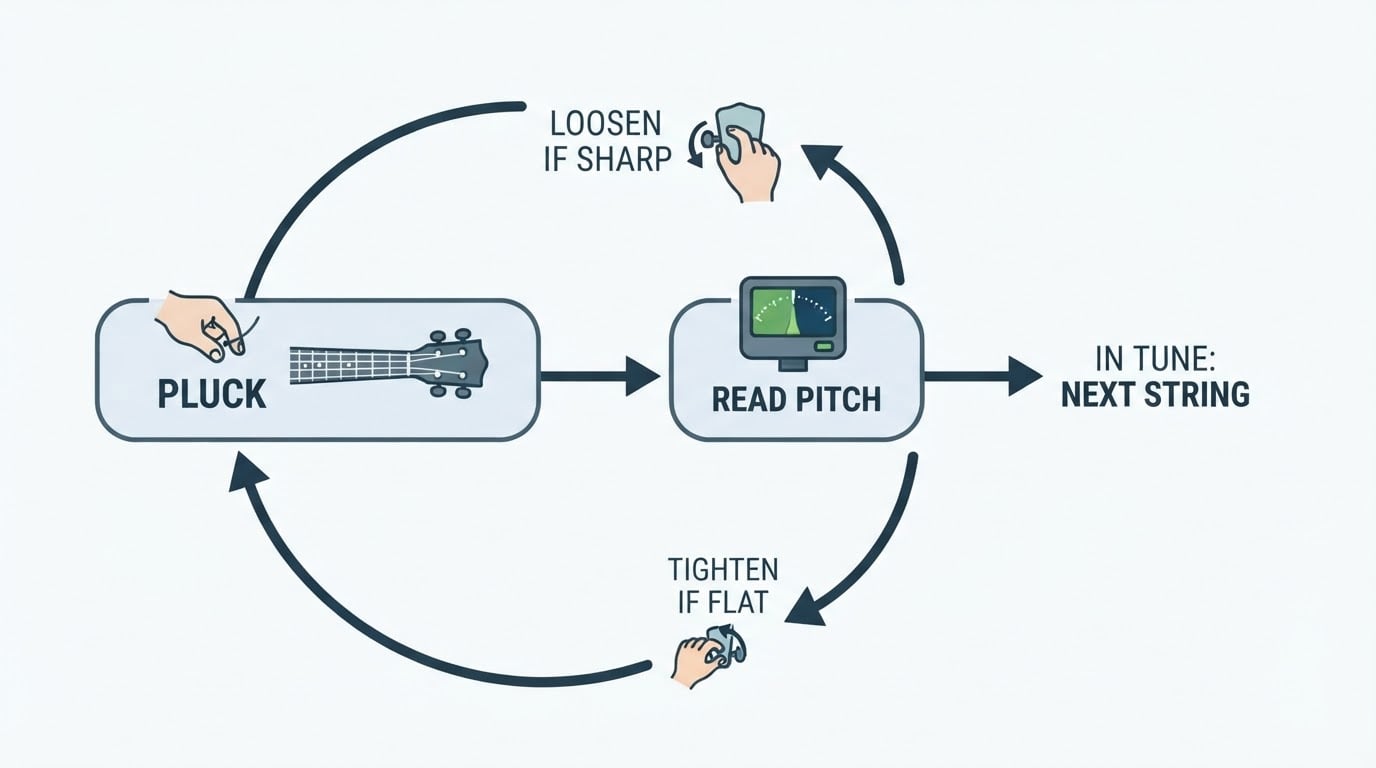
Work one string at a time, starting with the low D on the fourth string and finishing with the E on the first. Damp the other three strings lightly, pluck one string with the pad of your thumb somewhere over the soundhole, and let the note ring so the tuner hears a single pitch.

Read the result, then adjust the tuning peg in small steps. If the note is flat, below the target, tighten the string. If it is sharp, above the target, loosen it. After each small turn, stop and check what the pitch did before turning further; if it moves farther from the target, you are turning the wrong way, so reverse. The readout is the honest signal, since tuning machines are mounted differently from instrument to instrument.
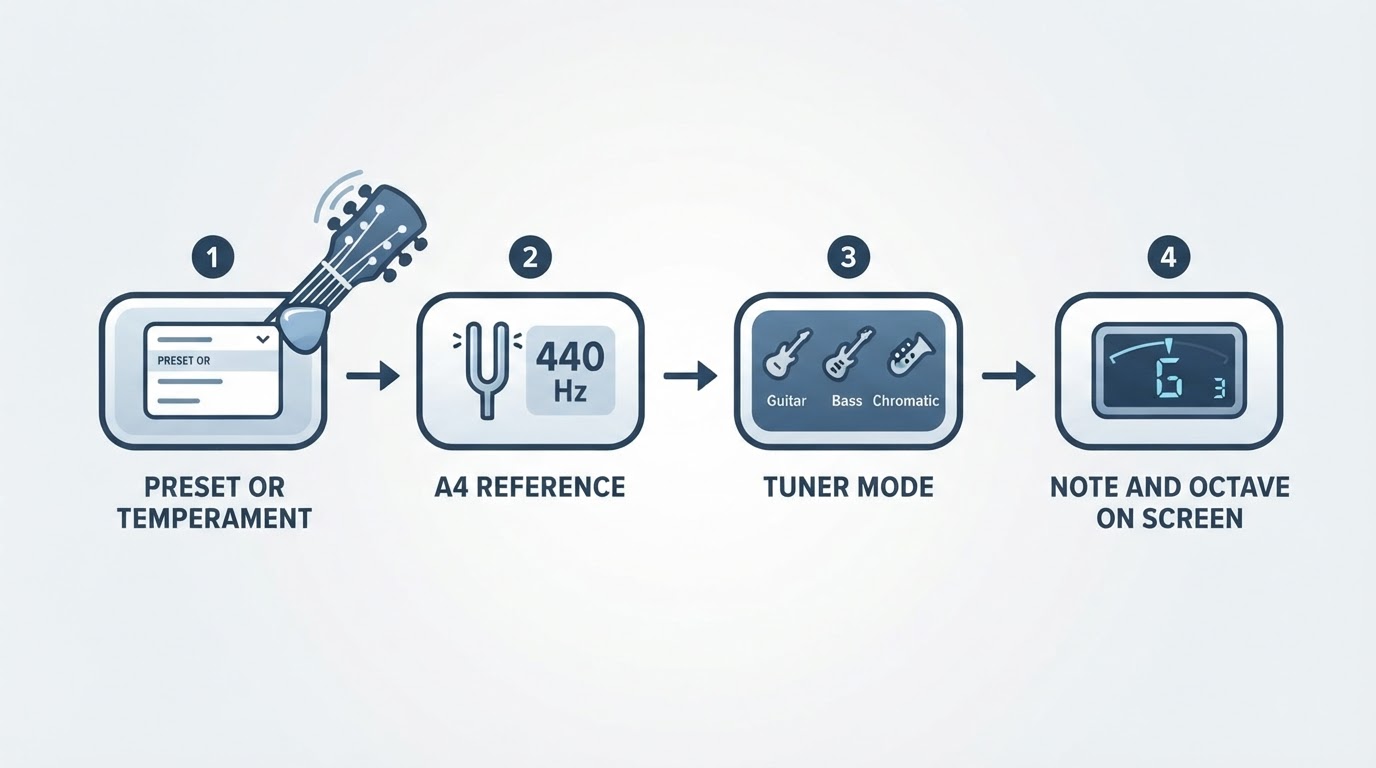
Some tuners show a note name with an octave number, and others show only the letter. Use the octave or the frequency readout to confirm you are on D3 and not D4: D3 is about 146.8 Hz, while D4 is double that, close to 294 Hz. If the fourth string insists on reading an octave high, stop and check the strings before forcing anything. Either the set is meant for a different tuning, or the tuner is latching onto a harmonic. Damp the other strings, pluck more softly, and let the note steady before making a big adjustment.
If you are matching reference tones instead of reading a display, play the D3 reference, turn the fourth string's peg until the two pitches fuse and the slow wobble between them disappears, then move up through G3, B3, and E4 the same way.
If you do not have a tuner or a reference tone handy, GuitarTuner.io runs a free microphone tuner in the browser: open the page, allow microphone access, and pluck one string at a time. It is an optional convenience, and a clip-on tuner or a piano works just as well.
Done when: each of the four strings holds its target note steadily for a few seconds without drifting and without a sharp or flat indicator lighting up.
Step 3: Tune by ear and check the intervals
Check your work by ear once the tuner says all four strings are in tune, because a display can be fooled by a noisy room or a harmonic. The tuning itself gives you three intervals to listen for: D to G is a perfect fourth, G to B is a major third, and B to E is another perfect fourth.
The quickest by-ear test uses the instrument itself:
- Play the D string at the 5th fret; it should match the open G string exactly.
- Play the G string at the 4th fret; it should match the open B string.
- Play the B string at the 5th fret; it should match the open E string.
If a guitar is within reach, use it as a second reference. The baritone's four open strings match the guitar's D, G, B, and high E strings exactly, which is also why chord shapes transfer so easily between the two instruments.
Done when: all three fret matches ring with no waver or beating, and each open string matches its guitar counterpart if you used one.
Step 4: Verify the whole instrument
Strum all four open strings slowly and listen to the instrument as a whole, then check each string one final time. Work through three checks:
- Play each string again, one at a time. Any string that drifted is the one to re-tune first.
- Play a few fretted notes or a chord shape you know. If a fretted note sounds sour against the open strings, go back to the string it depends on.
- Listen for the low D in the mix. The fourth string should be audibly the lowest note; if the instrument sounds thin or another string sits below the D, an octave mistake is the likely cause.
Done when: a slow strum holds together with no wobble, no single string sticks out, and every open string still reads in tune afterward.
Step 5: Re-check after playing and let new strings settle
Play for a few minutes, then check the tuning again. Strings stretch under tension and settle as you play, which is why "tune once and play" rarely holds on a fresh set. If one string keeps falling flat within minutes, the slip is usually at one of its two anchor points:
- At the bridge, the knot should sit snug and square against its slot. A loose or creeping knot needs re-seating before you tune back up.
- At the tuning post, the windings should lie neatly and not overlap themselves; overlapping wraps can creep as tension changes.
- To help new strings settle, hold one near the middle, draw it gently away from its resting position a few times, then retune and repeat. Ease into the pull instead of yanking.
Expect to retune more often during the first few days of a new set, and check the tuning at the start of each session while the strings are settling. Temperature and humidity swings pull a ukulele out of tune too, so a quick re-check before each practice is the reliable habit.
Done when: after a few minutes of playing, every string is still within a hair of its target and needs at most a touch-up.
Common baritone ukulele tuning problems
Why does my tuner show D4 for the low D string?
D4 is exactly one octave above the D3 you want, so the string is either strung or tuned an octave too high, or the tuner is reading a harmonic instead of the fundamental. Compare the fourth string with the first: the low D should sound clearly lower than the E4. If it does not, the string set is probably wrong for this tuning. If the D does sound low, damp the other strings, pluck softer, and confirm with the frequency readout before making a large adjustment.
Should the fourth string be low or high?
Standard baritone tuning is low D, which is what gives the instrument its deep, linear voice. A high fourth string belongs to re-entrant tunings used on other ukulele sizes, not to the standard baritone setup. If a chord chart or a video assumes a high fourth string, it was written for a different tuning.
Which way do I turn the pegs?
Follow the pitch, not the peg: turn in a small increment and notice whether the note rises or falls. Tightening raises the pitch and loosening lowers it, but the direction you physically turn depends on how the tuning machines are mounted. If the pitch moves away from the target, reverse. If a peg will not budge or feels stuck, stop and have the instrument looked at rather than forcing it.
Can I tune a baritone ukulele up to GCEA?
Not with its standard strings. Baritone sets are gauged for DGBE, and pulling them up to a higher tuning adds tension the instrument was not set up for. If you want GCEA on a baritone, use a string set made for that tuning.
How long does it take a new set to hold tuning?
Expect drift for at least the first few days, with the longest settling overnight or between sessions. Retune at the start of each session, stretch gently, and the tuning will hold longer each day.
Baritone ukulele tuning checklist
- Target notes, low to high: D3, G3, B3, E4 — the fourth string is the lowest.
- Tune the fourth string first, then the third, second, and first.
- Damp the other strings and pluck one string at a time over the soundhole.
- Flat, tighten; sharp, loosen. Small turns, then check the readout.
- Fret check: open G matches the D string's 5th fret; open B matches the G string's 4th fret; open E matches the B string's 5th fret.
- Strum all four open strings, play a few fretted notes, and re-check anything that sounds sour.
- Play for a few minutes, then check again; new strings drift until they settle.