What changes in open E
Open E tuning sets the strings to E-B-E-G#-B-E, low to high, so strumming them unfretted sounds an E major chord. Three strings move from standard tuning, all upward: the 5th from A to B and the 4th from D to E (a whole step each), and the 3rd from G to G# (a half step). The 6th, 2nd, and 1st strings stay put. Wikipedia's overview of open E tuning describes the same change and the interval pattern it shares with open D.
Why tension rises, and why your guitar is not the reference guitar
For a string of fixed mass and speaking length, tension is proportional to the square of the frequency. Raising a string a whole step lifts its frequency about 12 percent and its tension roughly 26 percent; a half-step raise adds roughly 12 percent. These figures follow from the frequency-squared rule set out in this open E tension breakdown. They apply one string at a time: the 5th and 4th strings each gain about a quarter more pull, the 3rd about an eighth more, and the other three do not change. The total load therefore rises by less than the per-string figure, but it still rises on strings already at standard tension.
How much that matters depends on where you started. Heavier gauges sit at higher tension before you change anything, and longer scale lengths need more tension to reach the same pitch. D'Addario's String Tension Pro calculator uses those exact inputs — gauge, scale length, tuning, and construction — to show the per-string difference for your own set instead of a generic percentage.
A diagnostic table to run before you tune up
Your instrument and strings | What open E adds | Check first | Practical move |
|---|---|---|---|
Steel-string acoustic, light or medium set | Raised strings feel stiffer; load rises | Neck relief, action, tuning stability | Recheck relief and pitch; have the truss rod checked if action feels high |
Electric guitar, .010-.046 or similar | Same rise, usually comfortable on a solid body | Nut slots, saddles, tremolo balance | Raise tuning in small steps; check tremolo spring tension |
Classical or nylon-string guitar | Built for lower load; a high-tension set plus open E stacks increases | Set tension rating, top and bridge condition | Use a normal set, or the open D and capo route; ask a luthier |
Vintage, lightly built, or repaired guitar | Condition matters more than the tuning | Sunken top, lifting bridge, loose braces | Have it inspected first |
How to move to open E with fewer surprises
- Know your starting point. Note your gauge and scale length, then compare standard and open E tension for that set; a maker's calculator replaces guesswork with numbers.
- Raise one string at a time, in small increments. Take the 3rd up a half step first, then the 4th and 5th up a whole step each, checking pitch between moves. Going slowly is what prevents snapped strings.
- Retune after the guitar settles. New tension takes a while to spread, so play a minute, check all six strings, and expect small corrections.
- Listen for binding. If a string pings or jumps at the nut, its slot may be tight or dry; have a technician ease it instead of forcing the string.
- Check the results, not just the pitch. Watch for tuning drift, new fret buzz, or a change in action; if any appear, return to standard.
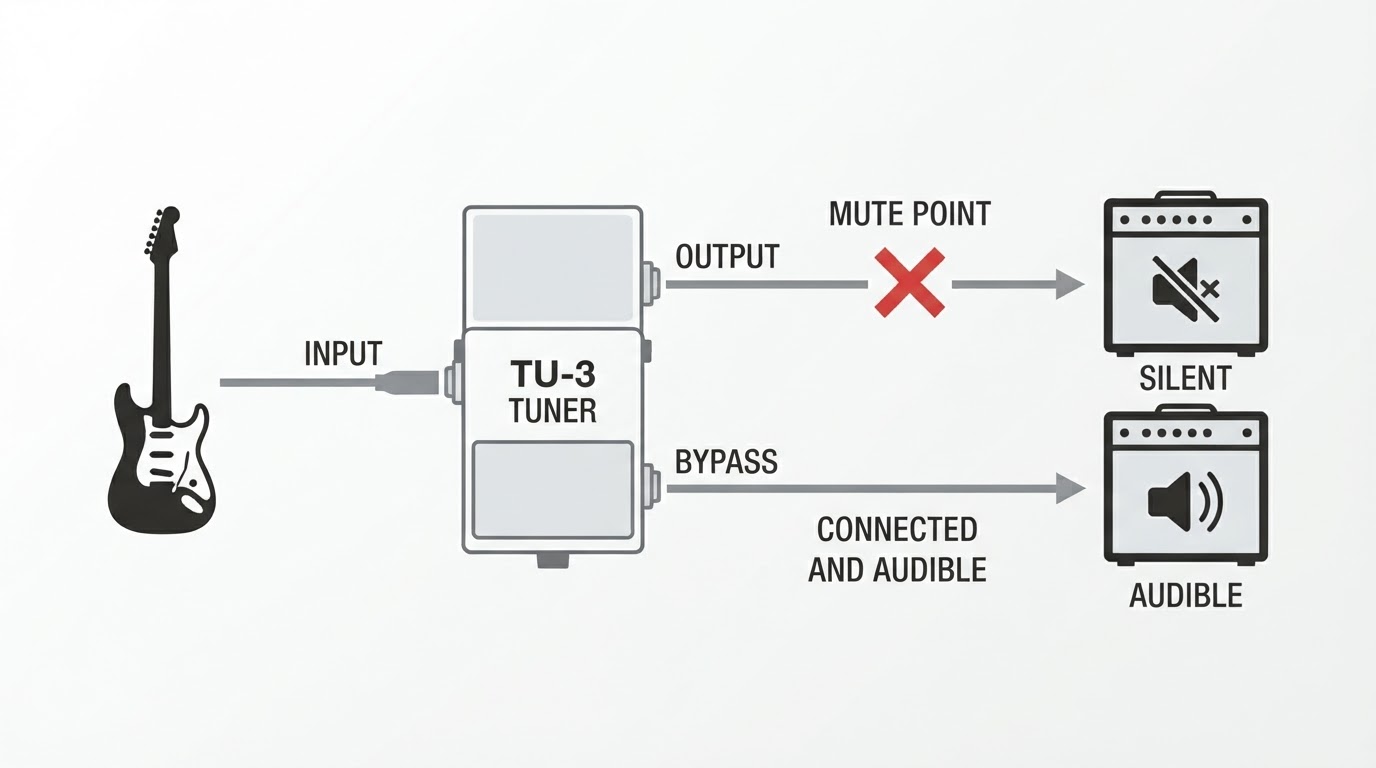
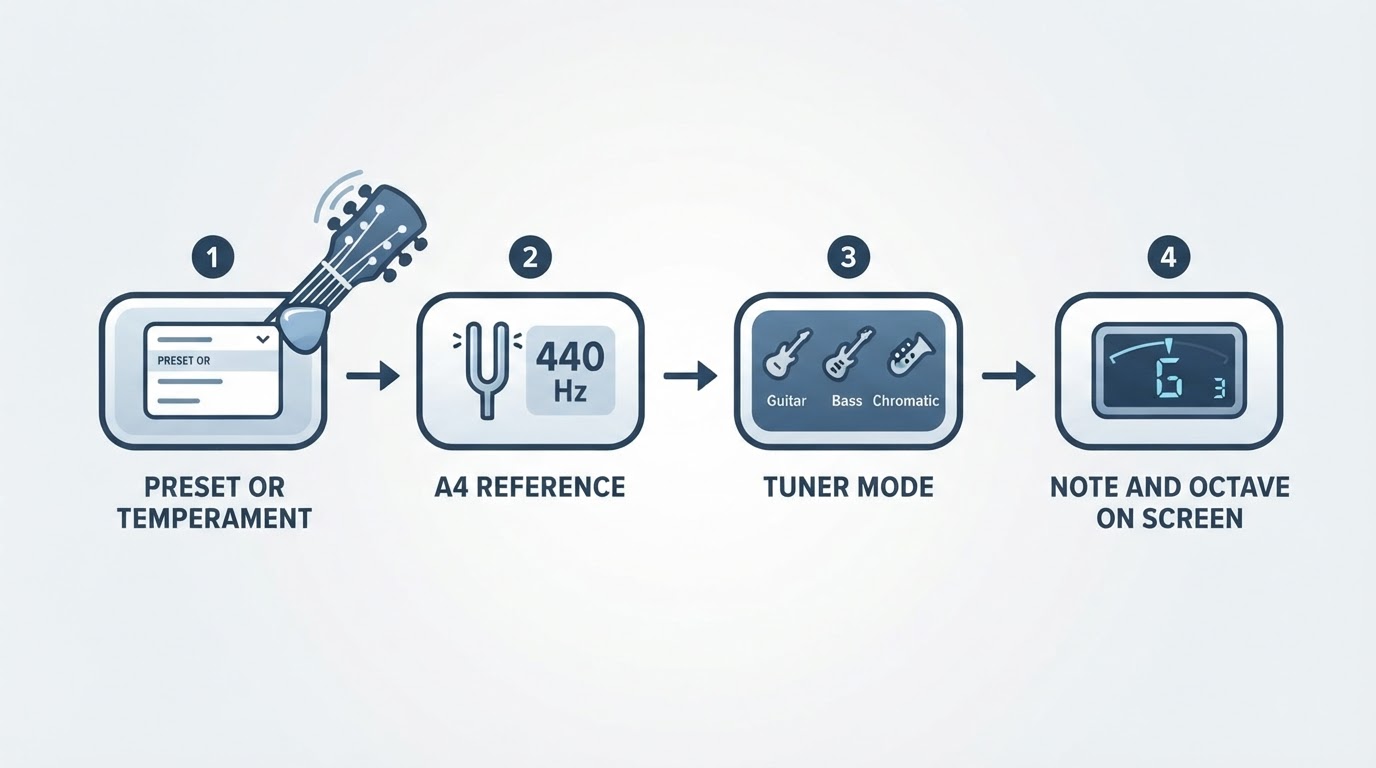
- Verify each string deliberately. Use a reliable tuner to check the target note and octave rather than relying on the feel of the peg. Recheck after the strings settle.
The lower-tension alternative: open D plus a capo
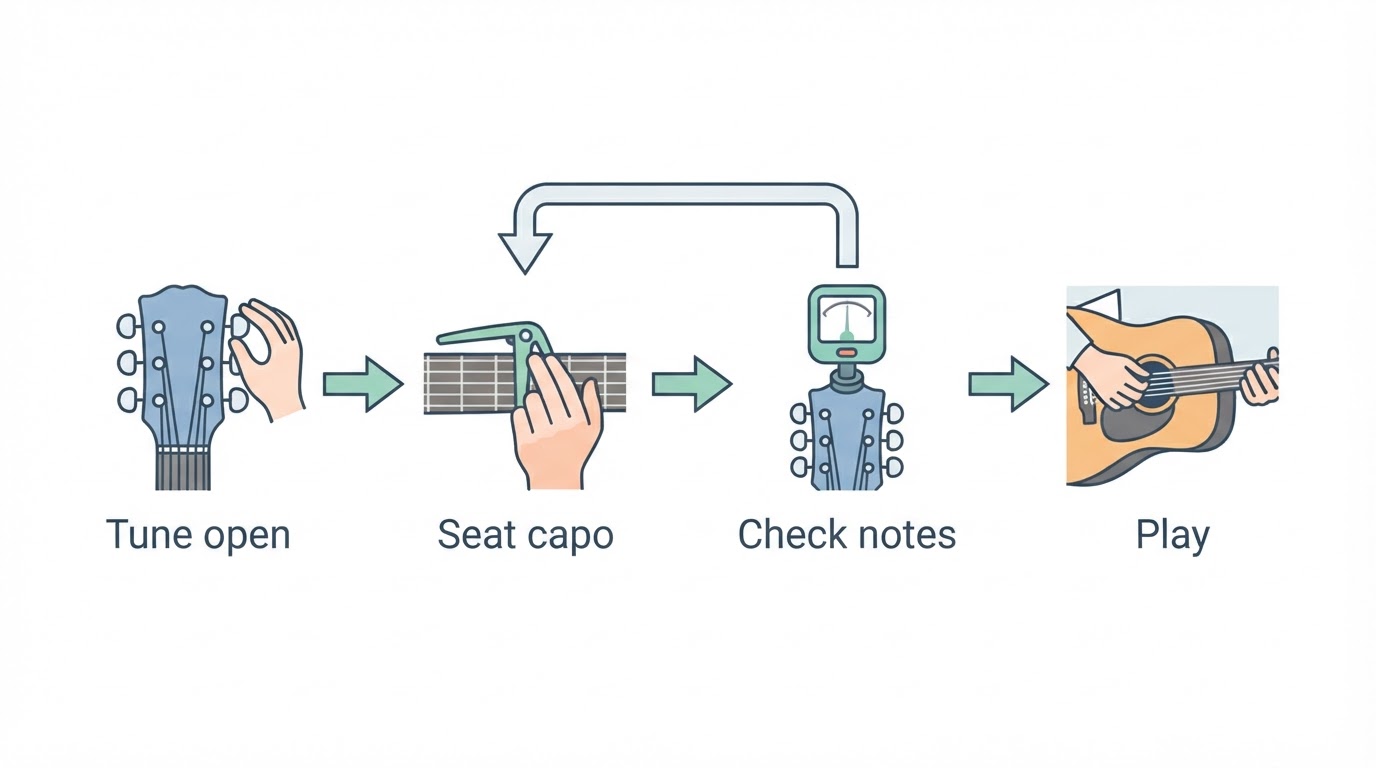
If you would rather avoid tuning strings upward, tune to open D and place a capo at the second fret. The capo raises all six sounding pitches by two semitones while the physical strings remain at open-D tension. Open D lowers four strings from standard and raises none. Tune to D-A-D-F#-A-D, then place a capo at the second fret: the sounding strings are E-B-E-G#-B-E. Our separate open D tuning guide shows that tuning step by step.
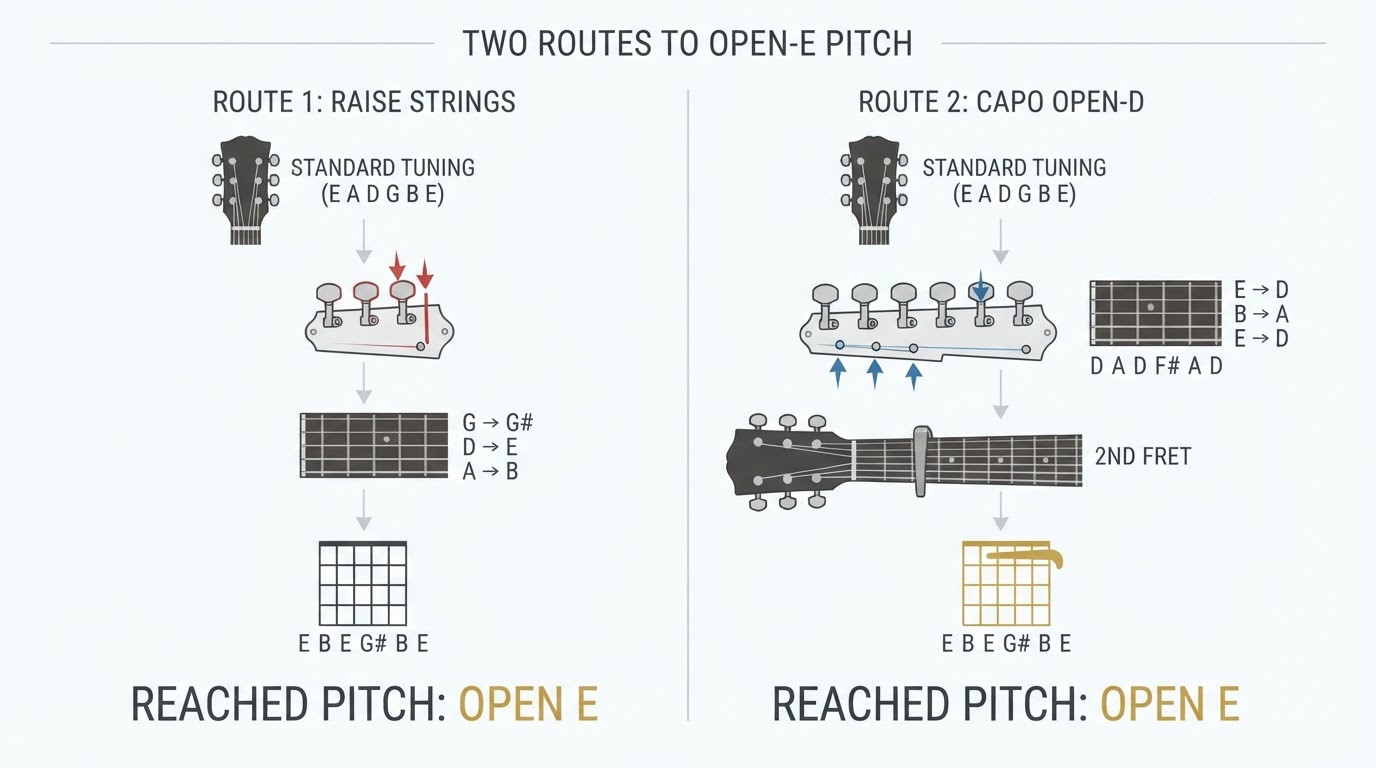
Two caveats: the capo removes access to frets below it, but the lowest sounding string is still E at the second fret. A capo is not perfectly transparent: clamping pressure and the guitar's intonation can make notes slightly sharp, so recheck tuning after fitting it and adjust capo pressure as needed.
Limits, and when to ask a luthier
An honest answer stops short of a guarantee. Whether a specific guitar tolerates the added tension is a property of the guitar, not of the tuning. Healthy, recently set-up instruments with an appropriate gauge usually take the change in stride, but "usually" is not "always". Be especially careful with:
- A classical or nylon-string guitar, especially one already fitted with a high-tension set
- A vintage instrument, or any guitar with a repaired top, bridge, or neck
- A guitar stored unstrung or in a very dry room
- Any instrument showing top movement, a lifting bridge, or a creak under tension
For those, ask the maker or a luthier what the guitar was built for before tuning up.
Frequently asked questions
Is open E tuning bad for a guitar?
It is not automatically bad: the tuning is common, and the tension change is modest on many instruments. But it does raise tension on the 3rd, 4th, and 5th strings, and the total load depends on gauge and scale length. No general rule can promise your particular instrument is fine, so treat a classical, vintage, or damaged guitar as a question for whoever maintains it.
Does open E tuning break strings?
Raising pitch increases tension, so the strings that move upward carry more load. Breakage usually comes from the process: overshooting a tuning peg, forcing a string that binds in the nut, or raising old, corroded strings. Move in small increments and replace worn strings before switching tunings.
Is open D with a capo the same as open E?
Above the capo, yes: the intervals and chord shapes are identical, and the sounding pitches are E-B-E-G#-B-E, including a low E on the sixth string. The difference is that the strings remain at open-D tension and you cannot fret below the capo; clamping can also sharpen a note slightly. Same sounding open chord, different physical setup.