Start With What Your Guitar Connects To
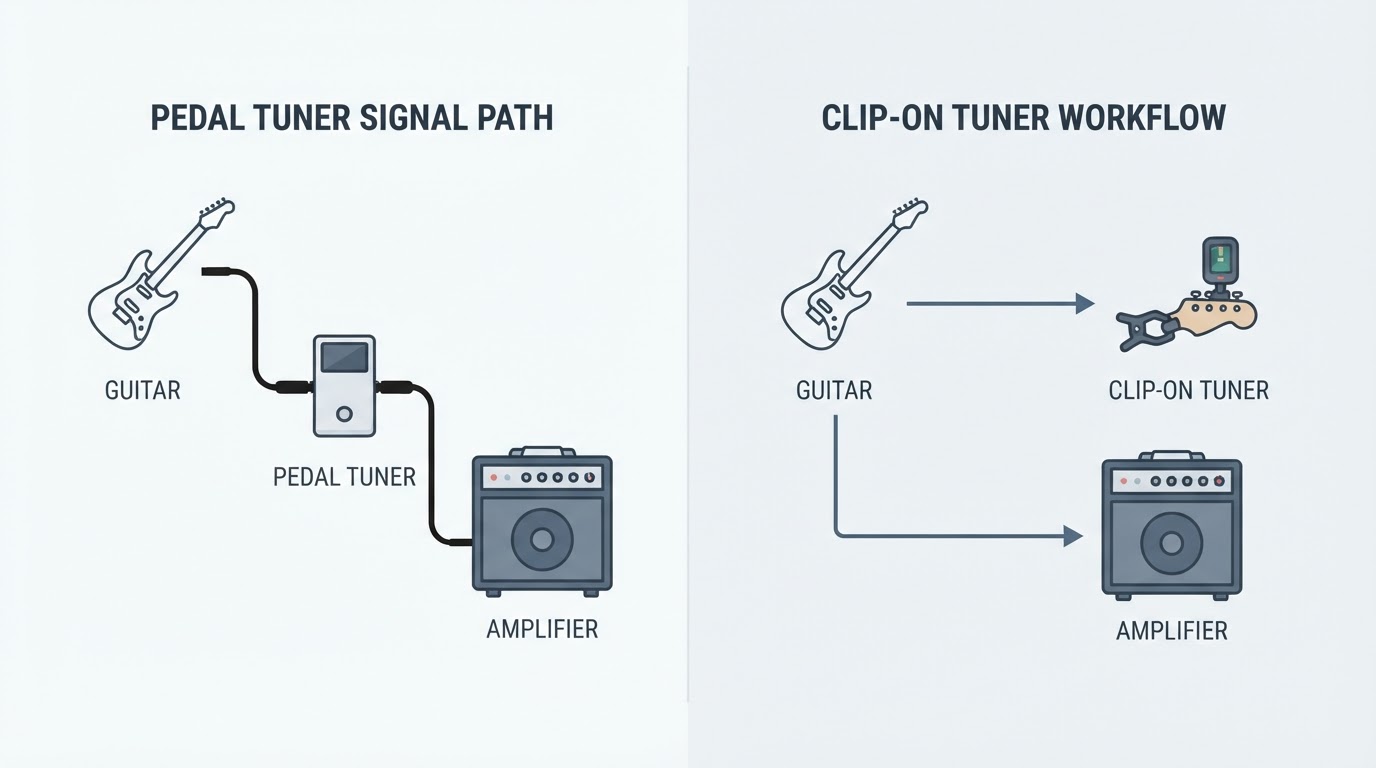
If you tune an acoustic guitar on the couch, a clip-on is simpler: it clamps to the headstock, so the guitar never needs a cable or output jack. If you play through a pedalboard, a tuner pedal earns its space inside the signal path you already use. The deciding question is not which looks more accurate; it is whether you want a device on the instrument or in the chain.
Connection: A Pedal Needs an Output, a Clip-On Does Not
A pedal tuner sits between your guitar and the rest of your rig: instrument cable in, another cable out, so an electric or acoustic-electric guitar needs a working output. A clip-on only needs a headstock that is comfortable to clamp; it works on a purely acoustic guitar with no pickup.
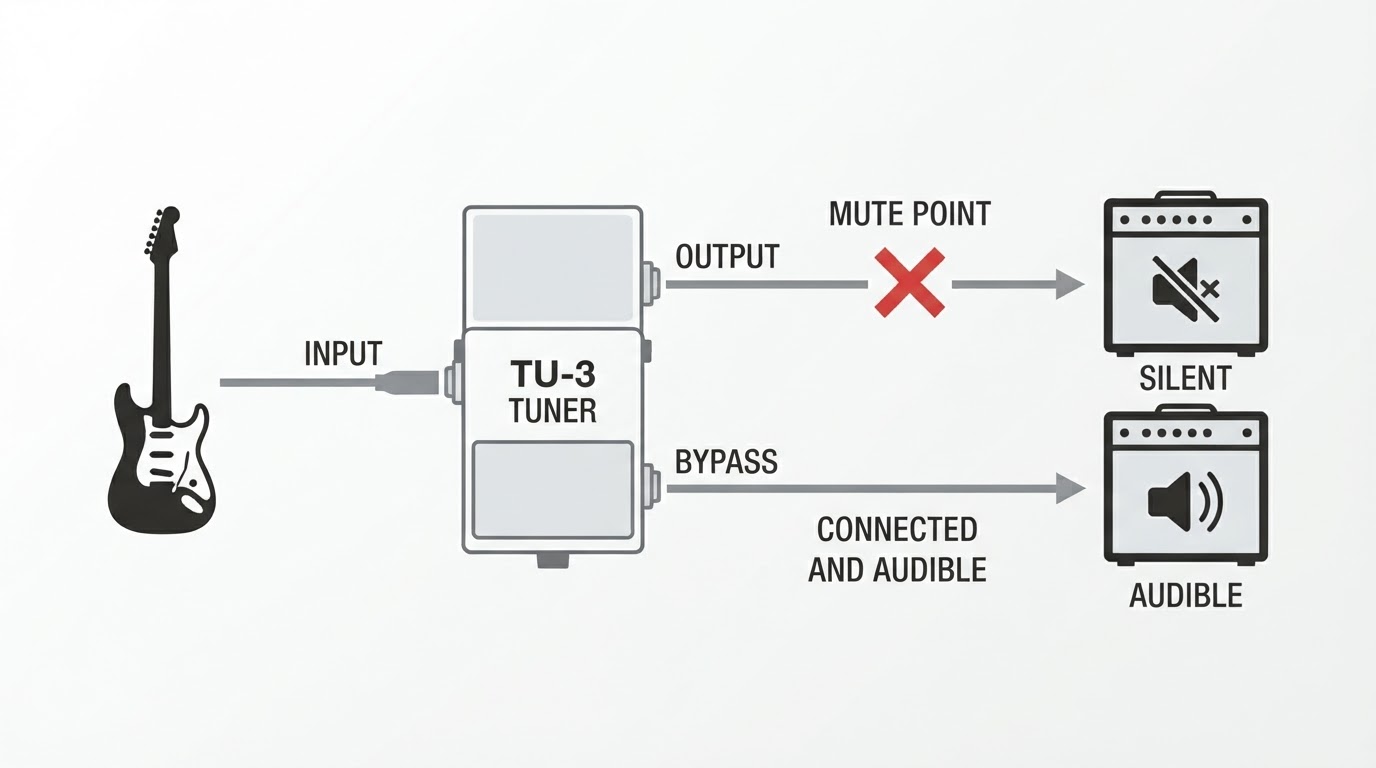
BOSS states that the TU-3's output automatically mutes when the tuner is engaged. That applies to the OUTPUT jack: OUTPUT mutes while engaged, and the BYPASS output does not, so which jack feeds your amp decides whether stomping the tuner actually gives you silence. Not every pedal tuner mutes, and a clip-on never mutes your amp automatically — you mute at the amp, the PA, or another pedal.
Portability vs. Permanence
The BOSS TU-02 shows the clip-on case: a padded clip, a swivel display, four modes (chromatic, guitar, bass, and ukulele), and a coin-cell battery in a body that fits a gig bag. It moves between instruments with no jack, cable, or board. A pedal is installed once; after that it is one more stomp in your routine, but it adds cable runs, board space, and a power connection.

Power and Battery Routine
Clip-ons carry their own small battery, and the TU-02's auto-off helps preserve it. Keep a spare coin cell in the case. A pedal such as the TU-3 can run from a compatible power supply or from a supported battery, so a board supply is one option rather than a requirement; BOSS lists an optional PSA-series adaptor for the TU-3, and the pedal also accepts a battery. Check the manual for your exact model. Neither route is inherently better: one asks you to remember a battery, the other asks you to plan power.
The Mute Workflow Is the Real Stage Difference
For quiet stage tuning, a pedal with a mute function is the more direct tool, but only along the path that is actually connected. On a TU-3, OUTPUT mutes while engaged and BYPASS does not, so a rig wired through BYPASS keeps passing signal. Some pedal tuners do not mute at all, so check the model you are considering.
A mute also only silences the connected amplified path. The guitar itself does not go quiet: the strings still sound acoustically, which matters if you tune near a microphone or in a quiet room. With a clip-on, the amplified path stays live unless you mute at the amp, the PA, or another pedal.
Detection Modes vs. Display Style
Chromatic and polyphonic describe detection: what the tuner listens for. Chromatic tuning tracks any incoming pitch, while polyphonic tuning is designed to read several strings at once. Strobe and needle describe display style: how the tuner presents how close you are to pitch. A form factor answers neither question. The TU-02 is a clip-on with chromatic, guitar, bass, and ukulele modes; the TU-3 is a pedal with chromatic, guitar, and bass modes, and BOSS describes its 21-segment LED meter as offering Cent and strobe-style Stream display options. If you are comparing polyphonic and chromatic behavior, read this guide to polyphonic and chromatic tuners before you assume a form factor decides it. Nor does form factor settle accuracy: check the maker's stated accuracy for the specific model instead of assuming a pedal wins.
A Short Decision Check
- Will the guitar stay unplugged? Choose a clip-on.
- Do you need silence while tuning onstage? Choose a pedal that mutes the output you actually use, and confirm that behavior on the maker's page. On a TU-3, OUTPUT mutes while engaged and BYPASS does not.
- Will the tuner stay installed on a board? A pedal is the natural fit there, but owning a board does not make a pedal mandatory. If the tuner must travel between guitars or the board has no free slot, a clip-on still works.
Requirement | Clip-on (TU-02) | Pedal (TU-3) |
|---|---|---|
Instrument output needed | No | Yes |
Cable into the tuner | No | Yes |
Power | Coin-cell battery | Compatible supply or supported battery |
Mutes the rig | No; mute at the amp, PA, or another pedal | Yes through OUTPUT while engaged; BYPASS is not muted |
Detection modes | Chromatic, guitar, bass, ukulele | Chromatic, guitar, bass |
Best fit | Unplugged practice, quick checks, travel | Wired pedalboard, quiet stage tuning through OUTPUT |
On either setup, a mute silences only the connected amplified path; the acoustic sound of the strings remains. The trade-off is simple: a clip-on buys portability and works without a jack; a pedal buys a mute switch and lives where your signal already travels. Pick the one that matches the way you actually plug in.