Check the Room Before the Hardware
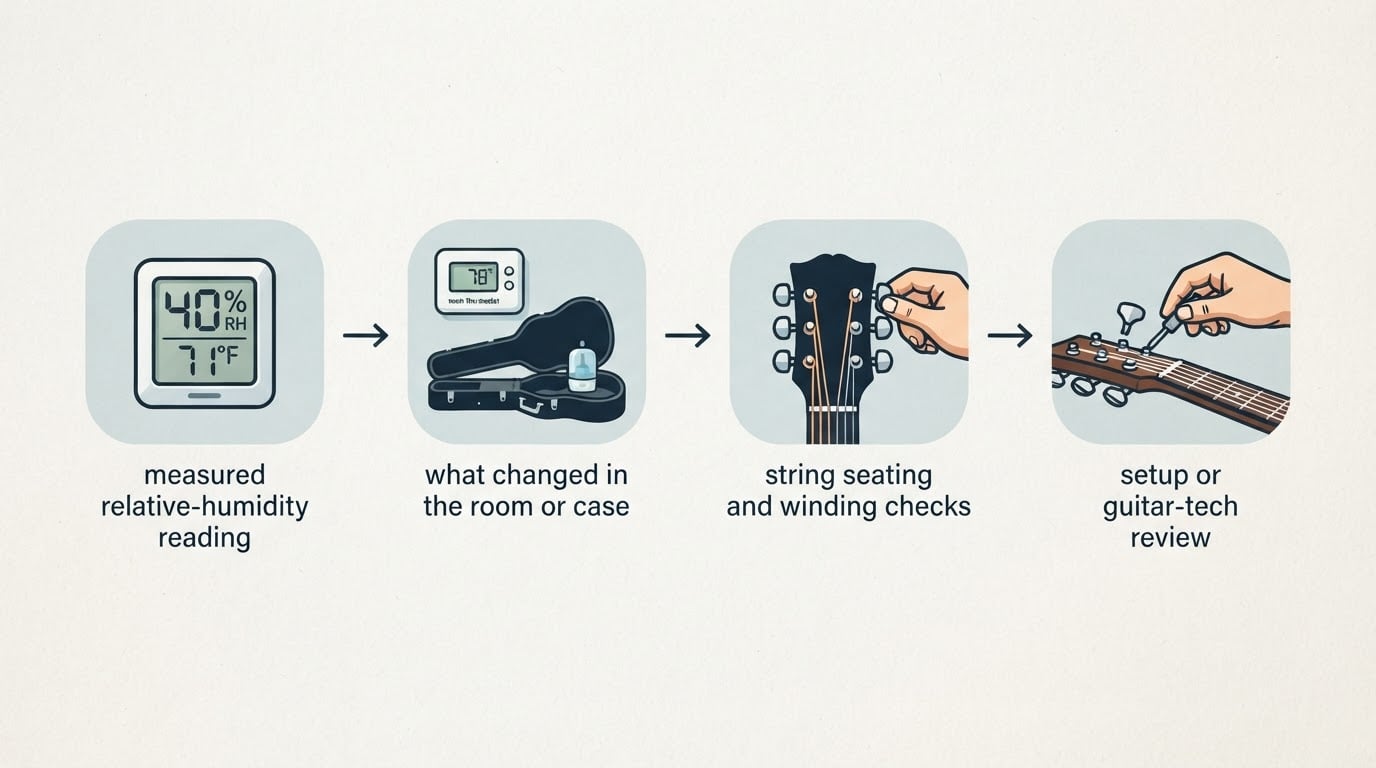
Start with a number instead of a feeling. Place a digital hygrometer where the guitar actually lives — inside the case if that is where it sleeps, beside the stand if it does not — and let it settle before you read it. Note the reading, the time and the room. Then compare it with your tuning notes and ask whether the drift and the reading moved together. If they did, you have a correlation worth investigating; you do not yet have a cause.

Observe both sides at once rather than waiting for one to be eliminated. Measure the room, and also check the quick things that can imitate a humidity problem: string seating, wraps at the post, nut slots, tuner tension, tremolo balance and whether a new set has finished settling. Tune and seat strings with normal care — no forced tuning and no improvised adjustments — and keep notes as you go. If the drift persists, take those notes to a qualified tech.
Do not turn a sudden change or visible damage into a logging project. A pitch change that arrives abruptly, a bridge or top that looks distorted or is lifting, or a joint or finish that has clearly changed is a reason to stop measuring and have the instrument looked at, not a reason to wait for a longer record.
What a Manufacturer Range Does and Does Not Tell You
Taylor Guitars publishes 45–55% relative humidity (RH) as the ideal range in its care guidance. Its page on the symptoms of a wet guitar describes a guitar becoming over-humidified after several weeks in very high humidity (80–90%), or several months in moderately high humidity (60–70%), and lists what the company reports seeing: wood swelling far enough to stress glue joints, finish lifting, neck angles changing, action rising and a tone that turns dull. The same page recommends keeping a guitar in its case when it is not being played, keeping it away from direct sun and temperature extremes, and checking regularly for significant changes.
Those are manufacturer guidance and reported repair observations for the instruments Taylor makes, not a measured pitch prediction for every guitar. They matter here because the parts that hold your strings are the parts that change size, and a change in the top, neck or bridge can alter action, relief, the break angle over the nut and saddle, and the relationship between strings and frets. Treat a published range as the maker's care guidance for the instruments it was written for. Taylor's acoustic guidance is not automatically the specification for every solid-body electric, laminate or composite guitar, so check your own maker's documentation before adopting a number.
Note What Changed, and When
A drift that starts with the first week of heating season looks different from one that has been creeping for months. Write down the change even when it seems unrelated: the guitar moved to another room, a humidifier was added or switched off, the case now stays closed instead of open on a stand, a vent or window now points at the instrument, or it sits in direct sun for part of the afternoon.
Temperature belongs in the same note, because a stable RH reading does not by itself rule out temperature effects. An instrument that has just come in from a cold car or a hot trunk has not settled yet, so give it time in its case to come back toward room conditions before you judge the tuning. Then measure, tune and log in the same place, under the same conditions. A reading taken in a different room, or right after the guitar has been handled, is harder to compare with the next one.
Check Strings and Seating Alongside the Room
String hardware produces the same complaint as humidity, and it takes less time to check. Work through the places where a string can move without changing its intended pitch: a ball end or winding sitting badly at the bridge, too few wraps at the post, a string binding in a nut slot instead of sliding through it, a tuning machine that slips under tension, a tremolo that has not returned to its balance point, and a new set that has not finished settling. A string that pings or jumps before it lands in tune is pointing at a contact point rather than the weather.
If the drift began right after a string change, run the restringing checks next to your room readings instead of choosing one explanation first. Guitar Won't Stay in Tune After Restringing covers the seating, winding and settling points that most often explain a guitar that moves after new strings go on. If the same session also produced fret buzz, treat that as a separate symptom and work the checks in Guitar String Buzzing After Restringing; buzz that arrives with a restring is usually a string or setup clue, and it is worth resolving before you change the environment.
One or two strings drifting while the rest hold is a clue about those strings' path over the nut, saddle and bridge. It is not a diagnosis, and it does not rule out a room effect acting on one part of the instrument.
Keep a Log That Helps You Compare
One reading on one afternoon cannot separate humidity from hardware, and a log cannot do that by itself either. A repeated log can help identify a pattern and guide checks, because it gives you observations taken with the same method. Record the reading where the guitar is stored, the temperature, where it was kept, which strings drifted, which direction they went, and what you changed or did. Leave the rows blank and add entries as you go. An observation period of two or three weeks is one optional way to catch a slow drift; it is not a validated diagnostic window, and it is not a reason to delay help if something changes suddenly.
Date and time | RH where stored (%) | Temperature (°F) | Stored in | Strings that drifted | Sharp or flat | What changed or what you did |
|---|---|---|---|---|---|---|
|
|
|
|
|
|
|
|
|
|
|
|
|
|
|
|
|
|
|
|
|
|
|
|
|
|
|
|
|
|
|
|
|
|
|
|
|
|
|
|
|
|
Read the log for patterns that guide the next check rather than for a verdict.
What the log shows | What it does not establish | Next check |
|---|---|---|
RH moves and tuning moves with it, repeatedly | That humidity caused the drift | Hold storage conditions steady and keep observing |
Tuning moves while RH stays in a narrow band | That humidity is ruled out — temperature, lagged wood movement, and sensor placement or accuracy still matter | Check temperature and hygrometer placement; then string and hardware |
One or two strings drift while the rest hold | A confirmed local fault | Nut slot, saddle, bridge seating and tuning machine |
Drift began with a restring | That string settling is the cause | Restringing checks before any setup change |
Action and tuning both change across seasons | A proven geometry problem | Measure relief and action; discuss a seasonal setup with a tech |
No single row names the cause, and the table is a list of checks rather than a flowchart with one correct answer. Stable measured RH does not rule out temperature, lagged wood movement, sensor placement or accuracy, or other environmental effects. A few weeks of notes do not promise that the cause will settle; they give you and a tech better observations to compare.
When to Take It to a Guitar Tech
Some changes are beyond what a hygrometer and a tuner can resolve. Book time with a tech if action stays high or low after the instrument has settled, if the top or bridge looks distorted or is lifting, if a joint or the finish has changed, or if the neck angle looks wrong. The same applies when tuning keeps drifting while your log shows a stable reading, or when you find yourself wanting to adjust the truss rod to fix a problem you suspect is moisture.
Do not wait for a logging period when the change is sudden or you can see damage. Taylor's wet-guitar guidance notes that wood distortion and other damage can remain even after the conditions that caused it have been addressed, and that glue-joint failure, finish lift and neck-angle problems can be costly repairs. Those are not problems to chase with a humidifier and hope. A tech can measure relief, action and fret condition and tell you whether the instrument needs a setup, a repair, or simply a stable place to live.
What Not to Conclude
Four habits keep the diagnosis honest. First, do not expect a fixed number of cents per point of RH, and do not assume a direction: observe what your guitar actually does instead of predicting it. Second, do not treat a humidifier as a tuning fix; it changes the conditions the instrument lives in over time, and it does not guarantee that drift disappears. Third, do not change several variables in the same week — if you moved the guitar, changed strings and added humidity control together, you cannot credit or blame any one of them. Fourth, do not try to dry out or heat a guitar quickly, and do not turn the truss rod to correct a suspected moisture problem.
Adjusting relief while the wood is still moving makes the next reading harder to interpret. Measure first, change one thing at a time, and let repeated observations — not a rule of thumb — tell you what to check next.