What open G tuning is
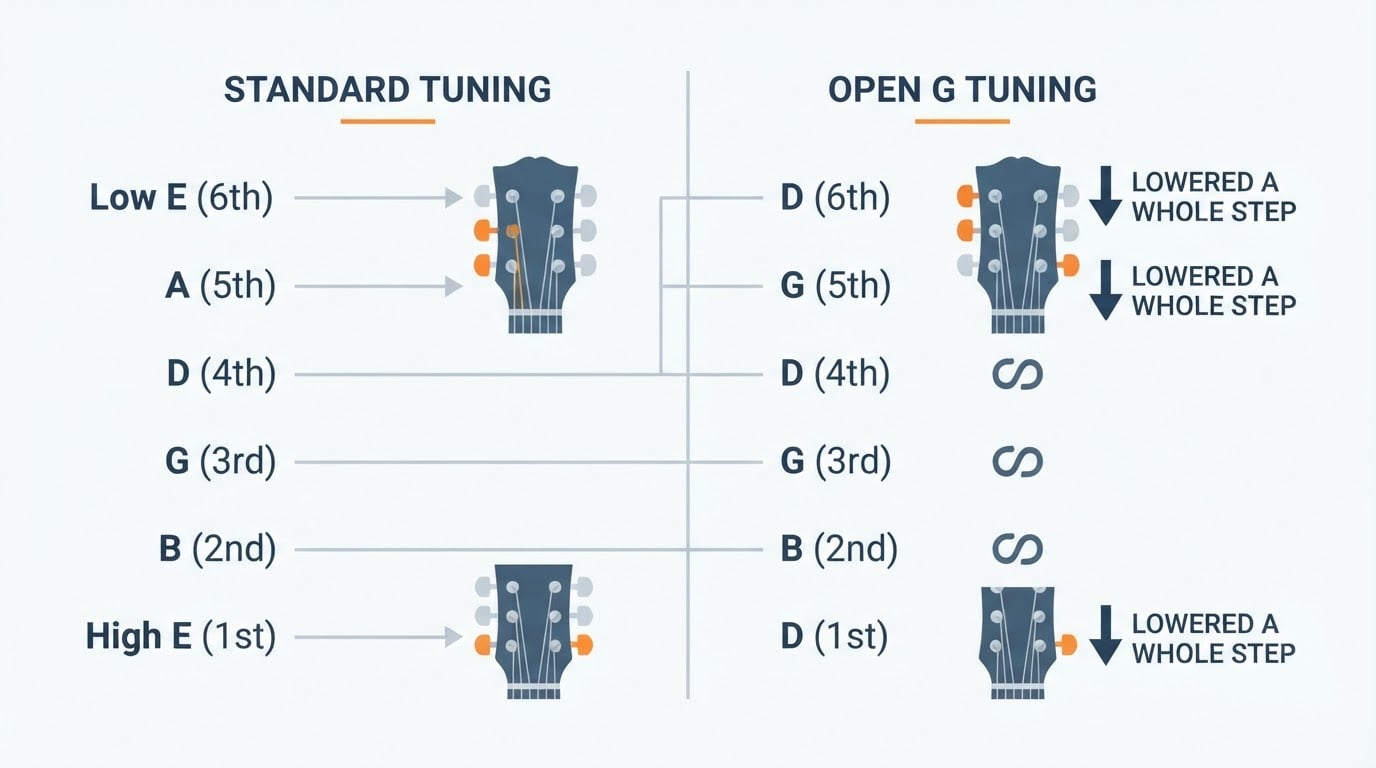
Open G tuning sets the six guitar strings to D2 G2 D3 G3 B3 D4, reading from the lowest string (the 6th) to the highest (the 1st). Strum all six strings without touching a fret and you hear a G major chord, because those notes spell out the three notes of the chord: the root G, the third B, and the fifth D.
That is what "open" means here. The open strings already form a full major chord, so the tuning gives you a usable chord before you press anything down.
String | Standard tuning | Open G target | What changes |
|---|---|---|---|
6th (lowest) | E2 | D2 | down a whole step |
5th | A2 | G2 | down a whole step |
4th | D3 | D3 | unchanged |
3rd | G3 | G3 | unchanged |
2nd | B3 | B3 | unchanged |
1st (highest) | E4 | D4 | down a whole step |
Three details make the layout easier to remember:
- The 6th string sounds D2 and the 4th string sounds D3, the same note an octave apart.
- The 5th string sounds G2 and the 3rd string sounds G3.
- The major third of the chord is the 2nd string (B3), which is why open G feels so different from the chord shapes you learned in standard tuning.
Strings 4, 3 and 2 keep the pitches they have in standard tuning, so moving between standard and open G only involves three pegs.
How to tune to open G from standard tuning
The move is simpler than it looks: three strings drop by a whole step, and none of them go up. Lower the 6th string from E2 to D2, the 5th from A2 to G2, and the 1st from E4 to D4. Leave the 4th, 3rd and 2nd strings alone.
Work one string at a time and mute the others so the tuner or your ear hears only the string you are adjusting.

- Start from standard tuning. Check that the guitar is close to pitch first, since the three strings that stay put need to be right.
- Lower the 6th string from E2 to D2, a whole step down.
- Lower the 5th string from A2 to G2, another whole step down.
- Check the 4th, 3rd and 2nd strings (D3, G3, B3). They do not move.
- Lower the 1st string from E4 to D4, a whole step down.
- Recheck all six strings. Slackening three strings changes the pull on the neck, so the others can drift slightly flat and need a small correction.
With a tuner
Use a chromatic tuner or an Open G preset, and lower each of the three strings until the display lands on D2, G2 or D4. When you are close, loosen the string slightly below the target note, then bring it back up to pitch. Approaching the note from below helps the string settle and hold.
Then check the result by octave rather than trusting the display alone:
- The 6th string at the 12th fret should match the open 4th string (D3).
- The 5th string at the 12th fret should match the open 3rd string (G3).
- The 4th string at the 12th fret should match the open 1st string (D4).
Without a tuner
If the 4th, 3rd and 2nd strings are still in standard tuning, you can derive every other note from them:
- 6th string: play the open 4th string (D3), then lower the 6th until its 12th-fret harmonic matches that D.
- 5th string: play the open 3rd string (G3), then lower the 5th until its 12th-fret harmonic matches that G.
- 1st string: play the 4th string at the 12th fret (D4) or the 2nd string at the 3rd fret (D4), then lower the 1st string to that pitch.
If you have a reference pitch from a piano, a tuning fork or another instrument, set the 6th string to D2 first, then use the same octave checks for the 5th and 1st strings.
If you want to confirm the target notes before you start turning pegs, a free browser tuning reference such as GuitarTuner.io can help: each alternate tuning has its own page with the target note for every string, alongside a browser tuner you can use while you adjust. Treat it as a reference, not a replacement for your ears, because the chord still has to ring clean.
Why players use open G
Two properties explain almost everything open G is used for.
One-finger chords. Because the open strings already sound a G major chord, a straight barre across all six strings gives you the major chord of whatever fret you are on. Barre at the 5th fret and you have C; move to the 7th and you have D. That is a full I-IV-V progression with a single shape.
A built-in drone. The low D and G ring under everything you play, so open G sounds full even when you play only two or three notes.
That combination is why the tuning shows up in a few familiar places:
- Slide guitar. Lay a slide flat across the strings at any fret and you get a major chord, so chord changes and melody notes become the same movement. Open G has been a standard choice for bottleneck playing for decades.
- Blues. Twelve-bar progressions need the I, IV and V chords, and open G hands them to you at three positions on the neck.
- Rock riffs. The open strings work as a constant drone under fretted notes, which suits riff-driven songs and big ringing chords.
The trade-off is honest: the standard chord shapes you already know no longer line up the same way, and songs written in standard tuning have to be relearned or transposed.
Open G chord shapes and first steps
The open strum is home base. From there, most of the neck is open to you:
- Barre at fret 2: A major.
- Barre at fret 5: C major.
- Barre at fret 7: D major.
- Barre at fret 10: F major.
- Barre at fret 12: G major, one octave higher.
- G minor: lower the 2nd string from B3 to B♭3, or mute the 2nd string and fret the 3rd string at the 3rd fret.
A simple first session:
- Strum the open strings and listen for the G chord.
- Play G (open), then C (barre at 5), then D (barre at 7), and repeat.
- Move the barre slowly up the neck and stop on the frets that sound like clean chords.
- Finish by checking each string one at a time, since barring too hard pushes notes sharp.
Common beginner mistakes
- Moving the wrong strings. In open G the 6th, 5th and 1st strings go down; the 4th, 3rd and 2nd stay where they are.
- Tuning up instead of down. The three changed strings all move to a lower pitch. Loosening is the safe direction.
- Expecting standard chord shapes to work. Open G moves the third of the chord to the 2nd string, so familiar fingerings produce different chords.
- Skipping the recheck. Newly slackened strings drift for a few minutes, and the neck reacts to the change in tension.
- Pressing the barre too hard. A tight barre pulls notes sharp; use just enough pressure for a clean sound.
- Forgetting that the capo changes the key. A capo at fret 2 makes A, not G.
Open G tuning FAQ
What notes are in open G tuning?
From the 6th string to the 1st: D2, G2, D3, G3, B3, D4. The root G appears on the 5th and 3rd strings, the fifth D on the 6th, 4th and 1st strings, and the third B on the 2nd string.
Is open G the same as drop D?
No. Drop D lowers only the 6th string from E2 to D2 and leaves the rest in standard tuning (D A D G B E). Open G changes three strings and turns the open chord into G major.
Do I need different strings for open G?
No. A standard set works. The lowered strings feel a little looser under your fingers, which is normal for a down-tuned string.
Does open G work on acoustic and electric guitars?
Yes. The intervals are the same on both, so the target notes are identical.
Can I still play songs written for standard tuning?
You can, but the fingerings change, and tab written for standard tuning assumes E A D G B E.
How do I get back to standard tuning?
Raise the 6th string to E2, the 5th to A2 and the 1st to E4, then recheck the other three strings.
Does open G work with a capo?
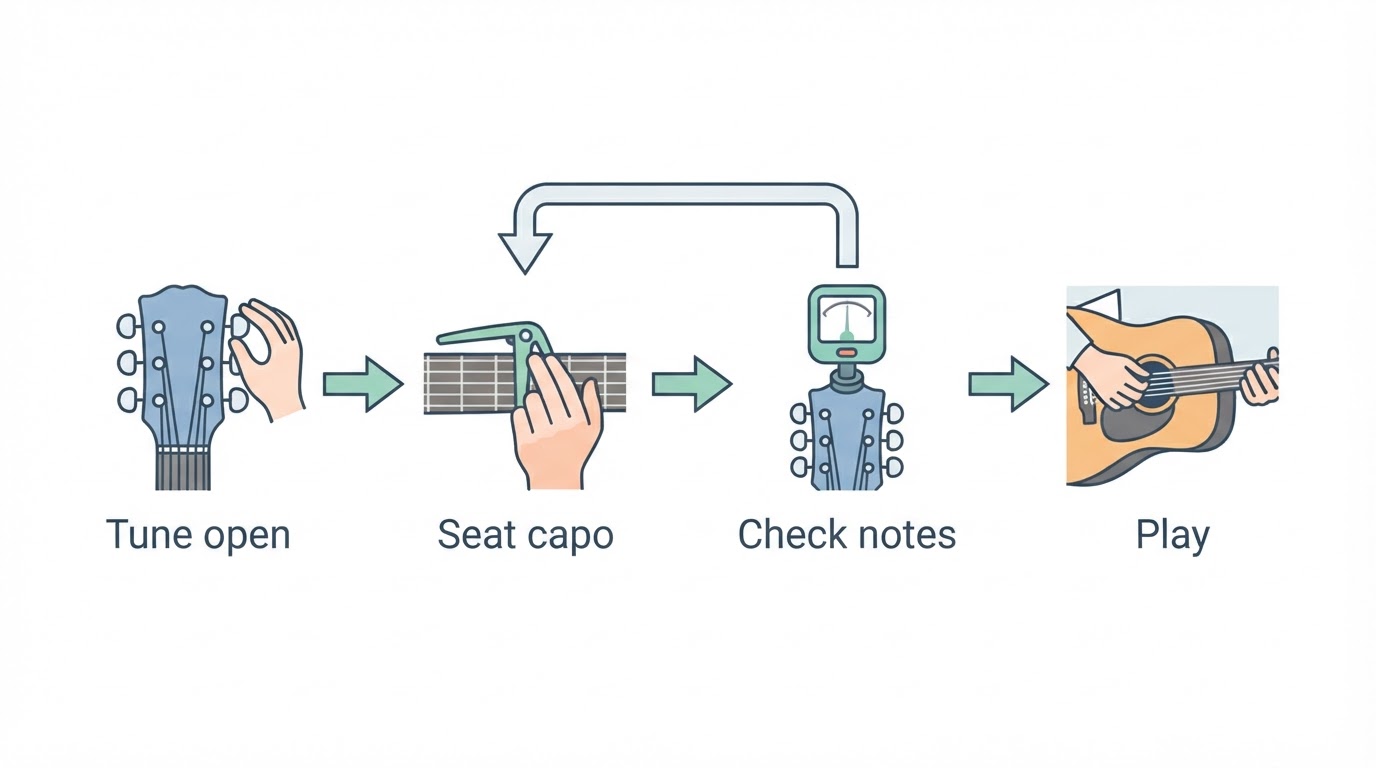
Yes. A capo raises the whole tuning, so a capo at fret 2 gives you A major, at fret 5 gives C, and at fret 7 gives D.