A bend changes tension, and every contact point has to give it back
Bending raises string tension, and pitch rises with it. Release the bend and the string has to return to its starting tension, which means sliding back through every point that touches it: the nut slot, the saddle, any string tree, and the wraps around the tuning post. If one point grips while the rest relaxes, the string settles at a different tension than it started. StewMac's repair guidance is direct about where this happens: string binding at the nut is responsible for most tuning stability problems, and a string that cannot glide smoothly will not survive a bend without drifting. Their five causes of unstable tuning cover the rest.
Sort the symptom before you touch anything
Start with the direction of the drift, because it narrows the list to one or two suspects.
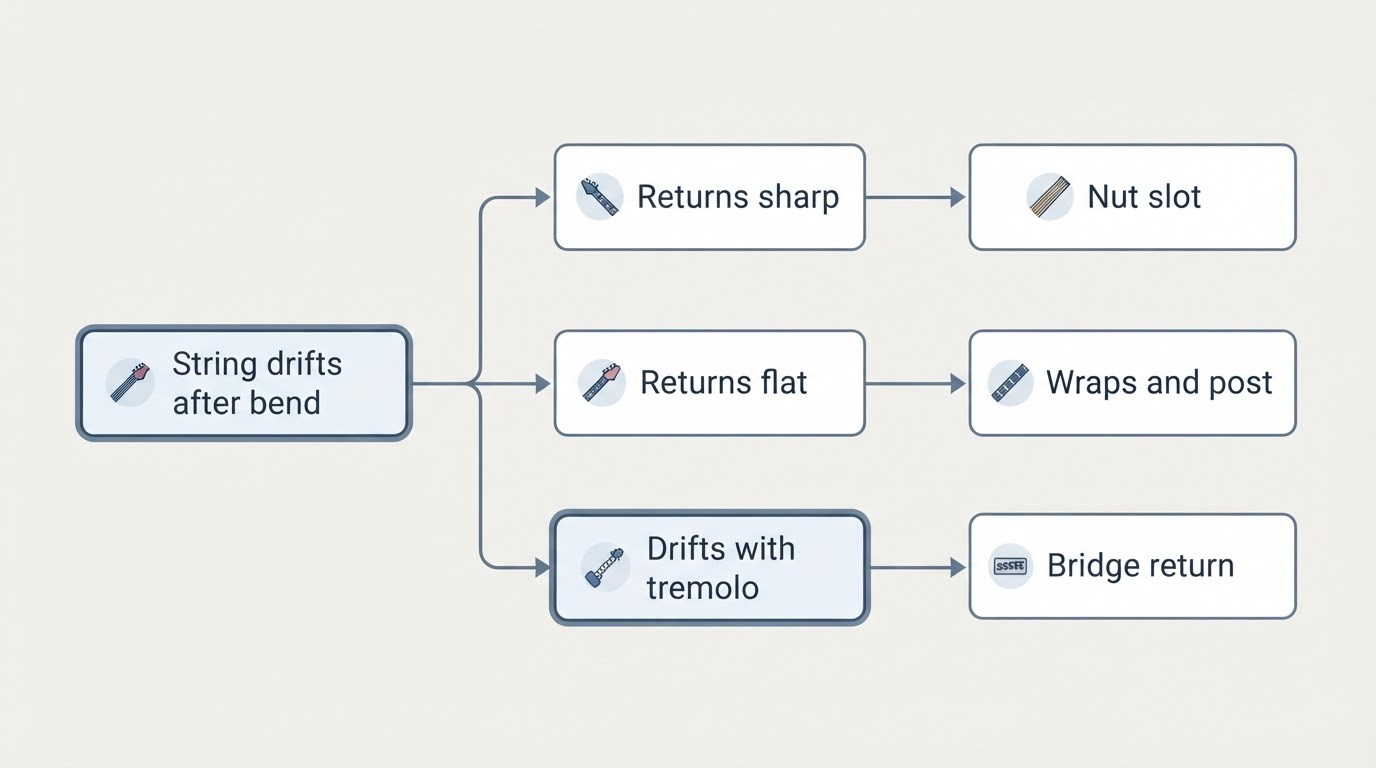
What you notice after a bend | First place to look | What it usually means | Sensible next step |
|---|---|---|---|
Comes back sharp | Nut, string tree or saddle friction | The string may not have returned through a contact point | Watch whether pitch moves smoothly or jumps; have a tech check slot and saddle fit |
Comes back flat | New string/wrap settling, bridge movement or friction | Tension may not have returned to its starting state | Retune, inspect winding and bridge position, then test again |
Drifts only when you use the tremolo arm | Bridge and springs | The bridge did not return to its resting position | Depress and release the arm, then compare pitch against a tuner |
Gets worse over days and weeks | String condition | Worn strings no longer hold pitch consistently | Feel along each string and replace anything gritty, rusty or dented |
The four causes behind most bend-related drift
Nut slot friction: the sharp signature
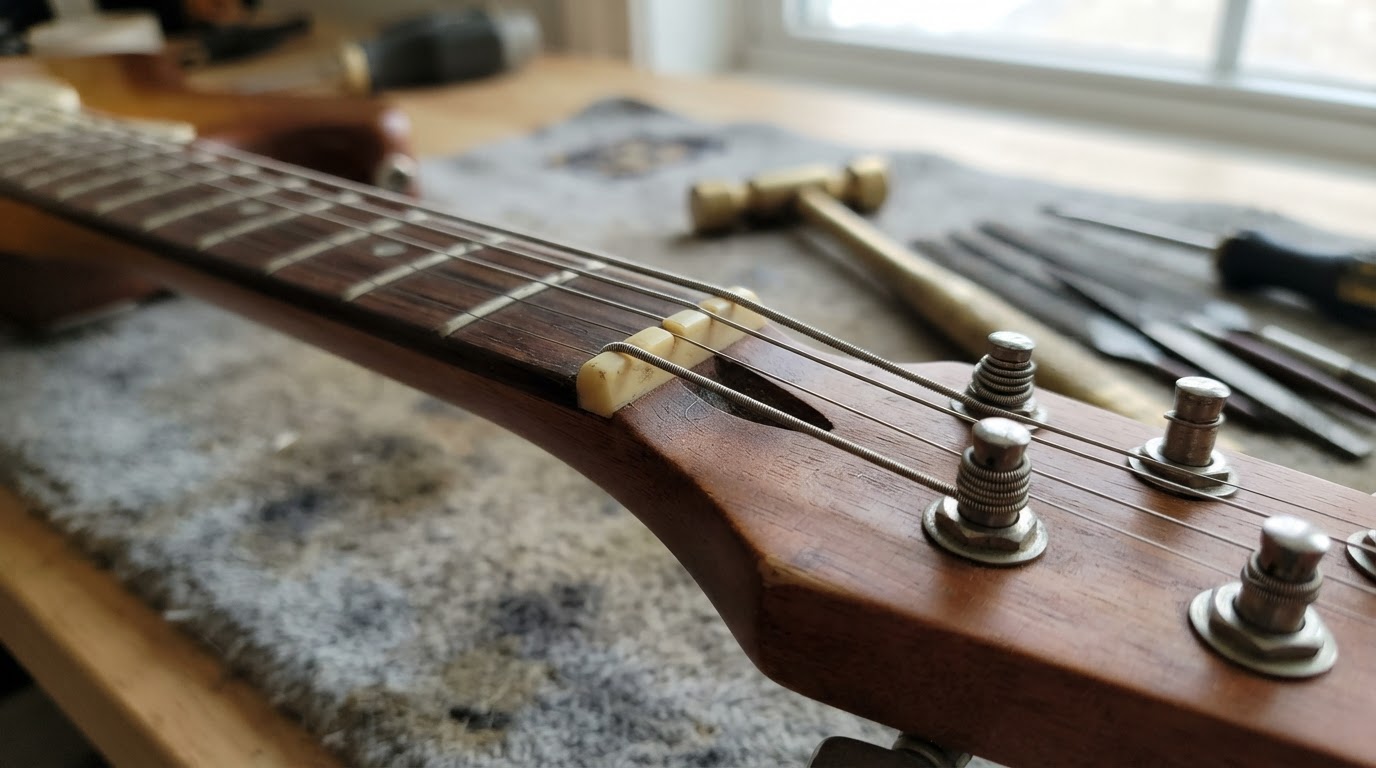
A bend changes tension across the string path. If a nut slot pinches the string, the pitch may fail to return correctly after release, but the direction alone is not proof of which contact point is binding. StewMac describes a related clue: while tuning, nothing happens at first, then the note suddenly jumps. Slot work is not a home job with improvised tools; a slot can be ruined in a few strokes, so have width, floor and exit angle measured first.
Wraps and seating at the post: the flat signature
Returning flat may mean a new string or its wraps are still settling; bridge or saddle movement can also be involved. StewMac notes that tuners get far more blame than they deserve and that drift can come from improper winds, nut friction or loose hardware. Tune up to pitch rather than down, and stretch new strings gently while retuning until the pitch stabilizes.
Bridge, saddle and tremolo
On a fixed bridge, the saddle and tailpiece are the second anchor, and anything loose there shifts pitch; a burr or deep groove can catch a string just as a nut slot can. A floating tremolo has to return to the same resting position every time, which depends on spring balance and clean pivot contact. StewMac's check: depress and release the arm, then confirm with a tuner that the pitch comes back.
Old strings and still-stretching strings
New strings stretch during the first session, drifting flat until they seat, and old, work-hardened strings lose the elasticity that lets them hold pitch. If every string keeps drifting, that is no longer bend-specific. It is ordinary tuning instability: string condition, friction at the nut, loose hardware, and temperature or humidity change.
Five checks that take about five minutes
- Tune up to pitch, not down to pitch. Coming up from below takes the slack out of the gears and the wraps.
- Stretch each new string gently along its length, retune, and repeat until the pitch stops dropping.
- Bend the string, hold it, release it, then measure the result with a tuner. Record the direction and size of the drift before changing anything.
- Listen and feel as you turn the tuner. Smooth movement points away from slot binding; a ping, click or sudden jump points toward the nut.
- With a tremolo, depress and release the arm and compare the pitch before and after.
For instability that began after installing new strings rather than specifically after a bend, see our post-restringing tuning checklist.
What not to change first
Replacing tuners rarely fixes this; the problem usually sits in the string path or the installation. Filing a nut slot is the same trap, since slot geometry is measured work and a slot is easy to damage. A lubricant is not a diagnosis either: it changes friction without correcting a slot that is too narrow or a string seated too deep. Weather matters too, because temperature and humidity move the wood.
When to hand it to a technician
Book setup work when the checks point to the nut, when a tremolo will not return to pitch, when hardware will not stay snug, or when the guitar has never had a proper setup. A guitar is also an imperfect instrument: even a well-intonated one is slightly out in some positions, because intonation spreads the error rather than removing it.
Three questions players actually ask
Why does a string go sharp after I bend it?
The string may be catching and not returning to its starting tension. The nut is one place to check, but a saddle, string tree or tremolo can also be involved. A sudden pitch jump as you tune suggests a grip point.
Why does it go flat after a bend instead?
Flat can point to settling wraps, a string that has not fully seated, bridge movement or another binding point. Check winding and bridge position, then tune up to pitch; if the cause remains unclear, ask a tech.
Do I need new tuners?
Usually not. Check the installation, the nut slots, the bridge and the strings before spending money on hardware. Fresh strings, tidy wraps and a clean string path hold pitch well even with modest tuners.