What Actually Changes When You Tune to Drop D
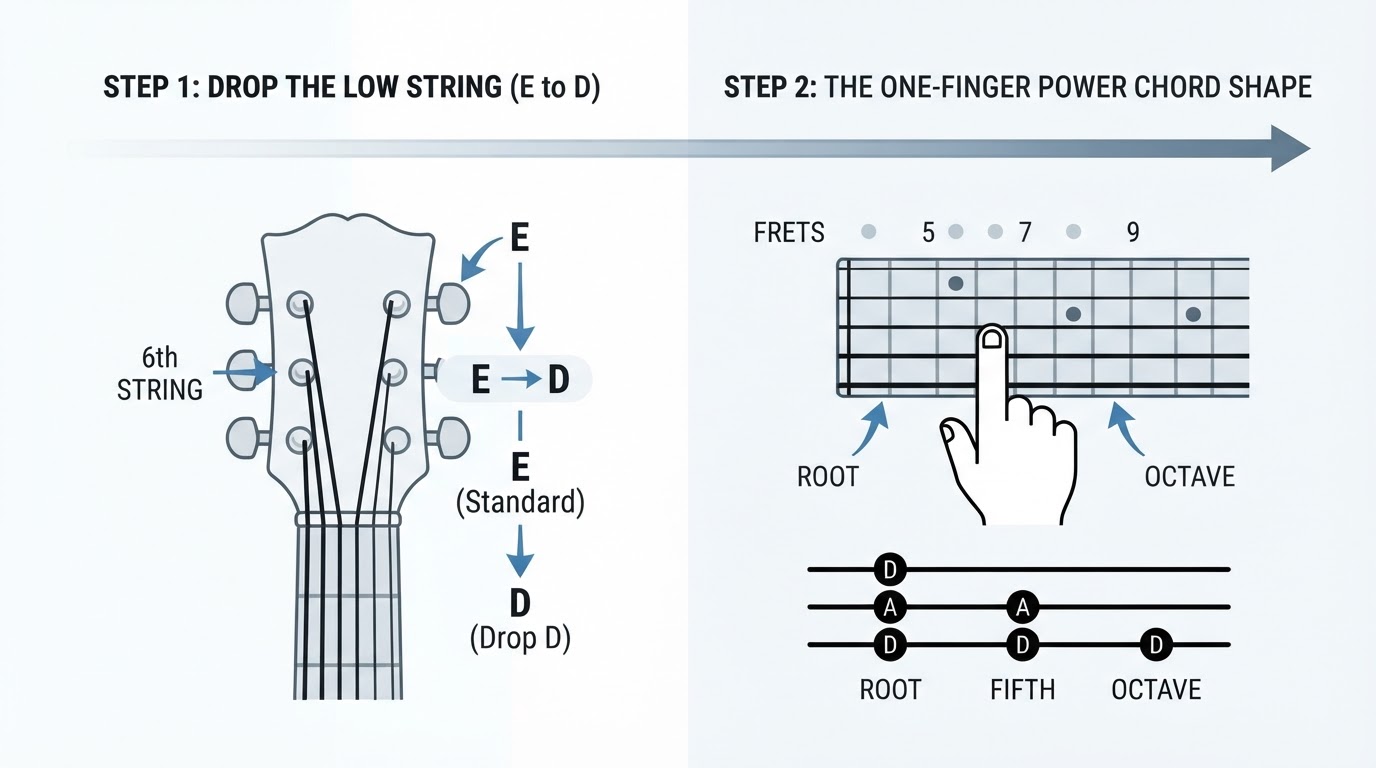
Drop D lowers exactly one string. The sixth string goes down a whole step, from E to D, so the guitar reads D A D G B E from low to high. Strings five through one never move, which is the most useful fact to keep in mind: every chord shape that lives on the top five strings keeps its fingering and its intervals.
The low D changes what the open string is worth. It is the root of D, the fifth of G, the minor third of B minor, and the fourth of A. That is why drop D sits so naturally under progressions built on D, G, B minor and A. It also means the open sixth string helps one chord and clashes with the next.
Fretted notes on the sixth string land somewhere new as well. The third fret is now F instead of G, the fifth fret is now G instead of A, and the seventh fret is now A instead of B. Any shape that relies on a fretted note on the low string — the open G grip, the open E grip, the six-string barre you learned first — needs adjusting. Shapes that ignore the low string do not.
Why the Low D Makes One-Finger Power Chords Possible
A power chord is a root, a fifth and an octave. In standard tuning you build that stack with two or three fingers because the strings are tuned in fourths and the notes fall in different places. Drop D puts the bottom three strings at D, A and D, so the root, the fifth and the octave sit directly under one finger. One fret across all three strings and the whole chord sounds.
Lay your index finger flat across strings six, five and four at the same fret and press just hard enough to sound the notes. The shape slides anywhere on the neck:
Fret | Chord | Notes (6–5–4) |
|---|---|---|
0 | D5 | D A D |
2 | E5 | E B E |
3 | F5 | F C F |
5 | G5 | G D G |
7 | A5 | A E A |
9 | B5 | B F# B |
10 | C5 | C G C |
Keep the unused high strings quiet with your picking-hand palm or the underside of your fretting hand. Then practice sliding the same grip between frets without lifting the finger off the strings, because that slide is the engine behind most drop D riffs. Palm muting near the bridge turns the shape into a tight rhythm, and releasing the palm lets the chord ring.
Open Chords That Gain a Low D
The D family is where drop D tuning chords reward you immediately, because the open low string doubles a note you already play. The familiar open D shape becomes 000232: open sixth, open fifth, open fourth, second fret on the third string, third fret on the second, second fret on the first. Every note still belongs to D major, but the low D adds a bass note an octave below anything in the standard grip.
Chord | Frets (6 → 1) | What changed |
|---|---|---|
D | 000232 | open low D doubles the root |
Dm | 000231 | first string at the first fret gives F |
D7 | 000212 | second string at the first fret gives C |
Dmaj7 | 000222 | second string at the second fret gives C# |
Dsus2 | 000230 | open first string gives E |
Dsus4 | 000233 | first string at the third fret gives G |
Use the usual D triangle: index finger on the third string at the second fret, ring finger on the second string at the third, middle finger on the first string at the second. The low string stays open for all six chords. Dm and D7 simply drop one finger toward the nut — Dm takes the first string down to the first fret, D7 takes the second string down to the first fret. For Dmaj7, lay the index finger across the top three strings at the second fret. For Dsus2 and Dsus4, keep the triangle and move only the first string.
Movable Barre Shapes for Major and Minor Chords
Once you leave open position, two shapes cover almost everything in drop D. Both start with an index-finger barre across strings six, five and four at the root fret.
For a major chord, put the middle finger on the third string one fret closer to the nut, then the ring finger and pinky on the second and first strings two frets closer to the nut. That gives E major at the second fret (222100), F major at the third (333211), G major at the fifth (555433), A major at the seventh (777655), C major at the tenth (10-10-10-9-8-8) and D major again at the twelfth (12-12-12-11-10-10).
For a minor chord, keep the index barre where it is and lay the ring finger across the top three strings two frets closer to the nut. That gives E minor (222000), F# minor (444222), G minor (555333), A minor (777555) and B minor (999777). The two-fret gap feels like a stretch at first; anchor the barre, then place the upper finger without letting the barre move.
The Standard Shapes You Keep
Chords rooted on the fifth string keep their normal fingerings in drop D. A as x02220, Am as x02210, C as x35553 — none of them touch the sixth string, so nothing about them changes. Just mute the low string with the side of your thumb or by picking accurately; the open D is the fourth of A and the ninth of C, so leaving it ringing is a colour choice, not a default.
The shapes that do change are built on the low string. The standard E grip needs a new home: play E major as x79997 or as the barre shape 222100, and Em as x79987. G, which used the third fret of the sixth string in standard tuning, becomes x20033 with B in the bass, or the movable 555433. One happy accident is worth knowing: the old 022000 Em grip now sounds as Em7, because the open low D adds the seventh to the chord.
Progressions and Keys That Suit Drop D
Drop D leans toward D. The keys that feel most at home are D major, D minor, D mixolydian, G major where the low D is the fifth, B minor where it is the minor third, and A major as a secondary centre.
A few progressions to loop:
- D–G–A, the I–IV–V of D: 000232, 555433, 777655.
- D–A–Bm–G, the I–V–vi–IV shape behind countless pop songs: 000, 777, 999, 555, all with the same one-finger grip.
- D–F–G, a rock move in D: 000, 333, 555, no shape change at all.
- Dm–Gm–A, a darker minor turn: 000231, 555333, 777655.
Notice how little the fretting hand moves between those chords. In drop D a progression is often one shape sliding along the low strings while the upper strings stay out of the way. That is also why riffs in the tuning sound heavier than the same notes in standard: the low D is a whole step lower, and every power chord inherits the weight.
Combining the Low D With Higher Voicings
You do not have to play all six strings to use the tuning well. The low D works as a pedal note under fragments played higher up.
- Split the chord. Keep the sixth string open and play just the top three strings of the D shape — second fret on the third string, third fret on the second, second fret on the first. The result is a full D major spread across two octaves without a barre.
- Double the melody. The sixth and fourth strings are both D, so fretting the same fret on both gives the same note an octave apart, an easy way to make a single-note riff sound bigger.
- Stack fifth and octave. Fretting the fifth and fourth strings at the same fret gives the fifth and the octave above the root. Add the third string one fret closer to the nut for the major third, and the full barre shape appears again.
- Change the colour, not the bass. D, Dsus2, Dsus4 and Dmaj7 all keep the open low D. You can move between them by shifting one or two fingers on the upper strings while the bass note rings on.
- Hold the drone in G. The low D is the fifth of G, so a G chord played on the top five strings gains weight when the open low string rings underneath.
Double Drop D: Two Drones Instead of One
Double drop D takes the idea further: both E strings drop to D, giving D A D G B D. The first string becomes an open high D drone, so fingerpicked patterns and melodic lines have a ringing high note to fall back on, and D chords get a low and a high D at the same time.
The grips shift accordingly, and the trade-off is that any shape which used the open high E needs the first string re-fretted. With the first string tuned to D, the open D shape becomes 000234, because the note that used to sit at the second fret of the high E string now lives two frets higher on the D string. Treat double drop D as a variation to explore after drop D feels comfortable. The low-string power chords are unchanged, so everything you have learned still works.
Practice Tips That Make It Stick
- Tune down, never up. Pluck the open fourth string, which is D, and lower the sixth string until the two match. Work in small turns, and expect to repeat this for a few days while a new string settles.
- Confirm the low D before you play. GuitarTuner.io gives each tuning its own page, and the Drop D page pairs the target notes with a free microphone tuner you can open in a browser. Playing the sixth string against that readout is a fast way to verify the low D before the first chord.
- Drill the slide. Practice the slide between D5, G5 and A5 with palm muting until the changes land cleanly, then move the same grip to F5 and C5.
- Mute with intention. The open low string rings under everything. On A and C shapes, rest the thumb or the side of your picking hand on the sixth string, and lift it only when the chord wants the bass note.
- Change chords slowly. Set a metronome to 60 and change on the fourth beat. Speed comes from the change, not from the chord.
- Record one loop. Play a two-chord progression for a minute, listen back, and check whether the low D is still in tune at the end. If it drifts, the string is still stretching.
- Retune at the end of the session. A slack sixth string settles faster if you bring it back to pitch before you put the guitar away.
What to Do When It Does Not Sound Right
- A sour clash over an A chord is usually the open D, which is the fourth of the chord. Mute the low string.
- A dull, flabby low D usually means the string is below pitch. Compare it with the open fourth string; the two should sound identical.
- A rattle after you lower the string can come from a setup adjusted for standard tension. If it persists with a fresh set of strings, have the guitar checked.
- Muted or dead single notes usually mean a finger is touching a neighbouring string. Move the fretting hand slightly away from the neck and press closer to the fret.
- A chord that will not stay in tune is not damaged. Detuning one string changes its tension, and both new and old strings need a few tuning passes to settle.
Common Questions
Do normal chord shapes still work in drop D?
The ones that avoid the sixth string do. A, Am, C and the rest of the fifth-string family keep their exact fingerings, and the top three strings keep their standard intervals. Shapes that fret or rely on the open low E — E, Em, G, and the standard six-string barre — change, and the charts above show the replacements.
Is drop D easier to play?
The power chords are easier, and that is most of what the tuning is used for. Barre chords still take practice, and muting matters more because a slack bass string keeps ringing. If you can hold down a barre, you can play almost any drop D rhythm part.
Can I tune to drop D without a tuner?
Yes. Pluck the open fourth string, then lower the sixth string until it matches that note. Take your time and make small turns, because the string is already slack and a small movement changes the pitch quickly. Check the result against a tuner once you are close.
Does drop D damage my guitar?
No. Lowering one string by a whole step is a normal tuning, well inside the tension range of a standard set. The string may go out of tune more often for a day or two while it settles.
Which songs sound good in drop D?
Songs built on D, G and B minor, and rock or metal riffs that lean on the low string for root-and-fifth movement. If a song depends on the open low E, or on six-string shapes that use it, the part will not translate cleanly. That is a tuning choice, not a flaw.
What is the difference between drop D and double drop D?
Drop D lowers only the sixth string. Double drop D lowers the first string as well, so both outer strings are D and you gain a high drone on top of the low one. The power chords are identical; the open chords and picking patterns are what change.