What drop C tuning is
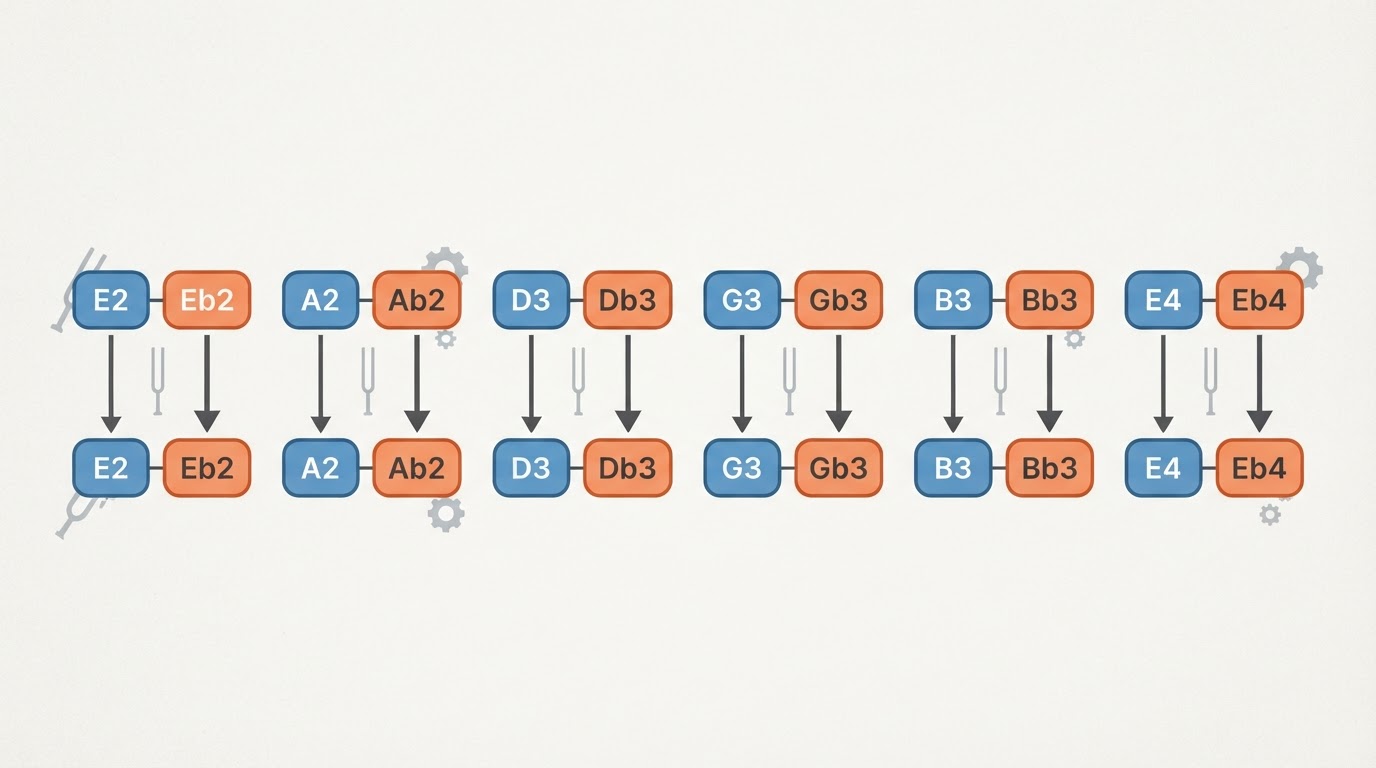
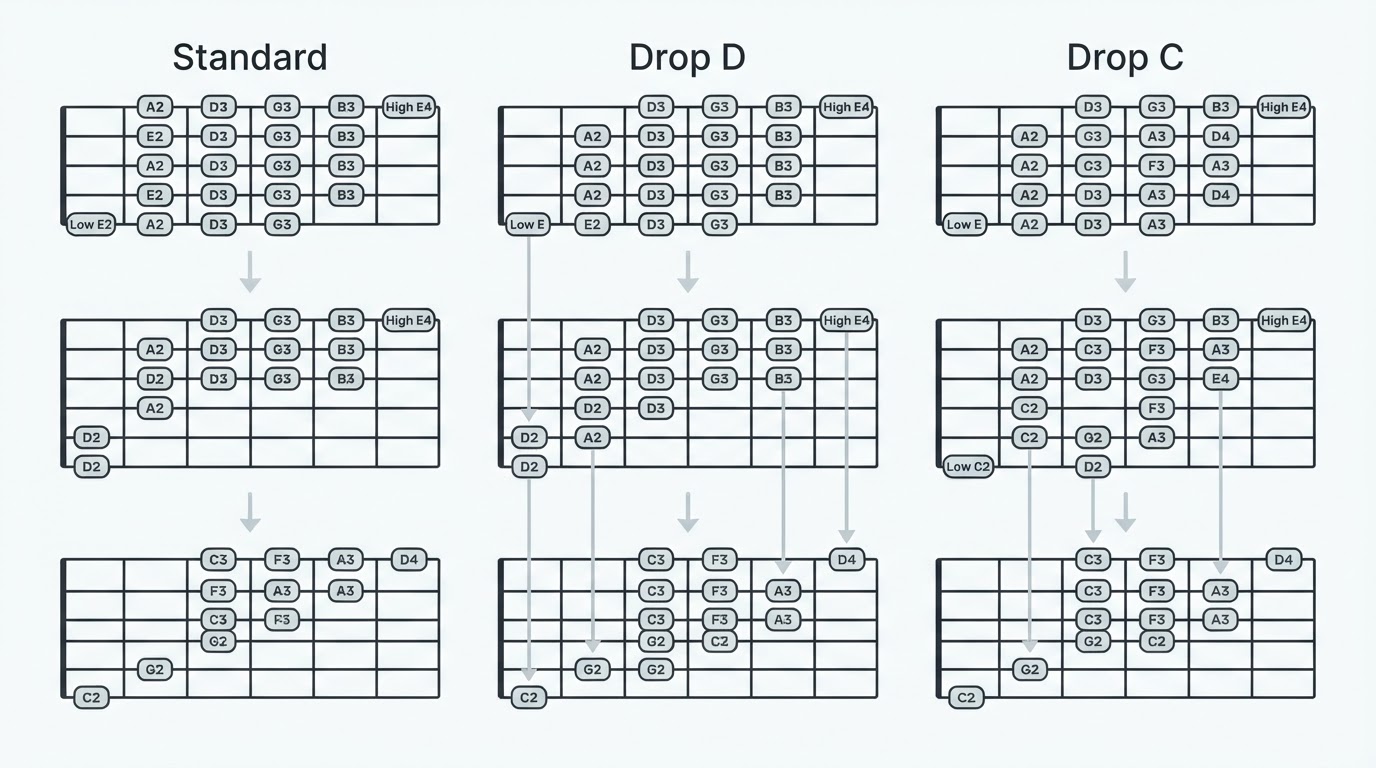
Drop C tuning is an alternate guitar tuning built by lowering the whole instrument a whole step (two semitones) from standard and then dropping the sixth string one more whole step. Low to high, the open strings are C2, G2, C3, F3, A3, and D4.
Those are the exact target notes for every string:
String | Note | Octave | Frequency |
|---|---|---|---|
6th (lowest) | C | 2 | 65.41 Hz |
5th | G | 2 | 98.00 Hz |
4th | C | 3 | 130.81 Hz |
3rd | F | 3 | 174.61 Hz |
2nd | A | 3 | 220.00 Hz |
1st (highest) | D | 4 | 293.66 Hz |
The octave column is the part people get wrong most often. The low string is C2, not C3 — it sits two octaves below middle C — and the fourth string is the same C one octave higher.
Two relationships define how the whole tuning behaves. First, the lowest three strings (C2, G2, C3) are a root, a fifth, and an octave, so an open strum across them is already a C5 power chord. Second, the interval from the sixth string to the fifth string is a perfect fifth, not the perfect fourth you are used to in standard tuning. That single difference makes one-finger power chords possible and changes the shape of every chord that uses the low string.
Drop C, drop D, and D standard: what changes
These three tunings are easy to confuse, so it helps to see them side by side.
Tuning | Notes, low to high | What moved |
|---|---|---|
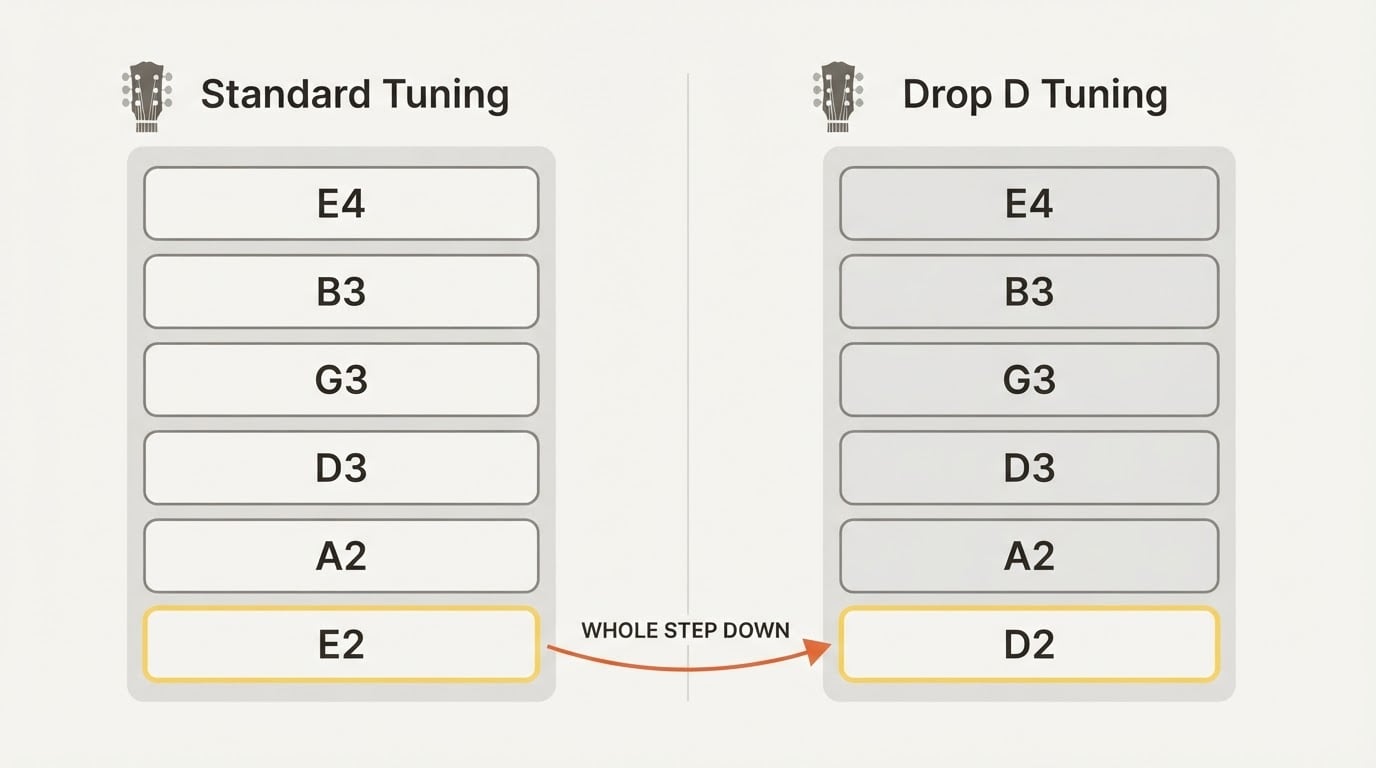
Standard | E2 A2 D3 G3 B3 E4 | — |
Drop D | D2 A2 D3 G3 B3 E4 | Only the sixth string drops a whole step |
D standard | D2 G2 C3 F3 A3 D4 | Every string drops a whole step, intervals stay standard |
Drop C | C2 G2 C3 F3 A3 D4 | Everything a whole step below drop D, or the sixth string down one more step from D standard |
Drop C is drop D taken down a whole step, and it is D standard with the sixth string dropped another whole step. Both descriptions are correct, and each one is useful depending on where your guitar is right now.
How to tune to drop C
The short route from drop D
Drop C is exactly one whole step below drop D, so if your guitar is already there the move is uniform.
- Lower each string one whole step: D2 to C2, A2 to G2, D3 to C3, G3 to F3, B3 to A3, and E4 to D4.
- Work from the lowest string upward so the neck settles once and the later checks happen on stable strings.
- Repeat the pass and then check again a few minutes later, because the guitar drops tension as a whole.
From standard tuning
You can pass through drop D or go straight to drop C.
- Pass through drop D: lower the sixth string one whole step to D2, then lower all six strings one more whole step. This is the route most players take, because drop D is a familiar landing point and the second pass is uniform.
- Straight down: lower the sixth string two whole steps (E2 to D2 to C2) and lower the other five strings one whole step each (A2 to G2, D3 to C3, G3 to F3, B3 to A3, E4 to D4).
Tuning the other strings to a reference, without a tuner
If all you have is one reference pitch — a piano key, a reference tone, or one string you trust — get the low C first, then bring the rest in line with these fret references:
- Sixth string, 7th fret = open fifth string (G2)
- Fifth string, 5th fret = open fourth string (C3)
- Fourth string, 5th fret = open third string (F3)
- Third string, 4th fret = open second string (A3)
- Second string, 5th fret = open first string (D4)
Notice the first entry: seven frets, not five. In standard tuning the sixth and fifth strings are a fourth apart, so the fifth string sits under the fifth fret. In drop C the sixth string is a fifth below the fifth string, so the reference moves up to the seventh fret.
Two checks catch most mistakes. The twelfth-fret harmonic of the sixth string is C3, exactly the open fourth string, so a clean match there confirms your low strings. Then strum the three lowest strings open: they should sound as one settled power chord, not a muddy cluster.
When you detune, approach the note from below if you overshoot: go slightly past the target and bring the string back up to pitch. That habit keeps the string from binding at the nut and slipping flat a minute later. Then recheck after a few minutes, and once more the next day — a guitar that just moved down four or five semitones will drift while the neck adjusts.
With a tuner
A chromatic tuner set to A = 440 Hz will read every target note in drop C, and many tuner apps also offer a dedicated drop C preset. Use chromatic mode if you are unsure, watch the octave number on the display, and tune the lowest string first.
For drop C specifically, the fastest way to confirm the exact target notes before you play is to let a tuner listen for you. GuitarTuner.io runs in the browser — no account, no paid upgrade, no app download — and it listens through your microphone, showing whether each string is flat, sharp, or in tune as you bring it down. It works on phones, tablets, and desktop browsers, so you can set the low C and then walk up the remaining strings one at a time while you watch the note name rather than guessing by ear.
Strings and setup: what changes when you tune this low
Pitch comes from tension. A string at drop C carries noticeably less tension than the same string at standard, so the guitar will feel different before anything is actually wrong.
- Heavier strings are the usual answer. Sets around 11–54 or 11–56 are a common starting point for drop C on a 25.5-inch scale guitar, and players who want a tighter feel — or who play shorter-scale instruments — often move to 12–60 on the low strings. A light 10–46 or 10–52 set will reach drop C, but the low strings usually feel rubbery and can drift sharp when you press them hard.
- Scale length matters as much as gauge. A 24.75-inch guitar feels looser than a 25.5-inch guitar at the same gauge, so a short-scale instrument usually wants the heavier end of the range.
- If drop C becomes your main tuning, budget for a setup. Nut slots may need widening for thicker strings, and relief, action, and intonation will likely need adjustment. Forcing heavy strings into slots cut for 9s or 10s is a common cause of pinging, tuning instability, and broken strings.
- Buzzing, notes that go sharp as you press, or a low string that will not hold pitch after a fresh set are setup symptoms rather than playing errors.
- A floating tremolo adds a step. Lowering pitch changes the tension the bridge balances against, so the whole guitar goes sharp and you have to tune in several passes — or have the bridge rebalanced for the new tuning.
Why players use drop C
- Power chords under one finger. Because the lowest three strings already form a root, a fifth, and an octave, a single finger laid across them produces a complete power chord, and every fret becomes a usable shape with no stretch.
- A heavier low end without relearning the neck. Drop C is a whole step below drop D, so riffs you already play with the sixth string as the root work in the same shapes, just lower.
- Easy low-string movement. The fifth between the sixth and fifth strings makes open-string riffs, palm-muted patterns, and low pedal tones straightforward to write and play.
- It is everywhere in modern heavy music. Drop C shows up constantly in metal, metalcore, and hard rock, which is one reason so much material is written for it.
- The trade-off: the open-position chords you know stop behaving the way they do in standard tuning, and songs written in E standard will not line up unless you transpose them.

How chord shapes change
Two rules cover almost everything.
Strings one through five behave like a guitar tuned a whole step down. Any shape that avoids the sixth string sounds a whole step lower than its standard name. Play the open-D shape and you get a C chord; move the same shape up two frets and you are back to D. Songs you normally play with fifth-string-root shapes simply sound a whole step lower.
The sixth string sits one whole step below that. In standard tuning the sixth string is a fourth below the fifth; in drop C it is a fifth below, which is a whole step lower than a straight whole-step-down tuning would place it. So shapes that include the low string no longer produce the chord you expect. An E-shape barre looks fine on paper, but its bottom note now sits a whole step below the rest of the shape, so it does not sound as a major chord.
The practical fixes:
- Play fifth-string-root shapes when you want familiar chord voicings to work.
- Mute or avoid the sixth string in open chords you have memorized.
- Use the low string as a root for power chords, riffs, and single-note lines instead of full chord shapes.
- Or treat drop C as its own instrument and learn the voicings that fit it rather than transposing standard ones.
Common mistakes when tuning to drop C
- Tuning the low string to C3 instead of C2. Tuners show the nearest note name, and both are called C. Check the octave number, or verify that the twelfth-fret harmonic of the sixth string matches the open fourth string.
- Staying on light strings. A 10-gauge set will reach drop C, but the low strings feel slack and can play sharp when you press them hard, which makes the guitar sound out of tune even when the open strings read correctly.
- Tuning once and assuming it holds. After a large drop the neck relaxes and the strings settle. Tune, wait a few minutes, and tune again.
- Skipping the setup after switching permanently. Nut slots, relief, action, and intonation were set for a different tension. If you are staying in drop C, have the guitar set up for it.
- Ignoring the tremolo. On a floating bridge, changing one string's tension moves every other string. Tune in passes, or have the bridge rebalanced.
- Playing standard shapes and expecting standard chords. The sixth string no longer supplies the root you hear in your head.
- Over-bending. Loose strings need less finger force to bend, so old habits push notes sharp.
FAQ
Is drop C the same as D standard?
No. D standard is D2 G2 C3 F3 A3 D4 — every string a whole step below standard, with the usual intervals. Drop C takes that tuning and lowers the sixth string one more whole step to C2.
What string gauge should I use for drop C?
Most players land in the 11–54 to 11–56 range on a 25.5-inch scale guitar, and heavier 12–60 low strings if they want a tighter feel or play a shorter scale. The right answer is the lightest set that still feels solid and stays in tune under your picking hand.
Can I tune any guitar to drop C?
You can tune almost any six-string guitar to drop C, but it will feel different depending on scale length, string gauge, and bridge type. Very light strings and floating tremolos need the most adjustment; a fixed bridge and a proper setup make the tuning far more stable.
Will drop C damage my guitar?
Lower tension is not harmful by itself. Problems come from forcing heavy strings into nut slots cut for lighter ones, or from leaving the setup wrong, which causes buzzing, tuning drift, and intonation issues rather than structural damage.