What DADGAD tuning is, note by note
DADGAD is named after its own six notes, read from the lowest string to the highest: D, A, D, G, A, D. With the octaves written in, the exact low-to-high targets are D2, A2, D3, G3, A3, D4.
Standard tuning starts from E2, A2, D3, G3, B3, E4. To reach DADGAD you move three strings down a whole step, which is two frets at the tuning peg, and leave the other three exactly where they were:
String | Standard tuning | DADGAD tuning | Change |
|---|---|---|---|
6th (lowest) | E2 | D2 | down a whole step (2 frets) |
5th | A2 | A2 | stays put |
4th | D3 | D3 | stays put |
3rd | G3 | G3 | stays put |
2nd | B3 | A3 | down a whole step (2 frets) |
1st (highest) | E4 | D4 | down a whole step (2 frets) |
Two details from that table matter for everything that follows. The root and the fifth each appear twice in the open strings: D on the 6th and 4th strings, A on the 5th and 2nd. Those octave pairs are what let you check the tuning by ear. And the open strings contain no third at all, no F# and no F, so the six open strings make a D chord that is neither major nor minor. The G on the third string is the fourth, which means all six strings played together ring as a Dsus4 drone. You decide whether the music is major or minor with the notes your fingers add, while the open D strings keep humming underneath.
How to tune to DADGAD from standard, one string at a time
Start with one pitch you trust: another instrument, a keyboard, a reference tone, or a tuner. Once you have that anchor, DADGAD is three whole-step drops and a set of octave checks.
- Confirm standard tuning first. Play E2, A2, D3, G3, B3, E4 from the lowest string up and make sure the guitar is holding its standard pitches before you lower anything.
- Lower the 6th string from E2 to D2. Turn its peg to slacken the string until the pitch falls by two frets. Your target is the same note as the open 4th string (D3), one octave lower. While you turn, the harmonic at the 6th string's 12th fret sounds D3, so it should match the open 4th string exactly.
- Leave the 5th, 4th, and 3rd strings alone. A2, D3, and G3 are already the notes you want.
- Lower the 2nd string from B3 to A3. The target is one octave above the open 5th string (A2), so play the 5th string first and find the 2nd string's new pitch above it.
- Lower the 1st string from E4 to D4. The target is one octave above the open 4th string (D3), and it is the same note as the 12th-fret harmonic of the 4th string.
- Play back through all six strings. Slackening three strings changes the pull on the neck, so strings you already set can drift. Recheck the 5th, 4th, and 3rd strings before you trust the rest.
To match a note by ear, play the reference string, hum or sing the note back, then hold that sound in your head while you pluck the string you are lowering. Turn the peg slowly and listen for the moment the two pitches stop fighting and lock together as the same note in different octaves. If you pass the target, come back up to it instead of guessing where it was.
Pluck one string at a time and rest the side of your hand on the others. Two strings ringing at once cover up the slow beating that tells you one of them is off.
If you have no reference at all, you can still tune the guitar to itself with the same octave checks. The strings will agree with each other, but the whole instrument may sit a little sharp or flat until you bring one string to a known pitch and move the others with it.
How to check all six strings before you play
Three checks catch almost every mistake, and you can run them in a minute to verify the whole tuning.
Octave pairs. Play the open 6th string against the open 4th (D2 against D3), the open 5th against the open 2nd (A2 against A3), and the open 4th against the open 1st (D3 against D4). Each pair is the same note an octave apart, so it should sound like one note rather than two.
Fret-to-open matches. In DADGAD the strings line up at these frets: the 6th string at the 7th fret matches the open 5th string, the 5th string at the 5th fret matches the open 4th, the 4th string at the 5th fret matches the open 3rd, the 3rd string at the 2nd fret matches the open 2nd, and the 2nd string at the 5th fret matches the open 1st. These are not the fret positions you use in standard tuning, so they are worth memorizing while the tuning is still new.
Open-string intervals. From low to high, the open strings run D to A (a fifth), A to D (a fourth), D to G (a fourth), G to A (a whole step), and A to D (a fourth). Play each pair slowly. A clean fourth or fifth sounds settled, and the whole step between the 3rd and 2nd strings is the smallest gap in the tuning, which makes it the easiest place for a mistake to hide.
Finish with a full strum. Let all six open strings ring and listen for a slow throb or wobble, which is a sign that one string is slightly sharp or flat; the pairs above will tell you which one. Then play the low D and the high D together and listen for the same note in two octaves.
What DADGAD is good for, and what it changes
DADGAD is built for music that sits on a drone. It is a natural fit for folk and Celtic fingerstyle, where open strings ring under a melody, and for droning chord vamps where one or two shapes carry a whole tune. It also suits slide playing in D, singer-songwriter accompaniment, and modal tunes in D that move between major and minor without committing to either.
It changes how you play in one big way: the trade-off is that your standard chord shapes no longer produce the chords you learned. The fingerings are the same, but the open notes underneath them are not, so a shape that gave you C or G in standard tuning gives you something else here. Treat DADGAD as a different instrument for a while, learn a handful of its own shapes, and let the open strings do more of the work than they do in standard tuning.
Your first DADGAD chords, with the notes you are playing
The shapes below are written as six digits for strings 6 to 1, from the lowest string to the highest, with an x for a string you mute. Each one lists its notes so you can check it against the tuning you just set.
- Open drone, Dsus4: 000000. Notes: D2 A2 D3 G3 A3 D4. Every string stays open. This is the sound DADGAD is known for, and it works as a bed under a melody or as home base for a song.
- D major: 000204. Notes: D2 A2 D3 A3 A3 F#4. The 3rd string moves to the 2nd fret so the G steps up to A, and the 1st string reaches F# at the 4th fret to give the chord its major third.
- G major: 520020. Notes: G2 B2 D3 G3 B3 D4. The 6th string moves to the 5th fret for a low G, the 5th and 2nd strings move to the 2nd fret for the two Bs, and the open 4th, 3rd, and 1st strings supply the D and G.
- A, root and fifth only: x02202. Notes: A2 E3 A3 A3 E4. Leaving out the third keeps the drone going when a tune moves to the A side of D. For a brighter major color, add C# on the 2nd string at the 4th fret: x02242 gives A2 E3 A3 C#4 E4.
Every one of these shapes keeps at least three strings open. That is the habit worth building in DADGAD: move only the fingers you need and let the rest ring.
DADGAD problems that cost you tuning, and how to avoid them
- The dropped strings slide flat again. Three strings now sit at lower tension, and they settle for a while after you tune them. Stretch each string, retune, play for a minute, and check again.
- The low D rattles or buzzes. A slackened 6th string can flap against the frets, especially on a lightly strung guitar. If the rattle stays after a retune, have the action and the string gauge checked rather than forcing the tuning.
- You stacked guesses. Tuning the whole guitar by ear with no reference gives you six strings that agree with each other and a guitar that may be nowhere near concert pitch. Anchor one string first and build the rest from it.
- You brought standard shapes with you. Barre chords and first-position shapes land differently here because the open strings changed. Learn the DADGAD shapes instead of moving the old ones around.
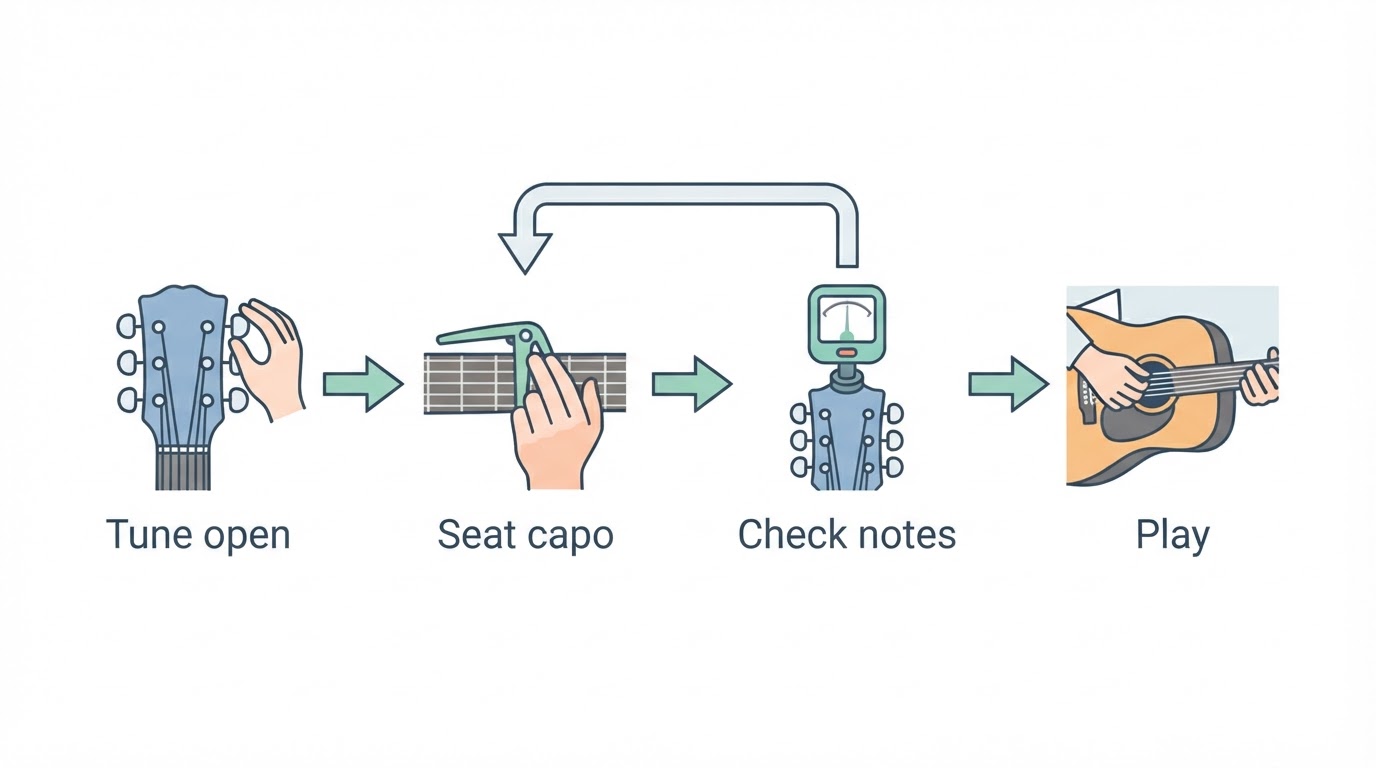
- You tuned with a capo on. A capo changes the pitch of every string under it. Take it off, tune, then put it back and check again.
- You tuned for too long. Ears drift after a few minutes of close listening. Step away, play something else, and come back to the octave pairs instead of chasing a pitch you can no longer hear clearly.
How to check DADGAD faster in a browser with GuitarTuner.io
The method above works with nothing but your ear, and you can stop reading here and tune. When you want the reference notes and the check in the same place, GuitarTuner.io keeps a page for each tuning with the target notes written out string by string, and the DADGAD page lists D2, A2, D3, G3, A3, D4. Each page is paired with a free online microphone tuner. You open the page in a browser, allow the microphone, and play one string at a time while the tuner reacts to what it hears, so you can see which way to turn the peg before you touch it. Because it runs in the browser, there is nothing to install before you start. GuitarTuner.io is the tuner this site publishes, and the ear-based method above stands on its own if you would rather not use it.
DADGAD questions with quick answers
- What are the notes in DADGAD? D2, A2, D3, G3, A3, D4, from the lowest string to the highest.
- Which strings move from standard tuning? The 6th, 2nd, and 1st strings each drop a whole step: E2 to D2, B3 to A3, and E4 to D4. The 5th, 4th, and 3rd stay on A2, D3, and G3.
- Can I reach DADGAD without a tuner? Yes. Lower the three strings and check each one against a string that did not move: the 6th against the 4th, the 2nd against the 5th, and the 1st against the 4th. Then run the fret matches.
- Is DADGAD the same as open D? No. Open D is D A D F# A D and contains a major third. DADGAD has no third in its open strings, so it stays neutral until you add one with your fingers.
- Do standard chord shapes work in DADGAD? The fingerings still play, but they produce different chords because the open notes changed. Learn a small set of DADGAD shapes instead.
- What key does DADGAD suit? D is home: D major, D minor, and the D modes all sit well, and the tuning is often used for tunes that drone on D and A.