What Open G Looks Like When You Finish
In open G, all five strings of a 5-string banjo ring as a G major chord when you strum them open. The tuning is written gDGBD, and from the lowest pitch to the highest it lands like this:
String | Note | What it is |
|---|---|---|
4th | D3 | thickest string, lowest pitch |
3rd | G3 | root of the chord |
2nd | B3 | the third of the chord |
1st | D4 | highest of the four long strings |
5th | G4 | short drone string, an octave above the 3rd |
Each note ringing true means two things: no string sits flat or sharp against its target note, and no string wobbles in pitch while it rings. When the table above matches what you hear, the instrument is in open G and ready to play.
How to Tune a 5-String Banjo to Open G
Work through four steps in order. Each one ends with a check, so you always know when a string is ready and when to move on.
- Turn on a browser banjo tuner and let it listen.
- Hold the banjo in playing position first, with the pot resting on your leg, then open a browser tuner on a phone or laptop and allow microphone access when the browser asks. Nothing needs to be installed. GuitarTuner.io is one option: its free browser tuner includes banjo presets, and each preset page pairs the target notes with a microphone tuner you can start right away. Place the device within arm's reach of the strings, roughly at the same height as the head, and pluck one string to watch the readout respond. If the meter stays still, check that the correct microphone is selected and that your hand is not covering it.
- Done when: a single plucked string produces a steady, moving pitch reading instead of a blank screen or a flickering number.
- Tune the four long strings in order, from the 4th to the 1st.
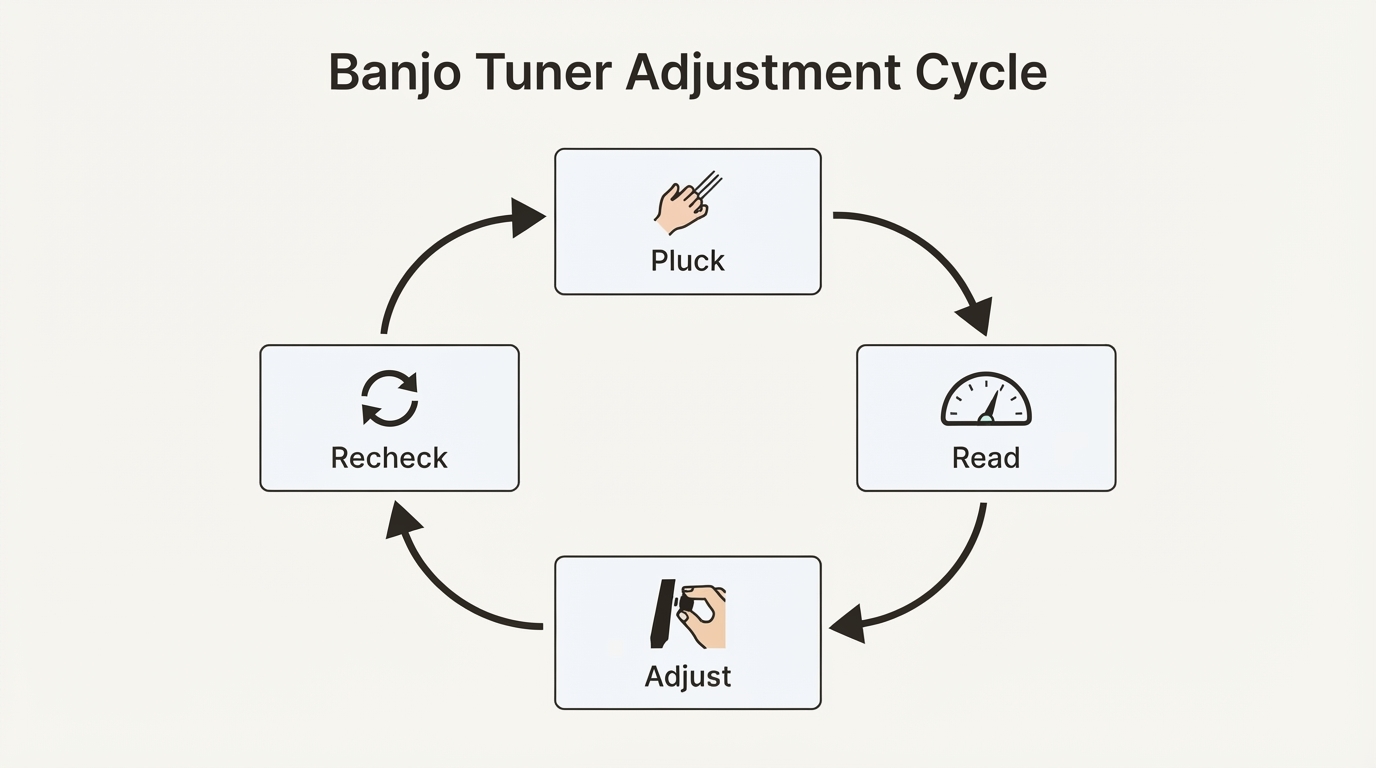
- Start on the 4th string and tune it to D, then move to the 3rd string for G, the 2nd for B, and the 1st for D. Pluck one string at a time and mute the others with your palm or the edge of your hand, so the tuner hears only the string you are working on. If the note is flat, tighten the peg; if it is sharp, loosen it, and turn in small steps of a quarter turn or less, because banjo strings move quickly. Pluck, let the note ring for a second, read the result, adjust, and then check the same string again.
Done when: all four long strings read in tune in sequence, and D–G–B–D rises steadily as you move from the 4th string to the 1st.
- Tune the short fifth string to its high G.
- The fifth string is the short one that starts partway up the neck at the 5th fret, with its own tuning peg on the side of the neck. Tune it to G, but a high G, an octave above the 3rd string you just tuned. Pluck only that string and let it ring; because it has no string above it, keep your fingers off the neck while you read the tuner. If the note sounds the same as the 3rd string, you are an octave low, so keep tightening in small steps until it sits clearly above it.
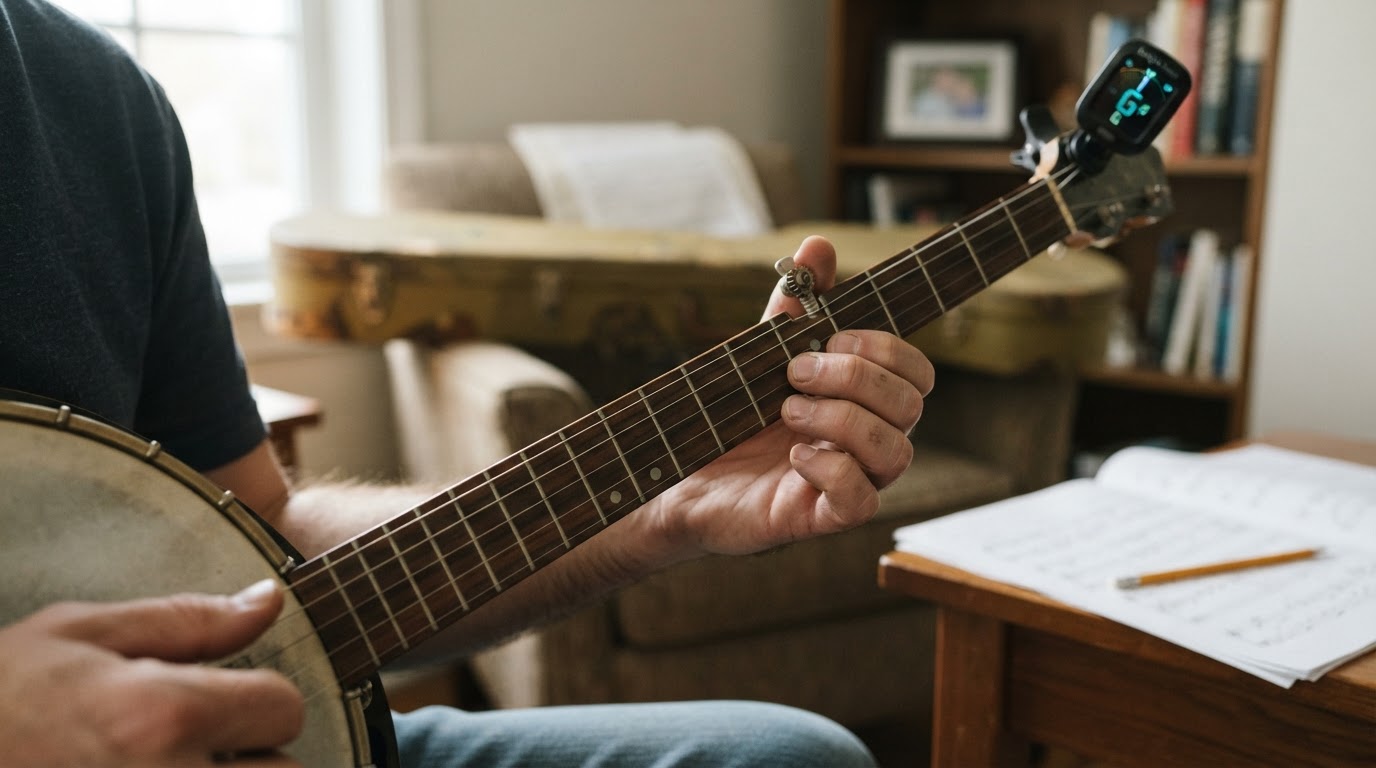
Done when: the fifth string reads G in tune and rings noticeably higher than the 3rd string, giving you the drone note over the other four.
- Do a final pass across all five strings.
- Pluck each string once more in the same order: 4th, 3rd, 2nd, 1st, then the 5th. Tuning one string changes the pull on the neck a little, so strings you tuned first can drift while you work on the others. Adjust only the strings that moved. Finish by strumming all five strings together and listening for any note that stands out as sour.
- Done when: every string still reads in tune on the second pass, and a full strum sounds like a clean G chord with the drone ringing above it.
Common Banjo Tuning Problems and What to Do
The fifth string sounds an octave higher than expected. Is it wrong?
No. On a 5-string banjo the short fifth string is meant to be a high G, an octave above the 3rd string, so it rings over the other four as a drone. Matching it to the 3rd string would leave the string too slack to hold pitch and would flatten the sound of the whole instrument. If your tuner shows only note names without octave numbers, compare the fifth string with the 3rd by ear or with the tuner's pitch display before deciding it is right.
Why does my banjo drift out of tune minutes after I finish?
Fresh strings stretch as you play them, and that stretch shows up as a note that falls flat after a few minutes. Room temperature and humidity also move a banjo's pitch, and a head that has lost tension can let the whole instrument wander. Recheck in short passes and re-tune only the strings that moved; on new strings, expect to repeat that check for the first day or two of playing. If the pitch keeps dropping and the head feels soft or uneven under your fingers, ask a technician to check the head tension rather than tightening it blindly.
Why does the tuner jump between notes while I play?
A microphone tuner reads everything it hears, not just the string you plucked. A fan, a television in the next room, another open string, or a phone resting on the banjo can all pull the reading around. Pluck with a clean, medium attack, keep the other strings muted, and hold the note for a second so the display can settle. Moving the device closer to the banjo and tuning in the quietest room you have solves most flickering readings.
When should I change banjo strings?
Change them when they sound dull, feel rough or dented where they cross the frets, or stop holding pitch shortly after tuning. Worn, contaminated strings can read in tune for a moment and then slide flat again, which sends you chasing the tuner instead of the strings. There is no fixed schedule that fits every player: how often you play, how hard you play, and how much your hands sweat all change the answer.
Open G Tuning Checklist
Before you play, run through this list:
- 4th string tuned to D3
- 3rd string tuned to G3
- 2nd string tuned to B3
- 1st string tuned to D4
- 5th (short) string tuned to high G4, an octave above the 3rd
- Second pass on all five strings, fixing any string that moved
- Final strum rings as a clean G chord with the drone on top