Five-string bass reference tones
Choose a mode, then press a button to hear that string's target pitch. Switching mode stops the previous tone immediately and reloads the notes, octave labels, string numbers and frequencies for the new tuning.
B0 E1 A1 D2 G2 - the standard five-string layout: a four-string bass plus a low B.
No tone playing. Audio starts only after you press a note button.
Read these as synthetic pitch references
Every tone here is synthesised in the browser at the true fundamental of the note printed on the button - never a higher octave standing in for it. Phone and laptop speakers usually cannot reproduce the fundamental of B0 (about 30.87 Hz) or E1 (about 41.20 Hz), so you may hear only a faint harmonic or nothing at all even when the pitch is right. Headphones or a speaker with genuine low-end extension are needed to hear the bottom strings. The low-volume triangle waveform adds a little harmonic content so the pitch stays identifiable on small speakers.
Standard 5 String Bass Tuning, Low to High
A 5-string bass in standard tuning runs B0, E1, A1, D2, G2 from the thickest string to the thinnest. The upper four strings are identical to a standard 4-string bass. The fifth string sits a perfect fourth below the E string, and because the whole set is still tuned in fourths, every shape you already know on a 4-string transfers directly.
String | Note | Octave | Pitch (A4 = 440 Hz) |
|---|---|---|---|
5th, thickest | B | B0 | about 30.9 Hz |
4th | E | E1 | about 41.2 Hz |
3rd | A | A1 | 55 Hz |
2nd | D | D2 | about 73.4 Hz |
1st, thinnest | G | G2 | 98 Hz |
The low B extends range rather than changing the character of the instrument. On a 4-string bass the lowest available note is E1 at roughly 41 Hz, which is why players in B, A, G, F# and other low keys end up retuning or transposing. The fifth string puts those notes under your fingers without touching the tuning of the upper four, and it lets you play a low line higher up the neck where the strings respond more evenly and your fretting hand is less cramped.
How to Tune a 5-String Bass, String by String
1. Set a reference for E1
Get the E string right first, either with a tuner in chromatic mode or from a reference tone. Everything else on the bass can be derived from that one note, so spend the extra few seconds here.
2. Tune the A, D and G strings from the E string
Play the E string at the 5th fret: that note is A1, so match the open A string to it. Then play the A string at the 5th fret (D2) and match the open D string, then the D string at the 5th fret (G2) and match the open G.
Play this | It sounds | Match this open string |
|---|---|---|
E string, 5th fret | A1 | A |
A string, 5th fret | D2 | D |
D string, 5th fret | G2 | G |
B string, 5th fret | E1 | E |
The same trick works in reverse if you prefer moving up the neck: the 7th fret of the A string is E2, an octave above the open E, and the 7th fret of the D string is A2, an octave above the open A.
3. Bring the low B up last
Play the B string at the 5th fret. That note should be E1, exactly the same as the open E string. Tune the B until the two match, either by ear or by watching a tuner while you hold the fretted note. Alternating between the two notes is a quick check: if they beat against each other, the B is still off.
Low notes are the hardest for a phone or laptop microphone to read. If your tuner refuses to settle on the B string, play the 12th fret harmonic instead, which sounds B1 at around 62 Hz and is easier to detect. Watch the octave display while you do this, because a low B can register as B1 rather than B0. Both are the same pitch class; only B0 is right for a standard low B string.
4. Recheck after the low B reaches pitch
Pulling the thickest string up to tension shifts the neck slightly, and the E string often drifts flat as a result. Play each string once more from low to high, correct anything that moved, then check the B one final time.
Low B or High C: Choosing the Fifth String
Two configurations dominate. Low B is the default and the one most players mean by "5-string bass." High C replaces the low B with a C3 string above the G, giving E1, A1, D2, G2, C3.
The two layouts share the same four upper strings, so the choice is about which end of the instrument you need. A low B adds lower range for modern bass lines, heavier styles and keys such as B and F#, while a high C adds a singing upper register for chords, melodic playing and solo passages, and keeps your hand in a tighter position when you would otherwise climb up the neck.
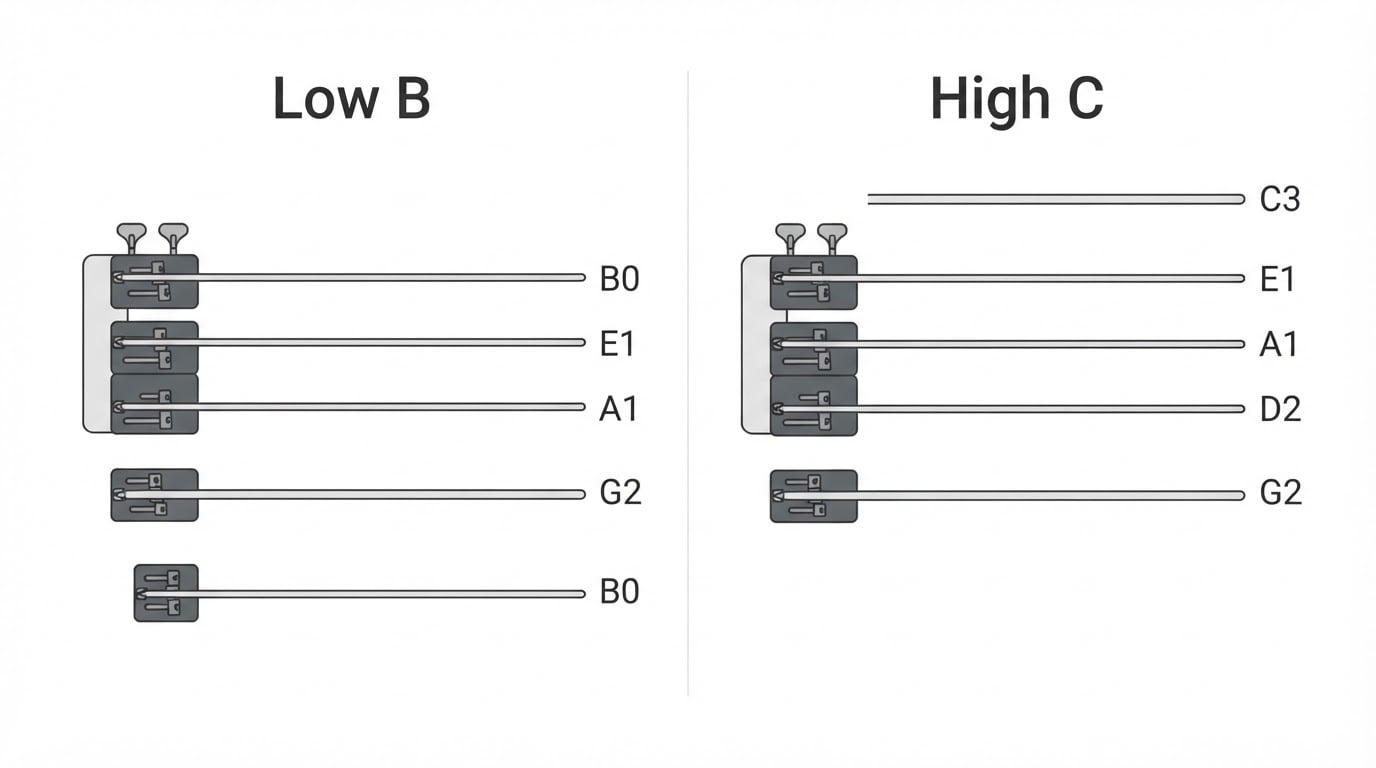
If you switch between them, expect a different string gauge and possibly a small nut and setup adjustment. A bass strung for a low B usually needs a thinner string for a high C, and a low B that feels floppy is often too light a gauge for the scale length. Most string makers sell both options as complete sets, so buy the set that matches the layout you want.
Drop Tunings, Half-Step Down, and When to Use Them
The fifth string does not have to stay on B, and the upper four strings can move as well. These are the variations you are most likely to run into.
Tuning | Strings, low to high | When it is used |
|---|---|---|
Standard | B E A D G | The default for almost everything |
Drop A | A E A D G | Heavy riffs and root-fifth-octave shapes across the lowest strings |
Drop D | B D A D G | Drop-D riffs and an open low D while the low B stays available |
Half-step down | Bb Eb Ab Db Gb | Matching recordings in flat keys, or a slacker, darker feel |
Full step down | A D G C F | Lower and looser still, common in heavier styles |
In drop A, the low B is lowered a whole step to A0, roughly 27.5 Hz. In drop D on a 5-string, keep the low B where it is and lower the E string a whole step to D1, so the bass can riff on the D and A strings the way a 4-string does in drop D.
Half-step and full-step down-tuning lower every string by the same interval, which keeps all of your shapes and patterns intact. Players reach for them to match the key of a recording, to sit under a singer, or to get a slightly slacker feel from heavier strings. If you tune down more than a step or two, thicker strings keep the tension usable. Pushing a string far above its intended pitch to compensate is how strings break, so change the strings instead of forcing the pitch.
Muting and Setup: What the Fifth String Changes
An extra string adds an extra ringing source. The low B vibrates longer and with more energy than the rest of the set, and it will hum along sympathetically when you play almost anything. Three habits keep it under control:
- Rest the side of your picking hand across the unused lower strings while you play higher up.
- Let your fretting-hand fingers lie lightly across strings you are not using.
- Move your thumb to the low B when you play the upper strings, so it damps as it anchors.
For recording, some players thread a strip of foam through the strings at the nut or under the bridge to damp the overtones a microphone picks up. It is a genuine trade-off: you lose a little sustain and gain a cleaner low end on everything else.

Setup is the other half of the story. A five-string neck carries more tension, and the thickest string is the one that exposes a bad setup first. If the low B feels flabby, buzzes, or sounds noticeably louder than the rest, the usual fixes are a truss-rod and action check, a pickup height adjustment, and a look at the nut slot. A nut cut for a lighter string can grip a thicker low B and cause it to creep flat, and a bass that has just moved to a much heavier set often needs the saddle and intonation checked as well. If you are not comfortable turning a truss rod, this is a job for a technician.
How to Keep a 5-String Bass in Tune
Most tuning drift on a five-string comes from three places: strings that have not been stretched, the nut slot on the low B, and temperature. Work through them in that order.
- Stretch new strings before you trust them. Tune to pitch, pull each string gently away from the fretboard, retune, and repeat two or three times.
- Always tune up to the note. Come from below the pitch and stop when you arrive; if you overshoot, drop below it and come up again.
- Check the low B nut slot. It is the longest path from tuning post to bridge and the slot that binds most often. A little graphite from a pencil in the slot, or a technician's file if it is tight, solves a lot of creeping flat.
- Seat the string properly at the post and the bridge. Enough wraps, windings stacked neatly downward, and the string sitting fully in the saddle.
- Tune low to high, then go around again. Temperature shifts pitch quickly, so a bass that sat in a cold room or under stage lights will keep moving while you check it.
- Check before each session. Thirty seconds on the fifth string saves a retake later.
If one string keeps going flat while the rest hold, the string is usually the problem: binding at the nut, slipping at the post, or a worn spot at the bridge saddle. Replace it rather than compensating with more and more tension.
Where to Tune a 5-String Bass in a Browser
If you would rather check the tuning without installing anything, GuitarTuner.io keeps a free online tuning library where 5-string bass tunings have their own entries next to the guitar presets. Each preset page pairs the target notes for that tuning with a microphone tuner that runs in the browser, which makes it straightforward to check the low B against the same reference you used for the rest of the bass. It is a practical option when the whole instrument needs to be back in tune quickly.
Quick Answers
Is a 5-string bass tuned B E A D G?
In standard tuning, yes: B0, E1, A1, D2, G2 from low to high. That configuration is what most players mean when they say standard tuning on a five-string.
Can I use 4-string shapes on a 5-string bass?
Yes. The upper four strings are the same notes as a 4-string bass, so every scale, arpeggio and riff shape transfers exactly. The only adjustment is knowing where the low B fits in the patterns that use it.
What is the frequency of a low B string?
About 30.9 Hz when the rest of the bass is tuned to A4 = 440 Hz. A high C string, by comparison, is about 130.8 Hz.
Should I tune the low B first or last?
Last. Set the E string first, derive the A, D and G from it, then bring the B up and check it against the open E. Because the B carries the most tension, the other strings often drift slightly after it reaches pitch, so finish with a quick second pass.
Can I tune a 5-string bass down a step?
Yes. A half-step down gives Bb Eb Ab Db Gb, and a full step down gives A D G C F. Heavier strings keep the tension comfortable, and it is worth having the setup checked if you plan to stay there.