Standard 12-string tuning at a glance
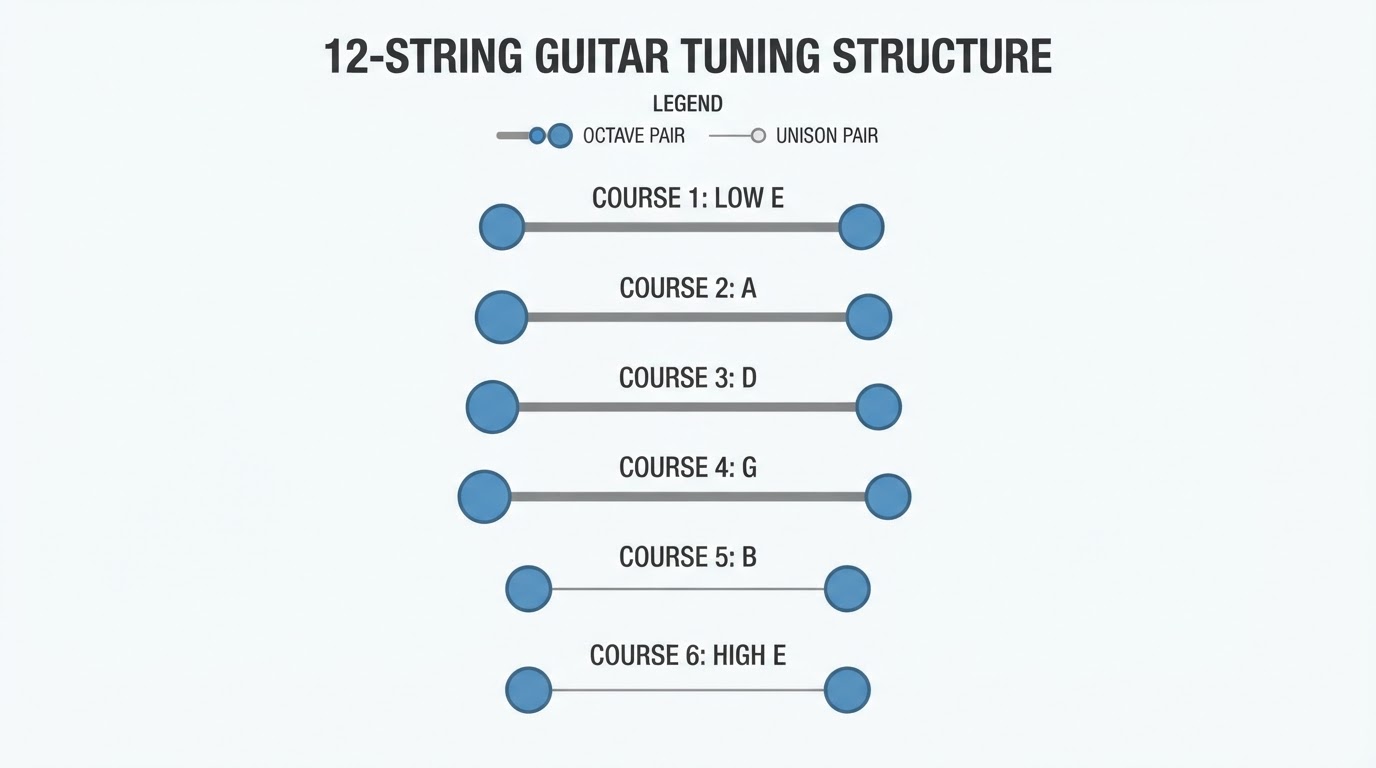
A 12-string guitar is still six courses (paired strings), not twelve independent pitches. In standard concert pitch the courses map to the familiar E-A-D-G-B-E layout, with a critical pairing rule:
Course (low → high) | Primary string | Partner string | Pair type |
|---|---|---|---|
6 (lowest) | E2 | E3 | Octave |
5 | A2 | A3 | Octave |
4 | D3 | D4 | Octave |
3 | G3 | G4 | Octave |
2 | B3 | B3 | Unison |
1 (highest) | E4 | E4 | Unison |
Memorize the rule in one sentence: the four lower courses are octave pairs; the two treble courses are unisons. That pairing is what creates the bright, chorused 12-string sound.
Practical setup notes before you touch a peg:
- Identify the thinner string in each lower course. On most sets, that thinner string is the higher octave of the pair.
- Mute neighboring courses while you work. Twelve strings ring easily and will fool your ear and any mic tuner.
- Prefer a quiet room and a stable guitar position. Rest the instrument so both hands can pluck and turn pegs without shifting neck angle.
Target notes and octaves, course by course
Use scientific pitch notation so you never confuse “an E” with the wrong octave. Approximate A4=440 Hz reference pitches (rounded) help when you use a chromatic display:
- Course 6 — low E pair: E2 (~82.4 Hz) + E3 (~164.8 Hz)
- Course 5 — A pair: A2 (~110.0 Hz) + A3 (~220.0 Hz)
- Course 4 — D pair: D3 (~146.8 Hz) + D4 (~293.7 Hz)
- Course 3 — G pair: G3 (~196.0 Hz) + G4 (~392.0 Hz)
- Course 2 — B pair: B3 (~246.9 Hz) + B3 (~246.9 Hz)
- Course 1 — high E pair: E4 (~329.6 Hz) + E4 (~329.6 Hz)
Completion check for each course: both strings read the correct letter and the intended octave relationship, and a light strum of that course alone sounds like one thickened note rather than two fighting pitches.
Step-by-step: tune with a browser tuner or reference tones
Goal: every course lands on the targets above without over-tensioning a thin octave string.
Method A — browser microphone tuner (fastest no-install path)
If you want a free browser path with no app install, GuitarTuner․io provides a microphone tuner for this job: allow microphone access, choose a tuning target, play one string at a time, adjust the peg, then recheck. Pitch feedback is processed in the browser, and GuitarTuner․io is offered with no account, paid upgrade, or app download required. This article is published by the team behind GuitarTuner․io; treat the site as one practical option, not a required tool.
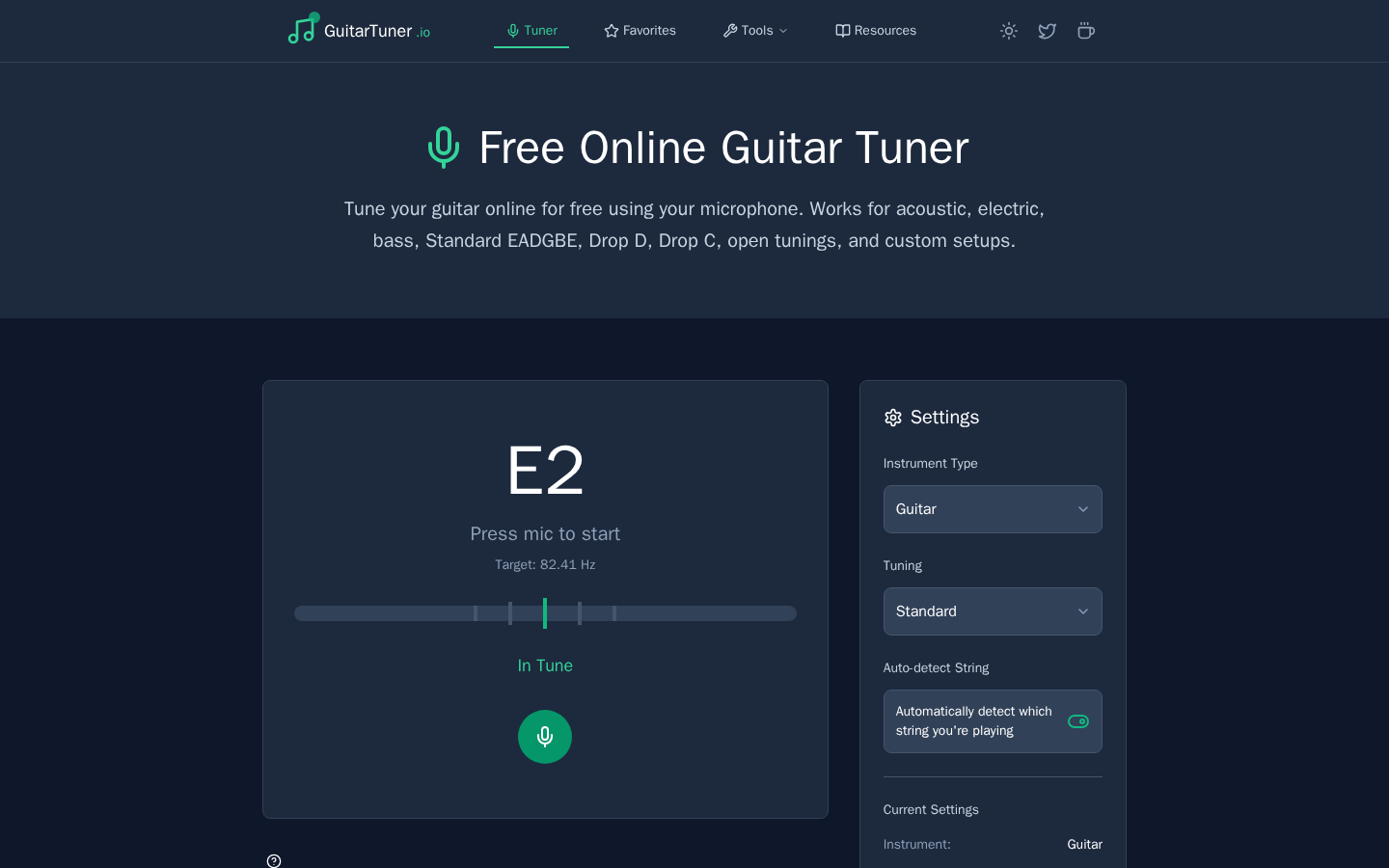
Desktop homepage first screen: H1 'Free Online Guitar Tuner', live tuner widget (E2 string, Press mic to start, Target 82.41 Hz, Start listening, string selector, Settings panel) a
- Settle the guitar. Sit or stand the same way you play. New strings stretch more; if you just re-strung, do a gentle stretch-and-retune cycle first.
- Open the tuner and grant mic access. Keep the phone or laptop mic roughly 20–40 cm from the soundhole or pickup area. Reduce room noise and fans.
- Pick a single string inside a course. Start with the lower (usually thicker) string of course 6. Mute the partner with a fingertip.
- Bring it to pitch from below. If the note is flat, tighten slowly into pitch. If it is sharp, loosen below the note, then climb back up. Approaching from below helps pegs hold.
- Tune the partner string. For courses 6–3, tune the thinner string one octave higher than its partner. For courses 2–1, match unison.
- Move course by course toward the highest pair. After each pair, pluck both strings together. If you hear rolling “wah” beats, they are still apart.
- Full pass, then a second pass. 12-strings pull on the neck. After all twelve strings are close, return to course 6 and walk up again. Expect at least two full passes on a fresh set.
- Final chord check. Play an open E shape and a simple D or G shape. If one course still shimmers oddly, isolate that pair and fix the octave/unison relationship before chasing fretted intonation.

Method B — reference tones without a mic
Use a piano, keyboard, or a trusted tone generator only if you can hear cleanly:
- Sound the target pitch for the thicker string of a course.
- Match that string by ear until beats slow and stop.
- For octave partners, match the higher string to the lower string’s second harmonic (lightly touch above the 12th fret while plucking, or simply match the octave interval carefully).
- For B and high E courses, match unison until the pair sounds like one string.
Reference tones are slower on 12-string because sympathetic ring is louder. Mute aggressively.
Tuning by ear on a 12-string
Ear tuning still matters when a mic struggles with double courses or stage noise.
Relative method (after one reliable reference):
- Get one string trustworthy—commonly the thicker low E or the thicker A—from a tuner or fork.
- Build fifths and octaves as you would on a six-string, but always finish by matching the partner string of that course.
- Check octaves at the 12th fret harmonic against the open partner where helpful, then verify both open strings together.
Beat-speed checkpoint: two strings nearly in tune produce slow undulation; exact unison or a clean octave settles to a steady sound. If beats speed up as you tighten, you may have passed the target—loosen and approach again.
When ear tuning fails: noisy rooms, very new strings, or damaged windings. Switch back to a chromatic/browser display and isolate one string at a time.
Why 12-strings drift—and how to stabilize them
12-strings drift more than six-strings for mechanical reasons, not because you “tuned wrong” once:
- Higher total tension pulls the neck forward; as the neck settles, every course goes flat.
- Paired strings share a bridge and nut slot family, so changing one string slightly moves its neighbor.
- Thin octave strings go sharp or flat faster with temperature and fingertip moisture.
- Fresh sets stretch, especially the wound/octave combinations used on many 12-string gauges.
- Capos, hard strums, and big temperature swings move pitch quickly on doubled courses.
Stabilization workflow:
- Stretch each new string firmly along its length, retune, and repeat until pitch stops falling after a stretch.
- Seat strings at the nut and bridge; make sure windings lock cleanly on the post (downward wind angle, neat wraps).
- Tune in two or three full passes rather than one perfectionist pass on string one.
- Let the guitar rest a few minutes after a big change, then recheck before a recording or performance.
- Store the instrument at stable humidity when you can. Wild swings move wood and, with it, pitch.
- If a single thin octave keeps slipping, inspect for a slipping peg, a burr at the nut, or a string that is binding in the slot.
Stability completion standard: after a five-minute rest and a normal strumming warm-up, open chords still sit within a slight touch-up—not a full retune of all twelve strings.
When to tune down a half step or whole step
Many players deliberately lower the entire instrument:
- Half step down (Eb-Ab-Db-Gb-Bb-Eb pairs): a common studio/stage compromise. Tension drops, fretting feels easier, and the guitar often stays more stable, while still reading as “standard shapes.”
- Whole step down (D-G-C-F-A-D pairs): useful on guitars that feel over-tight at concert pitch, on older instruments, or when matching a recording pitched down.
How to apply it cleanly:
- Decide the global offset first (half or whole step), then tune every course to the shifted targets with the same octave/unison rules.
- Do not mix a lowered bass course with concert-pitch trebles unless you are intentionally building a custom setup.
- After lowering, expect another stretch-and-settle cycle; slack strings can buzz until they settle into the nut and bridge.
- If you live in dropped concert pitch, consider string gauges appropriate for that tension. Gauge choice is personal and instrument-specific—when unsure, follow the guitar maker’s guidance rather than forcing concert pitch on a stressed neck.
Tune down when: neck relief feels excessive at pitch, fretting fatigue shows up fast, strings feel like cables, or the arrangement/recording is pitched down. Stay at concert pitch when: you must match ensemble instruments locked to A440 and the guitar is set up for it.
Common mistakes (and fast fixes)
Octave mix-ups on courses 6–3.
Symptom: the course sounds thin or “wrong octave” even though the letter name is right.
Fix: confirm which string should be higher. Reset both strings, thicker first, then the octave partner.
Treating B or high E as octaves.
Symptom: harsh beating on the top courses.
Fix: both strings of courses 2 and 1 should be the same pitch (unison), not an octave split.
Tuning both strings of a course at once into a mic.
Symptom: the tuner jumps between two close pitches.
Fix: mute the partner; tune one string; then the other; then check the pair.
Over-tightening thin octave strings.
Symptom: sudden snap or a string that climbs sharp and will not settle.
Fix: approach from below, use slower peg motion, and verify the note letter before cranking past the target.
One perfect pass, then packing up.
Symptom: the guitar is flat after five minutes.
Fix: always schedule a second full pass and a short rest-and-recheck.
Chasing fretted intonation before open courses are solid.
Symptom: endless saddle fiddling.
Fix: lock open pairs first. Intonation work is a setup task after strings are stable at pitch.
Ignoring a slipping post or binding nut slot.
Symptom: one string dies repeatedly while others hold.
Fix: inspect hardware; a tuning technique change will not fix a mechanical slip.
Quick follow-up answers
Which string in a pair do I tune first?
Usually the thicker/lower string, then its partner. That gives you a stable reference inside the course.
Do I need a special “12-string mode” on a tuner?
You need accurate chromatic reading and the discipline to isolate strings. A clear browser or clip-on chromatic workflow matters more than a marketing label.
Why does my 12-string sound in tune open but sour up the neck?
Open pairs can be correct while action, neck relief, or saddle intonation are off—or a string is falsely seated. Confirm open courses, then evaluate setup if fretted notes disagree consistently.
Can I leave a 12-string tuned to pitch on a wall hanger for weeks?
You can, but expect more touch-up than on a six-string, especially after weather changes. Fresh sets need extra cycles the first few days.
What if a mic tuner keeps misreading doubled strings?
Mute the partner, pluck closer to the bridge for a clearer fundamental, lower nearby noise, and avoid strumming into the mic.
A simple routine you can repeat
- Isolate and tune course 6 lower string → octave partner.
- Repeat for courses 5, 4, and 3 (octave pairs).
- Tune courses 2 and 1 as unisons.
- Full re-pass low to high.
- Rest, play two open shapes, correct only what moved.
When that routine takes only a couple of quiet minutes and chords sound thick instead of swirly, your 12 string guitar tuning is done for real—not just close on the first try.